In Stewart Culin’s Games of the North American Indians, one of the games he describes is an Arapaho women’s basket dice game. The original game uses five two-sided dice-like pieces tossed in a basket. A simple mathematical way to understand it is to model it instead as a coin-tossing game with 2 nickels and 3 dimes.
This is not meant to say that the Arapaho players literally used coins. They did not. Rather, the coin model is a convenient combinatorial translation of the game. Two of the original pieces are of one type, and three are of another type. That makes the game mathematically equivalent to flipping two coins of one denomination and three of another denomination, then scoring according to the pattern of heads and tails.
A historical game made modern
Culin describes the game as using a small yucca-fiber bowl and five “dice” made of bone or plum stones. Two of the five must match each other in shape and marking, while the other three form another matching set.
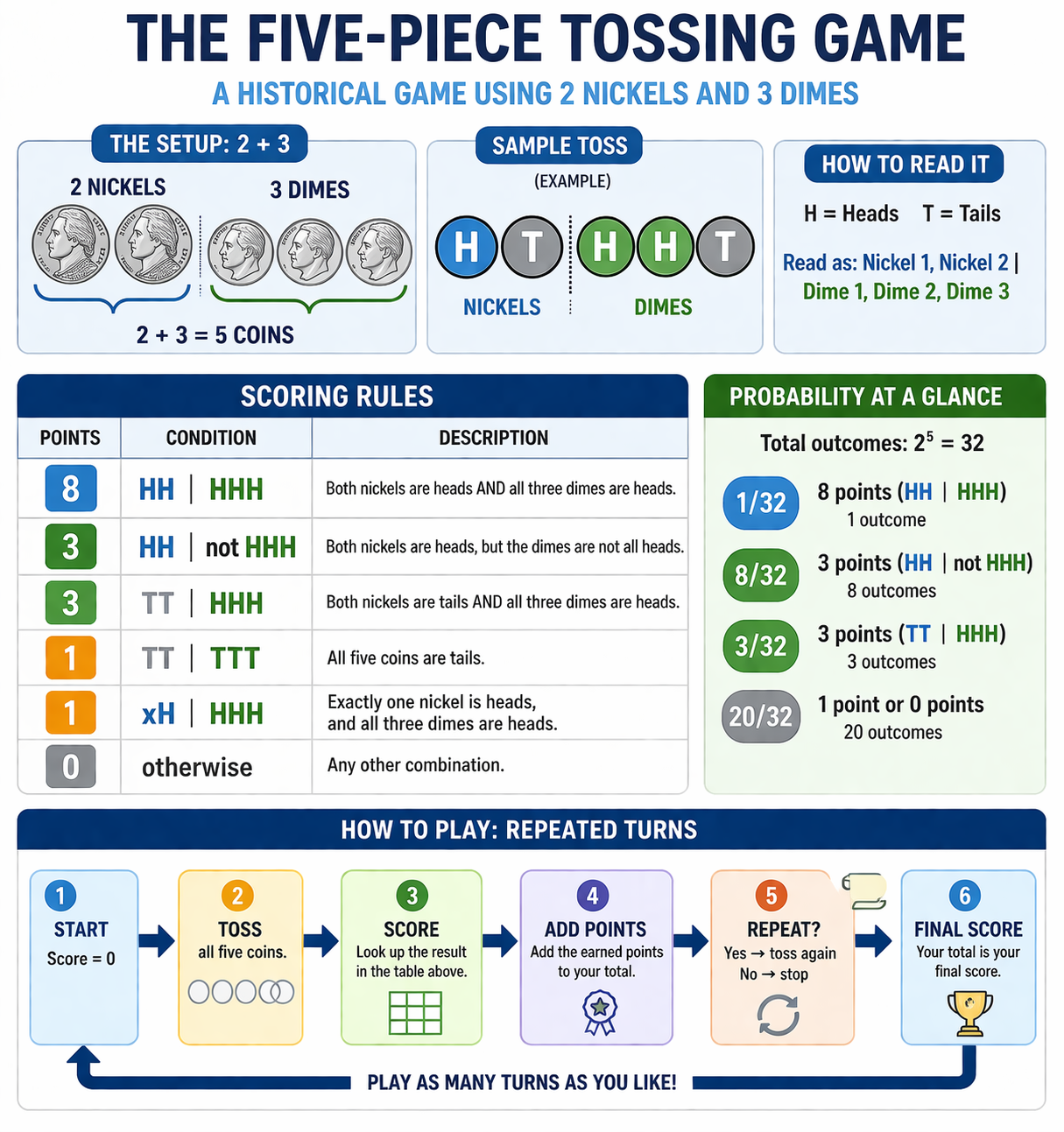
The coin model
Suppose we replace the five original pieces by:
- 2 nickels
- 3 dimes
Let heads mean “marked side up” and tails mean “blank side up.” Then one throw of the Arapaho basket becomes one simultaneous flip of the 2 nickels and the 3 dimes.
Define:
- N = the number of nickels showing heads, so N can be 0, 1, or 2
- D = the number of dimes showing heads, so D can be 0, 1, 2, or 3
So each flip produces a pair (N, D). The important point is that the score depends on the distribution of heads between the nickels and dimes, not merely on the total number of heads. That is why this is not just a five-coin game with all coins interchangeable.
Scoring rule
A convenient mathematical version of the scoring is:
- 8 points if both nickels and all three dimes are heads: (2,3)
- 3 points if:
- both nickels are heads and the dimes are not all heads: (2,0), (2,1), or (2,2), or
- both nickels are tails and all three dimes are heads: (0,3)
- 1 point if:
- all five are tails: (0,0), or
- exactly one nickel is heads and all three dimes are heads: (1,3)
- 0 points in all other cases
If a flip scores, the player continues flipping. If a flip scores 0, the turn ends and the basket passes. As Culin says, a successful throw earns another throw, a failed throw passes, and a game is commonly played to 100 points.
The full outcome table
| Nickels (N) | Dimes (D) | Probability | Score |
|---|---|---|---|
| 0 | 0 | 1/32 | 1 |
| 0 | 1 | 3/32 | 0 |
| 0 | 2 | 3/32 | 0 |
| 0 | 3 | 1/32 | 3 |
| 1 | 0 | 2/32 | 0 |
| 1 | 1 | 6/32 | 0 |
| 1 | 2 | 6/32 | 0 |
| 1 | 3 | 2/32 | 1 |
| 2 | 0 | 1/32 | 3 |
| 2 | 1 | 3/32 | 3 |
| 2 | 2 | 3/32 | 3 |
| 2 | 3 | 1/32 | 8 |
Probability distribution of the score
Assuming the coin model uses fair independent coins, the probabilities are:
- P(score = 8) = 1/32
- P(score = 3) = 8/32 = 1/4
- P(score = 1) = 3/32
- P(score = 0) = 20/32 = 5/8
So the probability that a single flip scores anything at all is:
P(score > 0) = 12/32 = 3/8.
That means a player succeeds on 37.5% of flips and fails on 62.5% of flips.
Expected score
The expected score on a single flip is:
E(score) = 8(1/32) + 3(8/32) + 1(3/32) = 35/32 ≈ 1.094.
Because a player keeps flipping after a successful result, the expected score in one uninterrupted turn is larger. If we let T be the expected total score of one turn, then:
T = E(score) / (1 – P(score > 0)) = (35/32) / (1 – 3/8) = 7/4 = 1.75.
So in this idealized coin-tossing model, the average value of a single turn is 1.75 points.
References
- Stewart Culin, Games of the North American Indians (1907), Bureau of American Ethnology. Internet Archive edition: https://archive.org/details/gamesofnorthamer00culirich
- Text version of Culin’s work, including the discussion of dice games and the Arapaho women’s basket dice game: https://archive.org/stream/in.ernet.dli.2015.31459/2015.31459.Games-Of-The-North-American-Indians_djvu.txt
- This blog post draft was prepared with assistance from ChatGPT by OpenAI: https://openai.com/chatgpt
 Yet Another Mathblog
You must be logged in to post a comment.