 |
If I were a Springer-Verlag Graduate Text in Mathematics, I would be David Eisenbud’s Commutative Algebra with a view towards Algebraic Geometry. I am an attempt to write on commutative algebra in a way that includes the geometric ideas that played a great role in its formation; with a view, in short, towards Algebraic Geometry. I cover the material that graduate students studying Algebraic Geometry – and in particular those studying the book Algebraic Geometry by Robin Hartshorne – should know. The reader should have had one year of basic graduate algebra. Which Springer GTM would you be? The Springer GTM Test |
A 1932 memorandum on rum-runner’s cryptosystems
During the prohibition era, organized crime made phenomenal amounts of money through illegal smuggling. Eventually, their messages were enciphered. By the late 1920s and early 1930s, these cryptosystems became rather sophisticated. Here is a memorandum form Elizebeth Friedman to CMDR Gorman in January or 1932 which gives an indication of this sophistication.
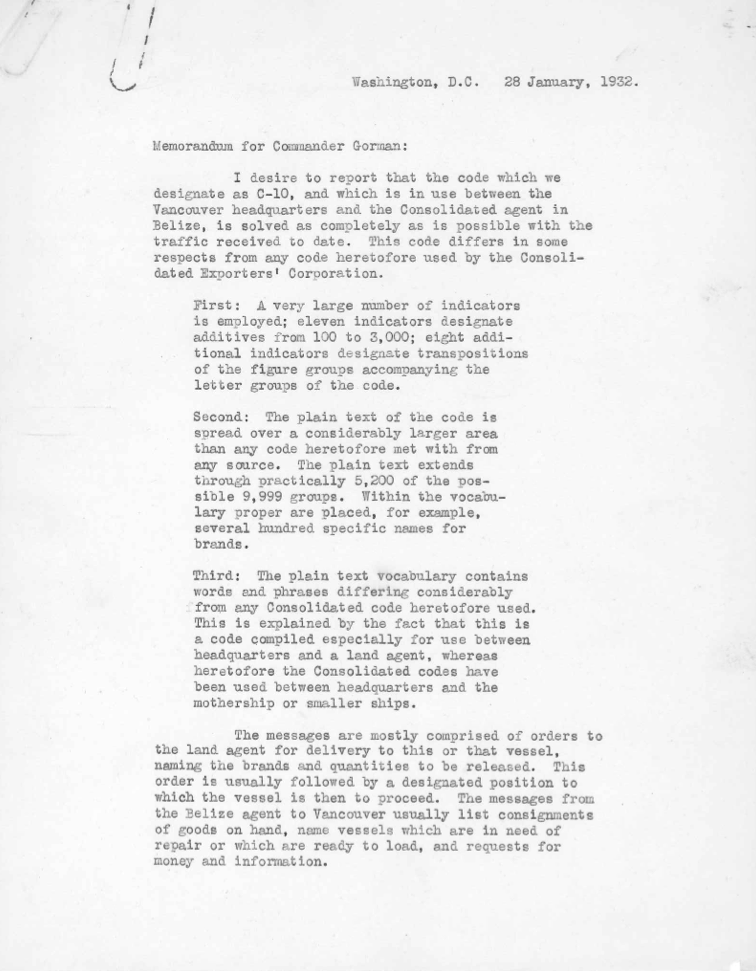

Many thanks to the George C. Marshall Foundation, Lexington, Virginia, for providing this reproduction!
A 1926 message from “I Am Alone”
The I Am Alone, flying a Canadian flag, was a rumrunner sunk by Coast Guard patrol boats in the Gulf of Mexico in March, 1929. The USCG knew that the ship was not a Canadian owned-and-controlled vessel but the proof went down to the bottom of the ocean when it was sunk. The Canadian Government sued the United States for $365,000 and the ensuing legal battle brought world-wide attention. Elizebeth Friedman decoded the messages transmitted by the I Am Alone, and those messages proved that the boat was, in fact, not a Canadian owned-and-controlled vessel. The case actually went to a Commission, whose final report was issued in 1935. They found, thanks in part to Elizebeth Friedman, that the owners and controllers of the vessel were not Canadian and used the boat primarily for illegal purposes.
The image below is a scan of an intercepted message, dated 1926-02-15, from the I Am Alone.
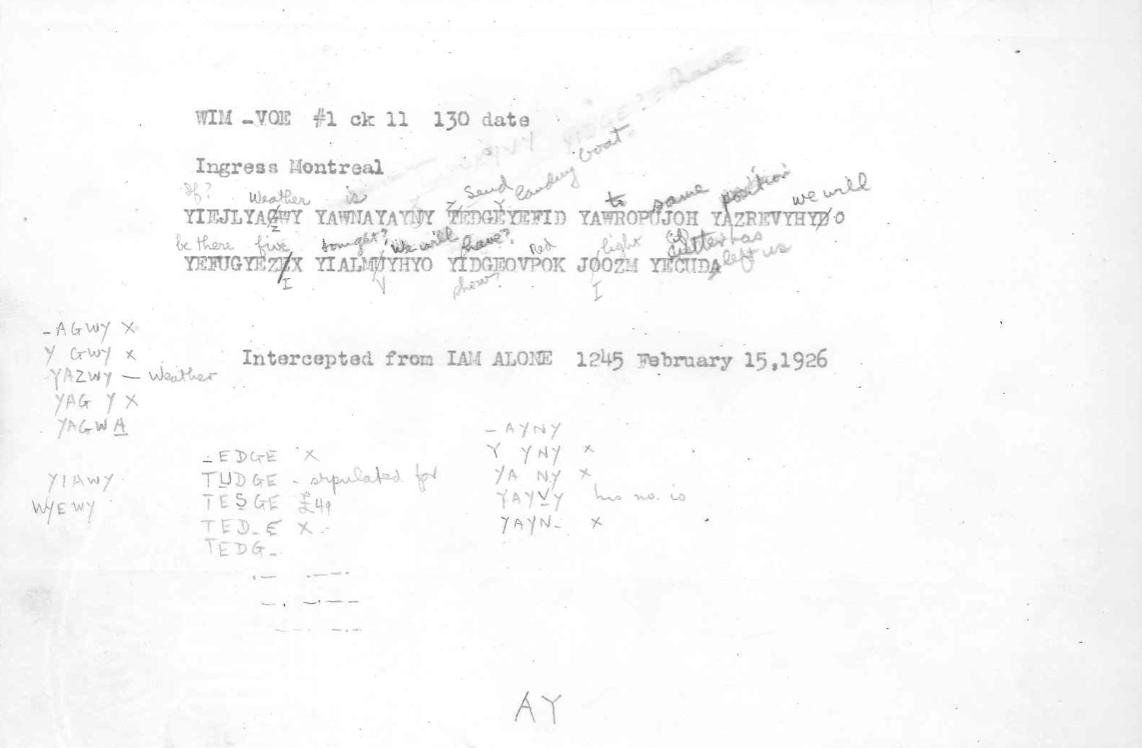
The writing is that of EF and you can make out her (mostly) deciphered message.
For more information, see, for example,
“All Necessary Force”: The Coast Guard And The Sinking of the Rum Runner “I’m Alone” by Joseph Anthony Ricci, 2011, or
“Listening to the rumrunners” by David Mowry, 2001.
The above image is courtesy of the Elizebeth S. Friedman Collection at the George C. Marshall Foundation, Lexington, Virginia. (If you make use of the image, please acknowledge the Marshall Foundation.)
Lester Hill’s “The checking of the accuracy …”, part 10
Construction of finite fields for use in checking
Let 

If 


The number of elements in a non-primary finite algebraic field
is a power of a prime. If we have
where 


Example: The field 


By adjoining a root of the equation 

where 


These marks (elements) are combined, in the rational field operations of 

the addition and multiplication tables of the field are given as in
Section 8, Example 1.

In a like manner, 

where 


Example: The field 


By adjunction of a root of the equation 


where 


Example: The field 

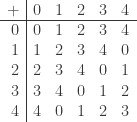

By adjoining a root of the equation 

where 


Of the non-primary fields,
mathematics problem 155
A colleague Bill Wardlaw (March 3, 1936-January 2, 2013) used to create a “Problem of the Week” for his students, giving a prize of a cookie if they could solve it. Here is one of them.
Mathematics Problem, #155
We can represent a triangle with sides of length a, b, c by the ordered triple (a, b, c). Changing the order of the sides doesn’t change the triangle, so (a, b, c), (b, a, c), (b, c, a), (c, b, a), (c, a, b), and (a, c, b) all represent the same triangle. To avoid confusion, let’s agree to write (a, b, c) with a < b < c. We say that a triangle <I (a, b, c) is integral if a, b, and c are integers. How many integral triangles are there with longest side less than or equal to 100 ?
Mathematics Problem 154
A colleague Bill Wardlaw (March 3, 1936-January 2, 2013) used to create a “Problem of the Week” for his students, giving a prize of a cookie if they could solve it. Here is one of them.
Mathematics Problem, #154
Find the volume of the intersection of three cylinders, each of radius a, which are centered on the x-axis, the y-axis, and the z-axis. That is, find the volume of the three dimensional region
E = {(x,y,z) | x2 + y2 < a2, y2 + z2 < a2, z2 + x2 < a2}.
Lester Hill’s “The checking of the accuracy …”, part 9
We may inquire into the possibility of undisclosed errors occurring in the transmittal of the sequence:

Invoking the theorem established in sections 4 and 5, and formulated at the close of section 5, we may assert:
-
(1) If not more than three errors are made in transmitting the fifteen letters of the sequence, and if the errors made affect the
only, the
being correctly transmitted, then the presence of error is certain to be disclosed.
-
(2) If not more than three errors are made, all told, but at least three of them affect the
chance of escaping disclosure.

These assertions result at once from the theorem referred to. But a closer study of the reference matrix employed in this example permits us to replace them by the following more satisfactory statements:
-
(1′)
If errors occur in not more than three of the fifteen elements of the sequence, and if at least one of the particular elements
is correctly transmitted, the presence of error will certainly be disclosed. But if exactly three errors are made, affecting presicely the elements
(
) chance of escaping disclosure.
-
(2′)
If more than three errors are made, then whatever the distribution of errors among the fifteen elements of the sequence, the presence of error will enjoy only a
(
) chance of escaping disclosure.
Assertions of this kind will be carefully established below, when a more important finite field is under consideration. The argument then made will be applicable in the case of any finite field. But it is worthwhile here to look more carefully into the exceptional distribution of errors which is italicized in (1′). This will help us note any weakness that ought to be avoided in the construction of reference matrices.
Suppose that exactly three errors are made, affecting precisely
These equations may be written:

But 


Etc. In this way, we find that the errors can escape disclosure if and only if

The error 


The trouble arises from the vanishing, in our reference matrix, of the two-rowed
determinant
Note that

since 

From the fact that 
It will be advantageous, as shown more completely in subsequent sections, to employ reference matrices which contain the smallest possible number of vanishing determinants of any orders.
Mathematical notes on Depth of Field
There are a million blog posts on photography depth of field (DOF). This one makes a million and one! If writing this will help me, and hopefully someone else, understand it better, it will be worth it.
We assume that a typical camera lens is fixed in space and represents the properties of a “thin convex lens in air”. We say an object, such as a distant mountain, is at infinity if light from it enters the lens along a ray perpendicular, or nearly perpendicular, to the lens plane. The principal focal point is that point behind the lens that an object at infinity (on the axis of the lens) focuses to. The focal length 
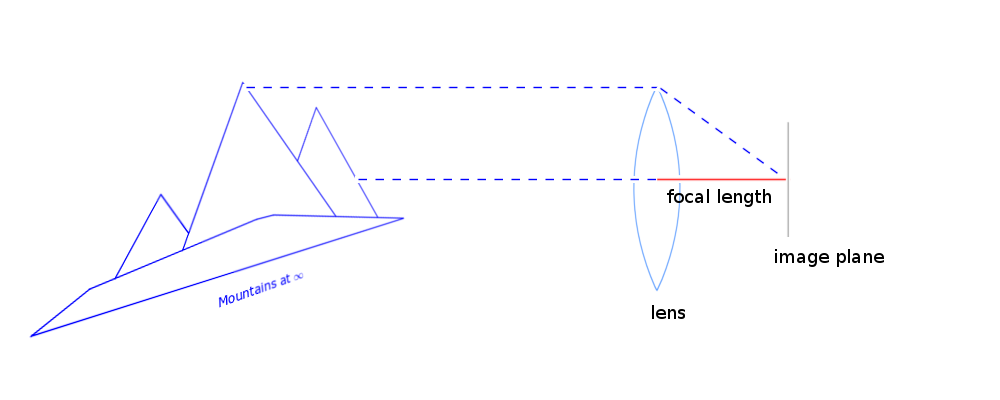
mountains “at infinity” with respect to lens, created using GIMP and Sage
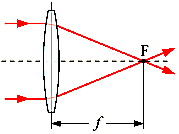
Focal length for a convex lens (source: Wikipedia)
Define the object plane to be the plane of the object you are photographing parallel to the plane of the lens) and want to look sharp in your photo. (Again, the object is assumed to be on the axis of the lens.) The light from the object converges behind the lens to a small region called the image. The image plane is a plane (parallel to the lens) which intersects this image region. You want the plane of the digital sensor (or camera film) to be at or very near the image plane, or else the photo will not have the object in focus.
We assume that the camera is a projective transformation from the plane of the object to the plane of the digital sensor. In other words, we assume that the camera has the property that if it focuses on a (stright) line or circle then it captures a line or circle on the film or digital sensor. (Of course, in reality, the lens imperfections and the light diffraction have an effect, but this hypothesis is nearly true in many cases.)
Consider an object at infinity (say, some distant mountains) in the plane of the plane of your lens. Suppose your camera’s digital sensor is located in the same plane as the image plane, so that the mountains will be in focus in your camera. The distance from the lens to the sensor plane is the focal length 

Lemma 1. The focal length 
Example: As 



The depth of field (DOF) is the portion of a scene that appears sharp in the image. More precisely, it is the area near the object plane in which the circles of confusion are acceptably small (where “acceptably small” has some precise pre-defined meaning, e.g., 0.2mm for a photo blown up to an 8′′ × 10′′ print). Although a lens can precisely focus at only one distance, the decrease in sharpness is gradual on either side of the focused distance, so that within the DOF, the unsharpness is imperceptible under normal viewing conditions. See the image below for an example of an image with a “small” (or “short”) DOF.

snowflake, small DOF example
The lens aperture is the circular opening in the lens allowing light to pass through. The actual diameter of opening is called the effective aperture. By convention, the aperture is measured as a quotient relative to the focal length 


which might be rounded up or down to

The larger f-stop is, the smaller the aperture.

An aperture slide card for an old-fashioned camera.
For more details, see for example:
- Jeff Conrad, Depth of field in depth, preprint 2006. Available at: http://www.largeformatphotography.info/.
- L. Evens, View camera geometry, preprint, 2008.
- R. E. Wheeler, Notes on view camera geometry, preprint, 2003.
Paley graphs in Sage
Let 


By hypothesis, 


Paley was a brilliant mathematician who died tragically at the age of 26. Paley graphs are one of the many spin-offs of his work. The following facts are known about them.
- The eigenvalues of Paley graphs are
(with multiplicity
(both with multiplicity
- It is known that a Paley graph is a Ramanujan graph.
- It is known that the family of Paley graphs of prime order is a vertex expander graph family.
- If
, where
has order
.
Here is Sage code for the Paley graph (thanks to Chris Godsil, see [GB]):
def Paley(q):
    K = GF(q)
    return Graph([K, lambda i,j: i != j and (i-j).is_square()])
(Replace “K” by “
sage: X = Paley(13)
sage: X.vertices()
[0, 1, 2, 3, 4, 5, 6, 7, 8, 9, 10, 11, 12]
sage: X.is_vertex_transitive()
True
sage: X.degree_sequence()
[6, 6, 6, 6, 6, 6, 6, 6, 6, 6, 6, 6, 6]
sage: X.spectrum()
[6, 1.302775637731995?, 1.302775637731995?, 1.302775637731995?,
1.302775637731995?, 1.302775637731995?, 1.302775637731995?,
-2.302775637731995?, -2.302775637731995?, -2.302775637731995?,
-2.302775637731995?, -2.302775637731995?, -2.302775637731995?]
sage: G = X.automorphism_group()
sage: G.cardinality()
78
We see that this Paley graph is regular of degree 

Here is an animation of this Paley graph:
The frames in this animation were constructed one-at-a-time by deleting an edge and plotting the new graph.
Here is an animation of the Paley graph of order 
The frames in this animation were constructed using a Python script:
X = Paley(17)
E = X.edges()
N = len(E)
EC = X.eulerian_circuit()
for i in range(N):
    X.plot(layout="circular", graph_border=True, dpi=150).save(filename="paley-graph_"+str(int("1000")+int("%s"%i))+".png")
    X.delete_edge(EC[i])
X.plot(layout="circular", graph_border=True, dpi=150).save(filename="paley-graph_"+str(int("1000")+int("%s"%N))+".png")
Instead of removing the frames “by hand” they are removed according to their occurrence in a Eulerian circuit of the graph.
Here is an animation of the Paley graph of order 
[GB] Chris Godsil and Rob Beezer, Explorations in Algebraic Graph Theory with Sage, 2012, in preparation.
Mathematics Problem, #120
A colleague Bill Wardlaw (March 3, 1936-January 2, 2013) used to create a “Problem of the Week” for his students, giving a prize of a cookie if they could solve it. Here is one of them.
Mathematics Problem, #120
A calculus 1 student Joe asks another student Bob “Is the following expression correct?” and writes
on the blackboard. Bob replies, “Well, it could be, but I don’t think that is what you mean.”

Find a function that makes what Joe said correct.
Solution to #119:
There are 
 Yet Another Mathblog
You must be logged in to post a comment.