Mathematicians and Chess

This page contains information on

  • which mathematicians (which we define as someone who has earned a PhD or equivalent in Mathematics) play(ed) chess at the International Master level or above (in OTB or correspondence or problem composing), and
  • how to get papers on mathematical chess problems.

Similar pages are here and here and here and here.

Mathematicians who play(ed) chess

  • Conel Hugh O’Donel Alexander (1909-1974), late British chess champion. Alexander may not have had a PhD in mathematics but taught mathematics and he did mathematical work during WWII (code and cryptography), as did the famous Soviet chess player David Bronstein (see the book Kahn, Kahn on codes). He was the strongest English player after WWII, until Jonathan Penrose appeared.
  • Adolf Anderssen (1818-1879). Pre World Championships but is regarded as the strongest player in the world between 1859 and 1866. He received a degree (probably not a PhD) in mathematics from Breslau University and taught mathematics at the Friedrichs gymnasium from 1847 to 1879. He was promoted to Professor in 1865 and was given an honorary doctorate by Breslau (for his accomplishments in chess) in 1865.
  • Magdy Amin Assem (195?-1996) specialized in p-adic representation theory and harmonic analysis on p-adic reductive groups. He published several important papers before a ruptured aneurysm tragically took his life. He was IM strength (rated 2379) in 1996.
  • Gedeon Barcza (1911-1986), pronounced bartsa, was a Hungarian professor of mathematics and a chess grandmaster. The opening 1.Nf3 d5 2.g3 is called the Barcza System. The opening 1.e4 e6 2.d4 c5 is known as the Barcza-Larsen Defense.
  • Ludwig Erdmann Bledow (1795-1846) was a German professor of mathematics (PhD). He founded the first German chess association, Berliner Schachgesellschaft, in 1827. He was the first person to suggest an international chess tournament (in a letter to von der Lasa in 1843). His chess rating is not known but he did at one point win a match against Adolf Anderssen.
  • Robert Coveyou (1915 – 1996) completed an M.S. degree in Mathematics, and joined the Oak Ridge National Laboratory as a research mathematician. He became a recognized expert in pseudo-random number generators. He is known for the quotation “The generation of random numbers is too important to be left to chance,” which is based on a title of a paper he wrote. An excellent tournament chess player, he was Tennessee State Champion eight times.
  • Nathan Divinsky (1925-2012) earned a PhD in Mathematics in 1950 from the University of Chicago and was a mathematics professor at the University of British Columbia in Vancouver. He tied for first place in the 1959 Manitoba Open.
  • Noam Elkies (1966-), a Professor of Mathematics at Harvard University specializing in number theory, is a study composer and problem solver (ex-world champion). Prof. Elkies, at age 26, became the youngest scholar ever to have attained a tenured professorship at Harvard. One of his endgame studies is mentioned, for example, in the book Technique for the tournament player, by GM Yusupov and IM Dvoretsky, Henry Holt, 1995. He wrote 11 very interesting columns on Endgame Exporations (posted by permission).
    Some other retrograde chess constructions of his may be found at the interesting Dead Reckoning web site of Andrew Buchanan.
    See also Professor Elkies’s very interesting Chess and Mathematics Seminar pages.
  • Thomas Ernst earned a Ph.D. in mathematics from Uppsala Univ. in 2002 and does research in algebraic combinatorics with applications to mathematical physics. His chess rating is about 2400 (FIDE).
  • Machgielis (Max) Euwe (1901-1981), World Chess Champion from 1935-1937, President of FIDE (Fédération Internationale des Echecs) from 1970 to 1978, and arbitrator over the turbulent Fischer – Spassky World Championship match in Reykjavik, Iceland in 1972. I don’t know as many details of his mathematical career as I’d like. One source gives: PhD (or actually its Dutch equivalent) in Mathematics from Amsterdam University in 1926. Another gives: Doctorate in philosophy in 1923 and taught as a career. Published an important paper on the mathematics of chess “Mengentheoretische Betrachtungen uber das Schachspiel”. This paper lead to a rule change in chess regarding the 3-times repetition draw.
    Euwe_1963
  • Ed Formanek (194?-), International Master. Ph.D. Rice University 1970. Retired from the mathematics faculty at Penn State Univ. Worked primarily in matrix theory and representation theory.
  • Stephen L. Jones is an attorney in LA, but when younger, taught math in the UMass system and spent a term as a member of the Institute for Advanced Study in Princeton NJ. He is one rung below the level of International Master at over the board chess; in correspondence chess, he has earned two of the three norms needed to become a Grandmaster.
  • Charles Kalme (1939-2002), earned his master title in chess at 15, was US Junior champ in 1954, 1955, US Intercollegiate champ in 1957, and drew in his game against Bobby Fischer in the 1960 US championship. In 1960, he also was selected to be on the First Team All-Ivy Men’s Soccer team, as well as the US Student Olympiad chess team. (Incidently, it is reported that this team, which included William Lombary on board one, did so well against the Soviets in their match that Boris Spassky, board one on the Soviet team, was denied forieng travel for two years as punishment.) In 1961 graduated 1st in his class at the Moore School of Electrical Engineering, The University of Pennsylvania, in Philadelphia. He also received the Cane award (a leadership award) that year. After getting his PhD from NYU (advisor Lipman Bers) in 1967 he to UC Berkeley for 2 years then to USC for 4-5 years. He published 2 papers in mathematics in this period, “A note on the connectivity of components of Kleinian groups”, Trans. Amer. Math. Soc. 137 1969 301–307, and “Remarks on a paper by Lipman Bers”, Ann. of Math. (2) 91 1970 601–606. He also translated Siegel and Moser, Lectures on celestial mechanics, Springer-Verlag, New York, 1971, from the German original. He was important in the early stages of computer chess programming. In fact, his picture and annotations of a game were featured in the article “An advice-taking chess computer” which appeared in the June 1973 issue of Scientific American. He was an associate editor at Math Reviews from 1975-1977 and then worked in the computer industry. Later in his life he worked on trying to bring computers to elementary schools in his native Latvia A National Strategy for Bringing Computer Literacy to Latvian Schools. His highest chess rating was acheived later in his life during a “chess comeback”: 2458.
    Here is his game against Bobby Fischer referred to above:[Event “?”]
    [Site “New York ch-US”]
    [Date “1960.??.??”]
    [Round “3”]
    [White “Fischer, Robert J”]
    [Black “Kalme, Charles”]
    [Result “1/2-1/2”]
    [NIC “”]
    [Eco “C92”]
    [Opening “Ruy Lopez, Closed, Ragozin-Petrosian (Keres) Variation”]
    1.e4 e5 2.Nf3 Nc6 3.Bb5 a6 4.Ba4 Nf6 5.O-O Be7 6.Re1 b5 7.Bb3 O-O 8.c3 d6 9.h3 Nd7 10.a4 Nc5 11.Bd5 Bb7 12.axb5 axb5 13.Rxa8 Qxa8 14.d4 Nd7 15.Na3 b4 16.Nc4 exd4 17.cxd4 Nf6 18.Bg5 Qd8 19.Qa4 Qa8 20.Qxa8 Rxa8 21.Bxf6 Bxf6 22.e5 dxe5 23.Ncxe5 Nxe5 24.Bxb7 Nd3 25.Bxa8 Nxe1 26.Be4 b3 27.Nd2 1/2-1/2
  • Miroslav Katetov (1918 -1995) earned his PhD from Charles Univ in 1939. Katetov was IM chess player (earned in 1951) and published about 70 research papers, mostly from topology and functional analysis.
  • Martin Kreuzer (1962-), CC Grandmaster, is rated over 2600 in correspondence chess (ICCF, as of Jan 2000). His OTB rating is over 2300. His specialty is computational commutative algebra and applications. Here is a recent game of his:
    Kreuzer, M – Stickler, A
    [Eco “B42”]
    [Opening “Sicilian, Kan”]
    1.e4 c5 2.Nf3 e6 3.d4 cxd4 4.Nxd4 a6 5.Bd3 Nc6 6.c3 Nge7 7.0-0 Ng6 8.Be3 Qc7 9.Nxc6 bxc6 10.f4 Be7 11.Qe2 0-0 12.Nd2 d5 13.g3 c5 14.Nf3 Bb7 15.exd5 exd5 16.Rae1 Rfe8 17.f5 Nf8 18.Qf2 Nd7 19.g4 f6 20.g5 fxg5 21.Nxg5 Bf6 22.Bf4 Qc6 23.Re6 Rxe6 24.fxe6 Bxg5 25.Bxg5 d4 26.Qf7+ Kh8 27.Rf3 Qd5 28.exd7 Qxg5+ 29.Rg3 Qe5 30.d8=Q+ Rxd8 31.Qxb7 Rf8 32.Qe4 Qh5 33.Qe2 Qh6 34.cxd4 cxd4 35.Bxa6 Qc1+ 36.Kg2 Qc6+ 37.Rf3 Re8 38.Qf1 Re3 39.Be2 h6 40.Kf2 Re8 41.Bd3 Qd6 42.Kg1 Kg8 43.a3 Qe7 44.b4 Ra8 45.Qc1 Qd7 46.Qf4 1-0
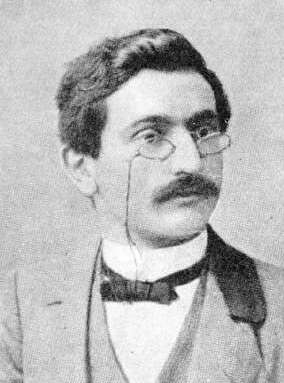
  • Emanuel Lasker (1868-1941), World Chess Champion from 1894-1921, PhD (or more precisely its German equivalent) in Mathematics from Erlangen Univ in 1902. Author of the influential paper “Zur theorie der moduln und ideale,” Math. Ann. 60(1905)20-116, where the well-known Lasker-Noether Primary Ideal Decomposition Theorem in Commutative Algebra was proven (it can be downloaded for free here). Lasker wrote and published numerous books and papers on mathematics, chess (and other games), and philosophy.
  • Vania Mascioni, former IECG Chairperson (IECG is the Internet Email Chess Group), is rated 2326 by IECG (as of 4-99). His area is Functional Analysis and Operator Theory.
  • A. Jonathan Mestel, grandmaster in over-the-board play and in chess problem solving, is an applied mathematician specializing in fluid mechanics and is the author of numerous research papers. He is on the mathematics faculty of the Imperial College in London.
  • Walter D. Morris (196?-), International Master. Currently on the mathematics faculty at George Mason Univ in Virginia.
  • Karsten Müller earned the Grandmaster title in 1998 and a PhD in mathematics in 2002 at the University of Hamburg.
  • John Nunn (1955-), Chess Grandmaster, D. Phil. (from Oxford Univ.) in 1978 at the age of 23. His PhD thesis is in algebraic topology. Nunn is also a GM chess problem solver.
  • Hans-Peter Rehm (1942-), earned his PhD in Mathematics from Karlsruhe Univ. (1970) then taught there for many years. He is a grandmaster of chess composition. He has written several papers in mathematics, such as “Prime factorization of integral Cayley octaves”, Ann. Fac. Sci. Toulouse Math (1993), but most in differential algebra, his specialty. A collection of his problems has been published as: Hans+Peter+Rehm=Schach Ausgewählte Schachkompositionen & Aufsätze (= selected chess problems and articles), Aachen 1994.
  • Kenneth W. Regan, Professor of Computer Science at the State Univ. of New York Buffalo, is currently rated 2453. His research is in computational complexity, a field of computer science which has a significant mathematical component.
  • Jakob Rosanes obtained his mathematics doctorate from the Univ. of Breslau in 1865 where he taught for the rest of his life. In the 1860s he played a match against A. Anderssen which ended with 3 wins, 3 losses, and 1 draw.
  • Jan Rusinek (1950-) obtained his mathematics PhD in 1978 and earned a Grandmaster of Chess Composition in 1992.
  • Jon Speelman (1956-) is an English Grandmaster chess player and chess writer. He earned his PhD in mathematics from Oxford.

Others that might go on this list would be Henry Ernest Atkins (he taught mathematics but never got a PhD, but won the British Chess Championship 9 times in the early 1900s), Andrew Kalotay (who earned a PhD in statistics in 1968 from the Univ of Toronto, and was a Master level chess player but was not formally given an IM chess ranking), Kenneth Rogoff (has a PhD in economics but has published statistics research papers and is a GM in chess), and Duncan Suttles (in the 1960s he started but never finished his PhD in mathematics, but is a chess GM).

Papers about mathematical problems in chess

Thanks to Christoph Bandelow, Max Burkett, Elaine Griffith, Hannu Lehto, John Kalme, Ewart Shaw, Richard Stanley, Will Traves, Steven Dowd, Z. Kornin, Noam Elkies and Hal Bogner for help and corrections on this page. This page is an updated version of that page and the other page.

The Vigenère cipher and Sage

The Vigenère cipher is named after Blaise de Vigenère, a sixteenth century diplomat and cryptographer, by a historical accident. Vigene`re actually invented a different and more complicated cipher. The so-called “Vigenère cipher” cipher was actually invented by Giovan Batista Belaso in 1553. In any case, it is this cipher which we shall discuss here first.

This cipher has been re-invented by several authors, such as author and mathematician Charles Lutwidge Dodgson (Lewis Carroll) who claimed his 1868 “The Alphabet Cipher” was unbreakable. Several others claimed the so-called Vigenère cipher was unbreakable (e.g., the Scientific American magazine in 1917). However, Friedrich Kasiski and Charles Babbage broke the cipher in the 1800’s [1]. This cipher was used in the 1700’s, for example, during the American Civil War. The Confederacy used a brass cipher disk to implement the Vigenère cipher (now on display in the NSA Museum in Fort Meade) [1].

The so-called Vigenère cipher is a generalization of the Cesaer shift cipher. Whereas the shift cipher shifts each letter by the same amount (that amount being the key of the shift cipher) the so-called Vigenère cipher shifts a letter by an amount determined by the key, which is a word or phrase known only to the sender and receiver).

For example, if the key was a single letter, such as “C”, then the so-called Vigenère cipher is actually a shift cipher with a shift of 2 (since “C” is the 2-nd letter of the alphabet, if you start counting at 0). If the key was a word with two letters, such as “CA”, then the so-called Vigenère cipher will shift letters in even positions by 2 and letters in odd positions are left alone (or shifted by 0, since “A” is the 0-th letter, if you start counting at 0).

REFERENCES:
[1] Wikipedia article on the Vigenere cipher.

Using Sage, let’s look at a message (a chant at football games between rivals USNA and West Point):

sage: AS = AlphabeticStrings()           
sage: A = AS.alphabet()
sage: VC = VigenereCryptosystem(AS, 1) # sets the key length to be = 1
sage: m = VC.encoding("Beat Army!"); m  # trivial example
BEATARMY

Now, we choose for illustration a simple key of length 1, and encipher this message:

sage: key = AS("D")
sage: c = VC.enciphering(key, m)
sage: c  # a trivial example
EHDWDUPB

You see here that in this case the cipher boils down to the Caesar/shift cipher (shifting by 3).

Deciphering is easy:

sage: VC.deciphering(key, c)
BEATARMY

Next, we choose for illustration a simple key of length 2, and encipher the same message:

sage: VC = VigenereCryptosystem(AS, 2)
sage: key = AS("CA")
sage: m = VC.encoding("Beat Army!"); m
BEATARMY
sage: c = VC.enciphering(key, m); c
DECTCROY

Since one of the key letters is “A” (which shifts by 0), half the plaintext is unchanged in going to the ciphertext.

Here is the algorithmic description of the above (so-called) Vigenère cipher:

    ALGORITHM:
    INPUT: 
      key - a string of upper-case letters (the secret "key")
      m - string of upper-case letters (the "plaintext" message)
    OUTPUT:
      c - string of upper-case letters (the "ciphertext" message)

  Identify the alphabet A, ..., Z with the integers 0, ..., 25. 
    Step 1: Compute from the string key a list L1 of corresponding
            integers. Let n1 = len(L1).
    Step 2: Compute from the string m a list L2 of corresponding
            integers. Let n2 = len(L2).
    Step 3: Break L2 up sequencially into sublists of size n1, and one sublist
            at the end of size <=n1. 
    Step 4: For each of these sublists L of L2, compute a new list C given by 
            C[i] = L[i]+L1[i] (mod 26) to the i-th element in the sublist, 
            for each i.
    Step 5: Assemble these lists C by concatenation into a new list of length n2.
    Step 6: Compute from the new list a string c of corresponding letters.

Once it is known that the key is, say, n characters long, frequency analysis can be applied to every n-th letter of the ciphertext to determine the plaintext. This method is called “Kasiski examination“, or the “Kasiski attack” (although it was first discovered by Charles Babbage).

The cipher Vigenère actually discovered is an “auto-key cipher” described as follows.

ALGORITHM:
    INPUT: 
      key - a string of upper-case letters (the secret "key")
      m - string of upper-case letters (the "plaintext" message)
    OUTPUT:
      c - string of upper-case letters (the "ciphertext" message)

  Identify the alphabet A, ..., Z with the integers 0, ..., 25. 
    Step 1: Compute from the string m a list L2 of corresponding
            integers. Let n2 = len(L2). 
    Step 2: Let n1 be the length of the key. Concatenate the string 
            key with the first n2-n1 characters of the plaintext message.
            Compute from this string of length n2 a list L1 of corresponding
            integers. Note n2 = len(L1).
    Step 3: Compute a new list C given by C[i] = L1[i]+L2[i] (mod 26), for each i.
            Note n2 = len(C).
    Step 5: Compute from the new list a string c of corresponding letters.

Note how the key is mixed with the plaintext to create the enciphering of the plaintext to ciphertext in Steps 2 and 3.

A screencast describing this has been posted to vimeo.

Michael Reid’s Happy New Year Puzzle, 2012

Here is another puzzle from Michael Reid on NOBNET. (Michael also notes that if you find a solution (a,b,c,d,e,f) then (d,e,f,a,b,c) is another solution.)

Puzzle: Replace a, b, c, d, e, f with the first six prime numbers, in some order, to make the expression a\cdot b^c + d \cdot e^f equal to the New Year.

Best wishes for a happy, healthy and prosperous New Year!

Bifid cipher and Sage

The Bifid cipher was invented around 1901 by Felix Delastelle. It is a “fractional substitution” cipher, where letters are replaced by pairs of symbols from a smaller alphabet. The cipher uses a 5×5 square filled with some ordering of the alphabet, except that “i”‘s and “j”‘s are identified (this is a so-called Polybius square; there is a 6×6 analog if you add back in “j” and also append onto the usual 26 letter alphabet, the digits 0, 1, …, 9). According to Helen Gaines’ book “Cryptanalysis”, this type of cipher was used in the field by the German army during World War I.

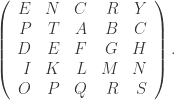
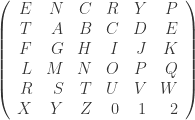
The Bifid cipher was discusses in Alasdair McAndrew’s book on Cryptography and Sage. We shall follow his discussion. As an example of a Polybius square for the Bifid cipher, pick the key to be “encrypt” (as Alasdair does). In that case, the Polybius square is \left(\begin{array}{rrrrr}  E & N & C & R & Y \\  P & T & A & B & C \\  D & E & F & G & H \\  I & K & L & M & N \\  O & P & Q & R & S  \end{array}\right). BTW, the 6\times 6 analog is: \left(\begin{array}{rrrrrr}  E & N & C & R & Y & P \\  T & A & B & C & D & E \\  F & G & H & I & J & K \\  L & M & N & O & P & Q \\  R & S & T & U & V & W \\  X & Y & Z & 0 & 1 & 2  \end{array}\right).

Here is Sage code to produce the 6\times 6 case (the 5\times 5 case is in Alasdair’s book):

def bifid(pt, key):
    """
    INPUT:
        pt - plaintext string      (digits okay)
        key - short string for key (no repetitions, digits okay)
    
    OUTPUT:
        ciphertext from Bifid cipher (all caps, no spaces)

    This is the version of the Bifid cipher that uses the 6x6
    Polybius square.

    AUTHOR:
        Alasdair McAndrew

    EXAMPLES:
        sage: key = "encrypt"
        sage: pt = "meet me on monday at 8am"
        sage: bifid(pt, key)
        [[2, 5], [0, 0], [0, 0], [1, 0], [2, 5], [0, 0], [3, 0], 
         [0, 1], [2, 5], [3, 0], [0, 1], [1, 3], [1, 1], [0, 4], 
         [1, 1], [1, 0], [5, 4], [1, 1], [2, 5]]
        'HNHOKNTA5MEPEGNQZYG'

    """
    AS = AlphabeticStrings()
    A = list(AS.alphabet())+[str(x) for x in range(10)]
    # first make sure the letters are capitalized
    # and text has no spaces
    key0 = [x.capitalize() for x in key if not(x.isspace())]
    pt0 = [x.capitalize() for x in pt if not(x.isspace())]
    # create long key
    long_key = key0+[x for x in A if not(x in key0)]
    n = len(pt0)
    # the fractionalization
    pairs = [[long_key.index(x)//6, long_key.index(x)%6] for x in pt0]
    print pairs
    tmp_cipher = flatten([x[0] for x in pairs]+[x[1] for x in pairs])
    ct = join([long_key[6*tmp_cipher[2*i]+tmp_cipher[2*i+1]] for i in range(n)], sep="")
    return ct

def bifid_square(key):
    """
    Produced the Polybius square for the 6x6 Bifid cipher.

    EXAMPLE:
        sage: key = "encrypt"
        sage: bifid_square(key)
        [E N C R Y P]
        [T A B C D E]
        [F G H I J K]
        [L M N O P Q]
        [R S T U V W]
        [X Y Z 0 1 2]

    """
    AS = AlphabeticStrings()
    A = list(AS.alphabet())+[str(x) for x in range(10)]
    # first make sure the letters are capitalized
    # and text has no spaces
    key0 = [SR(x.capitalize()) for x in key if not(x.isspace())]
    # create long key
    long_key = key0+[SR(x) for x in A if not(x in key0)]
    # the fractionalization
    pairs = [[long_key.index(SR(x))//6, long_key.index(SR(x))%6] for x in A]
    f = lambda i,j: long_key[6*i+j] 
    M = matrix(SR, 6, 6, f)
    return M

Have fun!

Michael Reid’s Digit operation puzzles

Michael Reid (http://www.math.ucf.edu/~reid/index.html) posted these questions on Nobnet recently. I’m reposting them here.

Consider two rules for modifying a positive integer:

i) replace a substring of its digits by the square of the number represented by the substring
ii) if a substring is a perfect cube, replace the substring by its cube root

Neither the substring being replaced, nor the string replacing it may have leading zeroes.

For example, starting with 123, we may square `23′ to obtain 1529. Then we can square `29′ to get 15841, then square `5′ to get 125841, and then we could take the cube root of `125′ to get 5841, and so on.

What is the smallest number we can obtain from the number 2011 with a sequence of these operations?

Now suppose the two operations are instead

iii) replace a substring by its cube
iv) replace a substring which is a square by its square root

What is the smallest number we can get with these operations if we start from 2011?

Here is another “digit operations” puzzle that I hope you will find a nice challenge.

Consider two rules for modifying a positive integer:

i) replace a substring of its digits by 7 times the number represented by the substring
ii) if a substring is a perfect 7th power, replace the substring by its 7th root

Neither the substring being replaced, nor the string replacing it may have leading zeroes.

For example, starting with 347, we may replace the substring `34′ by `238′ (multiplying by 7) to obtain 2387. Then we can multiply the substring `3′ to get 22187. Now we can take the 7th root of `2187′ to get 23, and so on.

What is the smallest number we can obtain from the number 2011 with a sequence of these operations?

Now suppose the two operations are instead

iii) if a substring is divisible by 7, we may divide the substring by 7
iv) replace a substring by its 7th power

(which are the reverses of operations i) and ii) above).

What is the smallest number we can get with these operations if we start from 2011?

Hadamard’s maximal determinant problem

This blog entry is to remind or introduce to people the fascinating problem called the Hadamard maximal determinant problem: What is the maximal possible determinant of a matrix M whose entries are of absolute value at most 1? Hadamard proved that if M is a complex matrix of order n, whose entries are bounded by |M_{ij}| \leq 1, for each i, j between 1 and n, then
|det(M)| \leq n^{n/2} (equality is attained, so this is best possible for such matrices).

If instead the entries of the matrix are +1 or -1 and the size of the matrix is nxn where n is a multiple of 4, then the problem of the maximal determinant presumably boils down to the well-known search for Hadamard matrices. This is discussed in many books, papers and website but in particular, I refer to

  1. http://en.wikipedia.org/wiki/Hadamard_matrix

  2. http://www.research.att.com/~njas/hadamard/
  3. Hadamard matrices and their applications, by K. J. Horadam
  4. http://www.uow.edu.au/~jennie/hadamard.html

What I think is fascinating is the entries of the matrix are only assumed to be real and not of size 4kx4k. In this case, the maximal value of the determinant is less clear. The results are complicated and depend in a fascinating way on the congruence class of n mod 4. Please see the excellent webpages (maintained by Will Orrick and Bruce Solomon)

  1. http://www.indiana.edu/~maxdet/, and in particular,
  2. http://www.indiana.edu/~maxdet/bounds.html

In particular, the case of an nxn matrix with n=4k+3 seems to be open.

Steiner systems and codes

A t-(v,k,λ)-design D=(P,B) is a pair consisting of a set P of points and a collection B of k-element subsets of P, called blocks, such that the number r of blocks that contain any point p in P is independent of p, and the number λ of blocks that contain any given t-element subset T of P is independent of the choice of T. The numbers v (the number of elements of P), b (the number of blocks), k, r, λ, and t are the parameters of the design. The parameters must satisfy several combinatorial identities, for example:

\lambda _i = \lambda \left(\begin{array}{c} v-i\\ t-i\end{array}\right)/\left(\begin{array}{c} k-i\\ t-i\end{array}\right)

where \lambda _i is the number of blocks that contain any i-element set of points.

A Steiner system S(t,k,v) is a t-(v,k,λ) design with λ=1. There are no Steiner systems known with t>5. The ones known (to me anyway) for t=5 are as follows:

S(5,6,12), S(5,6,24), S(5,8,24), S(5,7,28), S(5,6,48), S(5,6,72), S(5,6,84),
S(5,6,108), S(5,6,132), S(5,6,168), and S(5,6,244).

Question: Are there others with t=5? ANy with $t>5$?

A couple of these are well-known to arise as the support of codewords of a constant weight in a linear code C (as in the Assmus-Mattson theorem, discussed in another post) in the case when C is a Golay code (S(5,6,12) and S(5,8,24)). See also the wikipedia entry for Steiner system.

Question: Do any of these others arise “naturally from coding theory” like these two do? I.e., do they all arise as the support of codewords of a constant weight in a linear code C via Assmus-Mattson?

Here is a Sage example to illustrate the case of S(5,8,24):

sage: C = ExtendedBinaryGolayCode()
sage: C.assmus_mattson_designs(5)
[‘weights from C: ‘,
[8, 12, 16, 24],
‘designs from C: ‘,
[[5, (24, 8, 1)], [5, (24, 12, 48)], [5, (24, 16, 78)], [5, (24, 24, 1)]],
‘weights from C*: ‘,
[8, 12, 16],
‘designs from C*: ‘,
[[5, (24, 8, 1)], [5, (24, 12, 48)], [5, (24, 16, 78)]]]
sage: C.assmus_mattson_designs(6)
0
sage: blocks = [c.support() for c in C if hamming_weight(c)==8]; len(blocks)
759

new Rubik’s cube bound of Tom Rokicki

For some time, Tom Rokicki has been working on lowing the upper bound for the face-turn metric of the Rubik’s cube. His main work (finished in Feb or March 2008) is described in http://tomas.rokicki.com/rubik25.pdf. More recently, John Welborn came up out of the blue and offered Tom CPU time on the “farm” of computers which Sony Imageworks uses to render animated movies. As a result of this generous offer, Tom was able to extend the same method used in the 25-move upper bound to show: in the face turn metric, every position can be solved in <=N moves, where N=20,21,22 (which one, we don’t know yet).

Recently, New Scientist ran a short article on Tom’s result. Here is the link, though the full article requires a subscription: http://www.newscientist.com/channel/fundamentals/mg19926681.800-cracking-the-hardest-mystery-of-the-rubiks-cube.html .

Please see Herbert Kociemba’s cube
performance page for more info.

The Assmus-Mattson Theorem, Golay codes, and Mathieu groups

A block design is a pair (X,B), where X is a non-empty finite set of v>0 elements called points, and B is a non-empty finite multiset of size b whose elements are called blocks, such that each block is a non-empty finite multiset of k points. A design without repeated blocks is called a simple block design. If every subset of points of size t is contained in exactly \lambda blocks the the block design is called a t(v,k,\lambda) design (or simply a t-design when the parameters are not specfied). When \lambda = 1 then the block design is called a S(t,k,v) Steiner system.

Let C be an [n,k,d] code and let C_i = \{ c \in C\ |\ wt(c) = i\} denote the weight i subset of codewords of weight i. For each codeword c\in C, let supp(c)=\{i\ |\ c_i\not= 0\} denote the support of the codeword.

The first example below means that the binary [24,12,8]-code C has the property that the (support of the) codewords of weight 8 (resp, 12, 16) form a 5-design.

Example: Let $C$ denote the extended binary Golay code of length 24. This is a self-dual [24,12,8]-code. The set X_8 = \{supp(c)\ |\ c \in C_8\} is a 5-(24, 8, 1) design; X_{12} = \{supp(c)\ |\ c \in C_{12}\} is a 5-(24, 12, 48) design;and, X_{16} = \{supp(c)\ |\ c \in C_{16}\} is a 5-(24, 16, 78) design.

This is a consequence of the following theorem of Assmus and Mattson.

Assmus and Mattson Theorem (section 8.4, page 303 of [HP]):

Let A_0, A_1, ..., A_n be the weight distribution of the codewords in a binary linear [n , k, d] code C, and let A_0^\perp, A_1^\perp, ..., A_n^\perp be the weight distribution of the codewords in its dual [n,n-k, d^\perp] code C^\perp. Fix a t, 0<t<d, and let s = |\{ i\ |\ A_i^\perp \not= 0, 0<i\leq n-t\, \}|.
Assume s\leq d-t.

  • If A_i\not= 0 and d\leq i\leq n then C_i = \{ c \in C\ |\ wt(c) = i\} holds a simple t-design.
  • If A_i^\perp\not= 0 and d^\perp\leq i\leq n-t then C_i^\perp = \{ c \in C^\perp \ |\ wt(c) = i\} holds a simple t–design.
  • If A_i^\perp\not= 0 and d^\perp\leq i\leq n-t then C_i^\perp = \{ c \in C^\perp \ |\ wt(c) = i\} holds a simple t–design.

In the Assmus and Mattson Theorem, X is the set \{1,2,...,n\} of coordinate locations and B = \{supp(c)\ |\ c \in C_i\} is the set of supports of the codewords of C of weight i. Therefore, the parameters of the t-design for C_i are

  • t = given,
  • v = n,
  • k = i, (this k is not to be confused with dim(C)!),
  • b = A_i,
  • \lambda = b*binomial(k,t)/binomial(v,t)

(by Theorem 8.1.6, p. 294, in \cite{HP}). Here is a SAGE example.


sage: C = ExtendedBinaryGolayCode()
sage: C.assmus_mattson_designs(5)
['weights from C: ',
[8, 12, 16, 24],
'designs from C: ',
[[5, (24, 8, 1)], [5, (24, 12, 48)], [5, (24, 16, 78)], [5, (24, 24, 1)]],
'weights from C*: ',
[8, 12, 16],
'designs from C*: ',
[[5, (24, 8, 1)], [5, (24, 12, 48)], [5, (24, 16, 78)]]]
sage: C.assmus_mattson_designs(6)
0

The automorphism group of the extended binary Golay code is the Mathieu group M_{24}. Moreover, the code is spanned by the codewords of weight 8.

References:
[HP] W. C. Huffman, V. Pless, Fundamentals of error-correcting codes, Cambridge Univ. Press, 2003.
[CvL] P. Cameron, J. van Lint, Graphs, codes and designs, Cambridge Univ. Press, 1980.

Copyright law as it pertains to mathematics and mathematical software

Disclaimer: I am not a lawyer and this is not to be construed as legal advice. However, I find copyright law very interesting but complicated and wrote this only to try to explain some of the simpler aspects of copyright law which pertain to mathematical scholars.

This is a brief survey on some aspects of federal copyright law, as it pertains to mathematicians. (By mathematician, which we mean teachers or scholarly researchers at a non-profit educational institute; generally, the more commercial the enterprise, the more complicated the law is governing it. This small survey only discusses the simplest aspects.) It does not cover other aspects of intellectual property law, such as laws governing patents, trade secrets, and so on (see for example, [K]). We have used the excellent book [L] by Leaffer as a basis for this survey. Copyright law is very complex [US] but, I hope, this post shows that many parts of copyright law which pertain to mathematicians, is relatively uncomplicated.

U.S. copyright law applies to writings, or works ‘fixed in a tangible medium of expression’, produced by an author. For this article, we assume the author is a U. S. citizen and the work was produced on U. S. soil. However, a ‘writing’ is not assumed to be human-readable, so, for example, a software program in executable binary form, or ‘object code’, is included [L], section 3.06. The owner of the copyright of a work has the exclusive right for

  • reproduce or copy the work,
  • prepare derivative works,
  • distribute the work,
  • perform the work publicly,
  • display the work publicly.

Before explaining these terms, exceptions to these rights, and how these rights relate especially to mathematical works, we discuss works for which copyright law cannot be applied. The law is designed to protect creative written works.

  • Ideas are generally not subject to copyright. From section 102 of [US]:In no case does copyright protection for an original work of authorship extend to any idea, procedure, process, system, method of operation, concept, principle, or discovery, regardless of the form in which it is described, explained, illustrated, or embodied in such work.
  • An unoriginal work, or a work ‘mechanically produced’, say by a computer program whose use requires no originality, are not copyrightable (more precisely, are not subject to a separate copyright – the program could, for example, output copyrighted elements). For example, the output of an automatic theorem proving program is not copyrightable. On the other hand, the output of an image processing program which takes an image and applies a de-noising algorithm is a “mechanical” derivation of the original image, so the copyright is the same as that of the original.
  • Facts are is not copyrightable. It doesn’t matter how much money or man power it took to discover, collect, or obtain it. (However, there are various laws which can be used to protect such intellectual property, such as trade secret laws.) For example, you cannot copyright a theorem, such Fermat’s Last Theorem, as it is a fact.
    Indeed, section 102(b) of the copyright law (chapter 1, section 102 in [US]) says:

    In no case does copyright protection for an original work of authorship extend to any idea, procedure, process, system, method of operation, concept, principle, or discovery, regardless of the form in which it is described, explained, illustrated, or embodied in such work.

    I have put `discovery’ in bold for emphasis.

    In some cases, a creative arrangement of data is copyrightable, for example, statistical data displayed in an unusual way, even if the data itself is not.

  • Works in the public domain (in particular most ‘official’ works by the U. S. government), are not copyrightable. All written works eventually pass into the public domain. Due to the variety of copyright laws which have been passed in the United States over the years, the duration of copyright depends on when the work was written, if it is a joint work (or a ‘work for hire’) or not, and various other factors. In fact, all of chapter 3 or the copyright code [US] is devoted to to duration, so it is complicated. However, life plus 70 years should apply in most cases.
    From section 302(a) of [US]:
  • In General. — Copyright in a work created on or after January 1, 1978, subsists from its creation and, except as provided by the following subsections, endures for a term consisting of the life of the author and 70 years after the author’s death.

For the owner of a creative mathematical work, whether it is an article or a piece of software, we explain next what these rights mean.

  • Reproduction: A reproduction is to fix a copy in a tangible and relatively permanent form, such as a xerox copy or a file on a computer (though a copy stored in your cache is exempted). Aside from non-profit, educational, government, or ‘fair use’, the copyright holder has the sole right to make unlimited copies of the work. For example, if you publish a paper or book, you often sign over your copyright to a publisher. If anyone could make a copy of your article freely, the commercial interest of the publisher would disappear. Similarly, if you wrote a mathematical software program which you wanted to market, you would want to restrict the copies of the program to those who paid for it. A research paper downloaded from the internet and then emailed to a colleague is an example of a reproduction.However, there is a ‘fair use’ exception to copyright law regarding copying for personal use if you are a scholar (at a non-profit institute) or the educational use of your students if you are a teacher (at a non-profit institute). These do not apply to commercial think-tanks or to commercial training centers. The guidelines are different for research than for educational use, but the basic idea is to copy no more than is necessary. The guidelines for education are more strict. Generally, 1000 words or 10% of the material (the minimum of the two) are recommended limits [L], section 10.12.
  • Derivative works: Only the copyright holder can create a new work which is adapted from the original but which contains copyrightable modifications.From section 101 of [US]:A ‘derivative work’ is a work based upon one or more preexisting works, such as a translation, musical arrangement, dramatization, fictionalization, motion picture version, sound recording, art reproduction, abridgment, condensation, or any other form in which a work may be recast, transformed, or adapted. A work consisting of editorial revisions, annotations, elaborations, or other modifications, which, as a whole, represent an original work of authorship, is a ‘derivative work’.For example, if you wrote a mathematical textbook and you retained its copyrights, then only you have the right to create a translation into another language or a second edition. Conversely, if you wrote a mathematical software program which you wanted to give away for free but subject to the open source General Public License (GPL), then you want to restrict the modifications or derivations of your program to those who publically redistribute the modified program under the same open source terms. This is what the carefully crafted legal language of the GPL does for you [F], [W]. For analogous license for written (as opposed to software works), there is the Attribution-ShareAlike Creative Commons license [C] or the Free Software Foundation Documentation license [F].
  • Distribution: A work is distributed if it is made available to the ‘public’ in some form. For example, a copy in a public library or a file posted on a world-accessible internet site are publicly distributed. However, defining the term ‘public’ precisely in this context is a technical legal matter, for which we refer to [L], section 8.13.

For more details, we refer to Leaffer, [L], or Joyce et al [J]. You are encouraged to consider placing on your works one of the Creative Commons licenses [C] or one of the FSF licenses [F], whatever you feel is appropriate. These licenses allow others to distribute your work legally, enabling more people can learn from your mathematical efforts.

Bibiliography (I’ve included [Le] and [V] for related and, I think, interesting reading.)

[C] Creative Commons licenses, http://creativecommons.org/license/

[F] Free Software Foundation, http://www.fsf.org/

[J] C. Joyce, M. Leaffer, P. Jaszi, and T. Ochoa, Copyright law, 7th edition, LexisNexis, 2006.

[K]} B. Klemens, Math you can’t use, Brookings Institute Press, Washington DC, 2006.

[L] M. Leaffer, Understanding copyright law, 4th edition, LexisNexis, 2005.

[Le] L. Lessig, Code 2.0, http://codev2.cc/

[US] U.S. Copyright Law, October 2007, http://www.copyright.gov/title17/

[V] S. Vaidhyanathan, Copyrights and Copywrongs: The Rise of Intellectual Property and How It Threatens Creativity, NYU Press, 2001.

[W] M. Webblink, Understanding Open Source Software, http://www.nswscl.org.au/journal/51/Mark_H_Webbink.html