I’ve known TS for over 20 years as a principled colleague and a great teacher.

TS at the USNA in Dec 2015.
However, we really never spoke much except for the past five-to-ten years or so. For a period, I wrote a lot about error-correcting codes and we’d talk occasionally about our common interests (for example, I found his paper “The rigidity theorems of Hamada and Ohmori, revisited” fascinating). However, once I became interested in graph theory, we spoke as often as I could corner him. He taught me a lot and only know I realize how lucky I was to have him as a colleague.
I remember many times, late on a Friday, when we’d talk for an hour or two about chess, mathematics, “office politics” (he always knew more than me), and allergies. Here’s one of his favorite chess problems:

Mate in 549 moves. This problem was discovered by a team of chess engame experts at Lomonosov University, Moscow, August 2012.
Maybe this says more about me than him, but when it was just the two of us, we rarely talked about families or relationships. None-the-less, he always treated me like a good friend. One of my favorite memories was when my wife and I were shopping at the plaza where his condo building was located (it’s a big plaza). Elva and I were walking store-to-store when we spotted TS. He was walking to distract himself from his discomfort. At the time, doctors didn’t know what his problems were and he suspected allergies. I have a number of food sensitivities and he was a welcomed fountain of medical knowledge about these issues. (In fact, his hints have really helped me a lot, health-wise.) In any case, TS and Elva and I spoke for 30 minutes or so about health and family. I remember how gracious and thoughtful he was, skillfully steering the conversation into non-technical matters for Elva’s benefit. I ran into him another time while waiting for Elva, who was in a nearby doctor’s office (I told you this was a big shopping plaza). TS generously waited with me until Elva was ready to be picked up. What we chatted about is lost in the cobwebs of my memory but I remember vividly where we sat and the kind of day it was. TS had such a kind heart.
As I said, TS taught me a lot about graph theory. Whether in-between classes or when I was lucky enough to spot him late in the day, he’d kindly entertain my naive (usually false) conjectures and speculations about strongly regular graphs. I never heard him speak in anything but the kindest terms. He’d never say “that’s just plain wrong” or “idiotic” (even if it was) but instead teach me the correct way to think about it in a matter in which I could see myself how my speculations were wrong-headed. My upcoming book with Caroline Melles is indebted to his insight and suggestions.
Even after he left Maryland to spend his remaining days with his family in California, TS emailed encouragement and suggestions about an expository paper I was writing to help connect my matrix theory students with the methods of ranking sports teams. While he was very helpful and provided me with his excellent insights as usual, in truth, I used the work on the paper as an excuse to keep up with his health status. I’m relatively ignorant of medical issues and tried to stay optimistic until it’s totally unrealistic. As sad as it was, we was always frank and honest with me about his prognosis.
He’s gone now, but as a teacher, researcher, and as a kind soul, TS is unforgettable.
A list of TS’s publications:
- T. S. Michael, Tournaments, book chapter in Handbook of Linear Algebra, 2nd ed, CRC Press, Boca Raton, 2013.
- T. S. Michael, Cycles of length 5 in triangle-free graphs: a sporadic counterexample to a characterization of equality, Bulletin of the Institute of Combinatorics and Its Applications, 67 (2013) 6–8.
- T. S. Michael and Val Pinciu, Guarding orthogonal prison yards: an upper bound,
Congressus Numerantium, 211 (2012) 57–64. - Ilhan Hacioglu and T. S. Michael, The p-ranks of residual and derived skew Hadamard designs,
Discrete Mathematics, 311 (2011) 2216-2219. - T. S. Michael, Guards, galleries, fortresses, and the octoplex, College Math Journal, 42 (2011) 191-200. (This paper won a Polya Award)
- Elizabeth Doering, T. S. Michael, and Bryan Shader, Even and odd tournament matrices with minimum rank over finite fields, Electronic Journal of Linear Algebra, 22 (2011) 363-377.
- Brenda Johnson, Mark E. Kidwell, and T. S. Michael, Intrinsically knotted graphs have at least 21 edges, Journal of Knot Theory and Its Ramifications, 19 (2010) 1423-1429.
- T. S. Michael, How to Guard an Art Gallery and Other Discrete Mathematical Adventures. Johns Hopkins University Press, Baltimore, 2009.
- T. S. Michael and Val Pinciu, Art gallery theorems and triangulations, DIMACS Educational Module Series, 2007, 18 pp (electronic 07-1)
- T. S. Michael and Thomas Quint, Sphericity, cubicity, and edge clique covers of graphs, Discrete Applied Mathematics, 154 (2006) 1309-1313.
- T. S. Michael and Val Pinciu, Guarding the guards in art galleries, Math Horizons, 14 (2006), 22-23, 25.
- Richard J. Bower and T. S. Michael, Packing boxes with bricks, Mathematics Magazine, 79 (2006), 14-30.
- T. S. Michael and Thomas Quint, Optimal strategies for node selection games: skew matrices and symmetric games, Linear Algebra and Its Applications 412 (2006) 77-92.
- T. S. Michael, Ryser’s embedding problem for Hadamard matrices, Journal of Combinatorial Designs 14 (2006) 41-51.
- Richard J. Bower and T. S. Michael, When can you tile a box with translates of two given rectangular bricks?, Electronic Journal of Combinatorics 11 (2004) Note 7, 9 pages.
- T. S. Michael and Val Pinciu, Art gallery theorems for guarded guards, Computational Geometry 26 (2003) 247-258.
- T. S. Michael, Impossible decompositions of complete graphs into three Petersen subgraphs, Bulletin of the Institute of Combinatorics and Its Applications 39 (2003) 64-66.
- T. S. Michael and William N. Traves, Independence sequences of well-covered graphs: non-unimodality and the roller-coaster conjecture, Graphs and Combinatorics 19 (2003) 403-411.
- T. S. Michael and Thomas Quint, Sphere of influence graphs and the L-Infinity metric, Discrete Applied Mathematics 127 (2003) 447-460.
- T. S. Michael, Signed degree sequences and multigraphs, Journal of Graph Theory 41 (2002) 101-105.
- T. S. Michael and Val Pinciu, Multiply guarded guards in orthogonal art galleries, Lecture Notes in Computer Science 2073, pp 753-762, in: Proceedings of the International Conference on Computer Science, San Francisco, Springer, 2001.
- T. S. Michael, The rigidity theorems of Hamada and Ohmori, revisited, in Coding Theory and Cryptography: From the Geheimschreiber and Enigma to Quantum Theory. (Annapolis, MD, 1998), 175-179, Springer, Berlin, 2000.
- T. S. Michael and Thomas Quint, Sphere of influence graphs in general metric spaces, Mathematical and Computer Modelling, 29 (1999) 45-53.
- Suk-Geun Hwang, Arnold R. Kraeuter, and T. S. Michael, An upper bound for the permanent of a nonnegative matrix, Linear Algebra and Its Applications 281 (1998), 259-263.
* First Corrections: Linear Algebra and Its Applications 300 (1999), no. 1-3, 1-2 - T. S. Michael and W. D. Wallis, Skew-Hadamard matrices and the Smith normal form, Designs, Codes, and Cryptography, 13 (1998) 173-176.
- T. S. Michael, The p-ranks of skew Hadamard designs, Journal of Combinatorial Theory, Series A, 73 (1996) 170-171.
- T. S. Michael, The ranks of tournament matrices, American Mathematical Monthly, 102 (1995) 637-639.
- T. S. Michael, Lower bounds for graph domination by degrees, pp 789-800 in Graph Theory, Combinatorics, and Algorithms: Proceedings of the Seventh Quadrennial International Conference on the Theory and Applications of Graphs, Y. Alavi and A. Schwenk (eds.), Wiley, New York, 1995.
- T. S. Michael and Thomas Quint, Sphere of influence graphs: a survey, Congressus Numerantium, 105 (1994) 153-160.
- T. S. Michael and Thomas Quint, Sphere of influence graphs: edge density and clique size, Mathematical and Computer Modelling, 20 (1994) 19-24.
- T. S. Michael and Aaron Stucker, Mathematical pitfalls with equivalence classes, PRIMUS, 3 (1993) 331-335.
- T. S. Michael, The structure matrix of the class of r-multigraphs with a prescribed degree sequence, Linear Algebra and Its Applications, 183 (1993) 155-177.
- T. S. Michael, The decomposition of the complete graph into three isomorphic strongly regular graphs, Congressus Numerantium, 85 (1991) 177-183.
- T. S. Michael, The structure matrix and a generalization of Ryser’s maximum term rank formula, Linear Algebra and Its Applications, 145 (1991) 21-31.
- Richard A. Brualdi and T. S. Michael, The class of matrices of zeros, ones and twos with prescribed row and column sums, Linear Algebra and Its Applications, 114(115) (1989) 181-198.
- Richard A. Brualdi and T. S. Michael, The class of 2-multigraphs with a prescribed degree sequence, Linear and Multilinear Algebra, 24 (1989) 81-102.
- Richard A. Brualdi, John L. Goldwasser, and T. S. Michael, Maximum permanents of matrices of zeros and ones, Journal of Combinatorial Theory, Series A, 47 (1988) 207-245.



 and group the terms into like powers
  :
:
 denotes the number of times the number
  appears in Pascal’s triangle then
  for all
  .
. and the only number greater than one with
  is a=3003.
 Team
Team  Team
Team  denote some fixed ranking (where
  is some permutation of
  ). An upset occurs when a lower ranked team beats an upper ranked team. For each ranking,
  , let
, let  denote the total number of upsets. The minimum upset problem is to find an “efficient” construction of a ranking for which
  denote the number of times Team i beat team $j$ minus the number of times Team j beat Team i. We regard this matrix as the signed adjacency matrix of a digraph
  . Our goal is to find a Hamiltonian (undirected) path through the vertices of
  , with rows and columns indexed by the teams in some fixed order. The entry in the i-th row and the j-th column is defined by
 , and those that lost the most at the bottom.

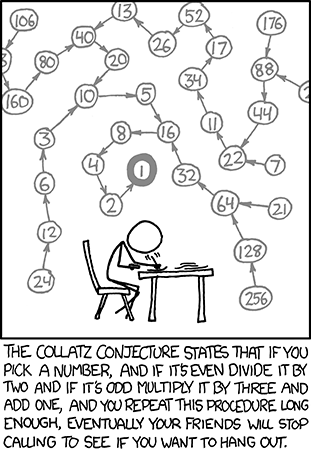
 on the set of positive integers:
 is even, divide it by two:
  .
. .
. , and
, and  . Believe it or not, this is the restriction to the positive integers of the complex-valued map
  .
.
 for the residue of n modulo d. Show that the residue modulo 7 of a (large) integer n can be found by separating the integer into 3-digit blocks
  .(Note that b(s) may have 1, 2, or 3 digits, but every other block must have exactly three digits.) Then the residue modulo 7 of n is the same as the residue modulo 7 of
  . For example,



 .
.
 Yet Another Mathblog
You must be logged in to post a comment.