Mathematics of zombies

What do you do if there is a Zombie attack? Can mathematics help? This page is (humorously) dedicated to collecting links to papers or blog posted related to the mathematical models of Zombies.


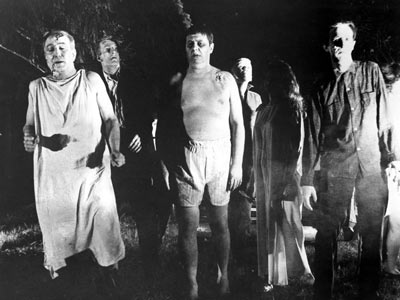
George Romero’s 1968 Night of the Living Dead, now in the public domain, introduced reanimated ghouls, otherwise known as zombies, which craved live human flesh. Romero’s script was insired on Richard Matheson’s I Am Legend. In Romero’s version, the zombies could be killed by destroying the zombie’s brain. A dead human could, in some cases be “reanimated,” turning into a zombie. These conditions are modeled mathematically in several papers, given below.

  1. When Zombies Attack! Mathematical Modelling of a Zombie Outbreak!, paper by Mathematicians at the University of Ottawa, Philip Munz, Ioan Hudea, Joe Imad and Robert J. Smith? (yes, his last name is spelled “Smith?”).
  2. youtube video 28 Minutes Later – The Maths of Zombies , made by Dr James Grime (aka, “siningbanana”), which references the above paper.
  3. Epidemics in the presence of social attraction and repulsion, Oct 2010 Zombie paper by Evelyn Sander and Chad M. Topaz.
  4. Statistical Inference in a Zombie Outbreak Model, slides for a talk given by Des Higman, May 2010.
  5. Mathematics kills zombies dead!, 08/17/2009 blog post by “Zombie Research Society Staff”.
  6. The Mathematics of Zombies, August 18, 2009 blog post by Mike Elliot.
  7. Love, War and Zombies – Systems of Differential Equations using Sage, April 2011 slides by David Joyner. Sage commands for Love, War and Zombies talk. This was given as a Project Mosaic/M-cast broadcast.
  8. Public domain 1968 film Night of the Living Dead by George Romero.

Splitting fields of representations of generalized symmetric groups, 4

First a technical definition.

Let A=C_\ell^n. Let \eta_k(z)=z^k, for z\in C_\ell and 1\leq k\leq \ell-1. For \eta\in C_\ell^*, let \mu\otimes \eta =(\mu_1\eta,\mu_2\eta,...,\mu_n\eta) where \mu=(\mu_1,\mu_2,...,\mu_n). This defines an action of C_\ell^* on A^* and hence on the set of equivalence classes of G, G^*. We call two representations \theta_{\mu,\rho}, \theta_{\mu',\rho'} C_\ell^*-equivalent, and write

\theta_{\mu,\rho}\sim_\ell \theta_{\mu',\rho'},

if \rho=\rho' and \mu'=\mu\otimes \eta for some \eta\in C_\ell^*. Similarly, we call two characters \mu, \mu' of C_\ell^n C_\ell^*-equivalent, and write

\mu\sim_\ell \mu',

if \mu'=\mu\otimes \eta for some \eta\in C_\ell^*.

For example, Let \ell =9, n=3 and \mu=(\eta_2,\eta_5,\eta_8). Then \mu\sim \mu\otimes\eta_3.

Let \theta_{\mu,\rho} be as in the previous post. Note that

\theta_{\mu\otimes \eta,\rho} = \theta_{\mu,\rho}\otimes \eta ,

for \eta\in C_\ell^*. Therefore, the matrix representations of two C_\ell^*-equivalent representations differ only
by a character.

Let G=C_\ell^n\, >\!\!\lhd \, S_n.

The results in the above section tells us how to construct all the irreducible representations of G. We must

  1. write down all the characters (i.e., 1-dimensional representations) of A=C_\ell^n,
  2. describe the action of S_n on A^*,
  3. for each \mu\in [A^*], compute the stabilizer (S_n)_{\mu},
  4. describe all irreducible representations of each (S_n)_{\mu},
  5. write down the formula for the character of \theta_{\mu,\rho}.

Write \mu\in [A^*] as \mu=(\mu_1,...,\mu_n), where each component is a character of the cyclic group C_\ell, \mu_j\in C_\ell^*. Let \mu'_1,...,\mu'_r denote all the distinct characters which occur in \mu, so

\{\mu'_1,...,\mu'_r\}=\{ \mu_1,...,\mu_n\}.

Let n_1 denote the number of \mu'_1‘s in \mu, n_2 denote the number of \mu'_2‘s in \mu, …, n_r denote the number of \mu'_r‘s in \mu. Then n=n_1+...+n_r. Call this the partition associated to \mu.

If two characters \mu=(\mu_1,...,\mu_n), \mu'=(\mu'_1,...,\mu'_n) belong to the same class in [(C_\ell^n)^*], under the S_n-equivalence relation, then their associated partitions are equal.

The Frobenius formula for the character of an induced representation gives the following character formula. Let \chi denote the character of \theta_{\mu,\rho}. Then

\chi(\vec{v},p)=\sum_{g\in S_n/(S_n)_\mu} \chi^o_\rho(gpg^{-1})\mu^g(\vec{v}),

for all \vec{v}\in C_\ell^n and p\in S_n. In particular, if p=1 then

\chi(\vec{v},1)=({\rm dim}\ \rho)\sum_{g\in S_n/(S_n)_\mu} \mu^g(\vec{v}).

Michael Reid’s Happy New Year Puzzle, 2012

Here is another puzzle from Michael Reid on NOBNET. (Michael also notes that if you find a solution (a,b,c,d,e,f) then (d,e,f,a,b,c) is another solution.)

Puzzle: Replace a, b, c, d, e, f with the first six prime numbers, in some order, to make the expression a\cdot b^c + d \cdot e^f equal to the New Year.

Best wishes for a happy, healthy and prosperous New Year!

Bifid cipher and Sage

The Bifid cipher was invented around 1901 by Felix Delastelle. It is a “fractional substitution” cipher, where letters are replaced by pairs of symbols from a smaller alphabet. The cipher uses a 5×5 square filled with some ordering of the alphabet, except that “i”‘s and “j”‘s are identified (this is a so-called Polybius square; there is a 6×6 analog if you add back in “j” and also append onto the usual 26 letter alphabet, the digits 0, 1, …, 9). According to Helen Gaines’ book “Cryptanalysis”, this type of cipher was used in the field by the German army during World War I.

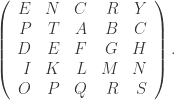
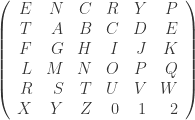
The Bifid cipher was discusses in Alasdair McAndrew’s book on Cryptography and Sage. We shall follow his discussion. As an example of a Polybius square for the Bifid cipher, pick the key to be “encrypt” (as Alasdair does). In that case, the Polybius square is \left(\begin{array}{rrrrr}  E & N & C & R & Y \\  P & T & A & B & C \\  D & E & F & G & H \\  I & K & L & M & N \\  O & P & Q & R & S  \end{array}\right). BTW, the 6\times 6 analog is: \left(\begin{array}{rrrrrr}  E & N & C & R & Y & P \\  T & A & B & C & D & E \\  F & G & H & I & J & K \\  L & M & N & O & P & Q \\  R & S & T & U & V & W \\  X & Y & Z & 0 & 1 & 2  \end{array}\right).

Here is Sage code to produce the 6\times 6 case (the 5\times 5 case is in Alasdair’s book):

def bifid(pt, key):
    """
    INPUT:
        pt - plaintext string      (digits okay)
        key - short string for key (no repetitions, digits okay)
    
    OUTPUT:
        ciphertext from Bifid cipher (all caps, no spaces)

    This is the version of the Bifid cipher that uses the 6x6
    Polybius square.

    AUTHOR:
        Alasdair McAndrew

    EXAMPLES:
        sage: key = "encrypt"
        sage: pt = "meet me on monday at 8am"
        sage: bifid(pt, key)
        [[2, 5], [0, 0], [0, 0], [1, 0], [2, 5], [0, 0], [3, 0], 
         [0, 1], [2, 5], [3, 0], [0, 1], [1, 3], [1, 1], [0, 4], 
         [1, 1], [1, 0], [5, 4], [1, 1], [2, 5]]
        'HNHOKNTA5MEPEGNQZYG'

    """
    AS = AlphabeticStrings()
    A = list(AS.alphabet())+[str(x) for x in range(10)]
    # first make sure the letters are capitalized
    # and text has no spaces
    key0 = [x.capitalize() for x in key if not(x.isspace())]
    pt0 = [x.capitalize() for x in pt if not(x.isspace())]
    # create long key
    long_key = key0+[x for x in A if not(x in key0)]
    n = len(pt0)
    # the fractionalization
    pairs = [[long_key.index(x)//6, long_key.index(x)%6] for x in pt0]
    print pairs
    tmp_cipher = flatten([x[0] for x in pairs]+[x[1] for x in pairs])
    ct = join([long_key[6*tmp_cipher[2*i]+tmp_cipher[2*i+1]] for i in range(n)], sep="")
    return ct

def bifid_square(key):
    """
    Produced the Polybius square for the 6x6 Bifid cipher.

    EXAMPLE:
        sage: key = "encrypt"
        sage: bifid_square(key)
        [E N C R Y P]
        [T A B C D E]
        [F G H I J K]
        [L M N O P Q]
        [R S T U V W]
        [X Y Z 0 1 2]

    """
    AS = AlphabeticStrings()
    A = list(AS.alphabet())+[str(x) for x in range(10)]
    # first make sure the letters are capitalized
    # and text has no spaces
    key0 = [SR(x.capitalize()) for x in key if not(x.isspace())]
    # create long key
    long_key = key0+[SR(x) for x in A if not(x in key0)]
    # the fractionalization
    pairs = [[long_key.index(SR(x))//6, long_key.index(SR(x))%6] for x in A]
    f = lambda i,j: long_key[6*i+j] 
    M = matrix(SR, 6, 6, f)
    return M

Have fun!

Michael Reid’s Digit operation puzzles

Michael Reid (http://www.math.ucf.edu/~reid/index.html) posted these questions on Nobnet recently. I’m reposting them here.

Consider two rules for modifying a positive integer:

i) replace a substring of its digits by the square of the number represented by the substring
ii) if a substring is a perfect cube, replace the substring by its cube root

Neither the substring being replaced, nor the string replacing it may have leading zeroes.

For example, starting with 123, we may square `23′ to obtain 1529. Then we can square `29′ to get 15841, then square `5′ to get 125841, and then we could take the cube root of `125′ to get 5841, and so on.

What is the smallest number we can obtain from the number 2011 with a sequence of these operations?

Now suppose the two operations are instead

iii) replace a substring by its cube
iv) replace a substring which is a square by its square root

What is the smallest number we can get with these operations if we start from 2011?

Here is another “digit operations” puzzle that I hope you will find a nice challenge.

Consider two rules for modifying a positive integer:

i) replace a substring of its digits by 7 times the number represented by the substring
ii) if a substring is a perfect 7th power, replace the substring by its 7th root

Neither the substring being replaced, nor the string replacing it may have leading zeroes.

For example, starting with 347, we may replace the substring `34′ by `238′ (multiplying by 7) to obtain 2387. Then we can multiply the substring `3′ to get 22187. Now we can take the 7th root of `2187′ to get 23, and so on.

What is the smallest number we can obtain from the number 2011 with a sequence of these operations?

Now suppose the two operations are instead

iii) if a substring is divisible by 7, we may divide the substring by 7
iv) replace a substring by its 7th power

(which are the reverses of operations i) and ii) above).

What is the smallest number we can get with these operations if we start from 2011?

Zombies and Mathematics

What do you do if there is a Zombie attack? Can mathematics help? This post is (humorously) dedicated to collecting links to papers or blog posted related to the mathematical models of Zombies.

George Romero‘s 1968 Night of the Living Dead, now in the public domain, introduced reanimated ghouls, otherwise known as zombies, which craved live human flesh. Romero’s script was insired on Richard Matheson’s I Am Legend. In Romero’s version, the zombies could be killed by destroying the zombie’s brain. A dead human could, in some cases be “reanimated,” turning into a zombie. These conditions are modeled mathematically in several papers, given below.

Public domain 1968 film Night of the Living Dead by George Romero.

Sage and the future of mathematics

I am not a biologist nor a chemist, and maybe neither are you, but suppose we were. Now, if I described a procedure, in “standard” detail, to produce a result XYZ, you would (based on your reasonably expected expertise in the field), follow the steps you believe were described and either reproduce XYZ or, if I was mistaken, not be able to reproduce XYZ. This is called scientific reproducibility. It is cructial to what I believe is one of the fundamental principles of science, namely Popper’s Falsifiability Criterion.

More and more people are arguing, correctly in my opinion, that in the computational realm, in particular in mathematical research which uses computational experiments, that much higher standards are needed. The Ars Technica article linked above suggests that “it’s time for a major revision of the scientific method.” Also, Victoria Stodden argues one must “facilitate reproducibility. Without this data may be open, but will remain de facto in the ivory tower.” The argument basically is that to reproduce computational mathematical experiments is unreasonably difficult, requiring more that a reasonable expertise. These days, it may in fact (unfortunately) require purchasing very expensive software, or possessing of very sophisticated programming skills, accessibility to special hardware, or (worse) guessing parameters and programming procedures only hinted at by the researcher.

Hopefully, Sage can play the role of a standard bearer for such computational reproducibility. Sage is free, open source and there is a publically available server it runs on (sagenb.org).

What government agencies should require such reproducibility? In my opinion, all scientific funding agencies (NSF, etc) should follow these higher standards of computational accountability.