Odd king tours on even chessboards, revisited

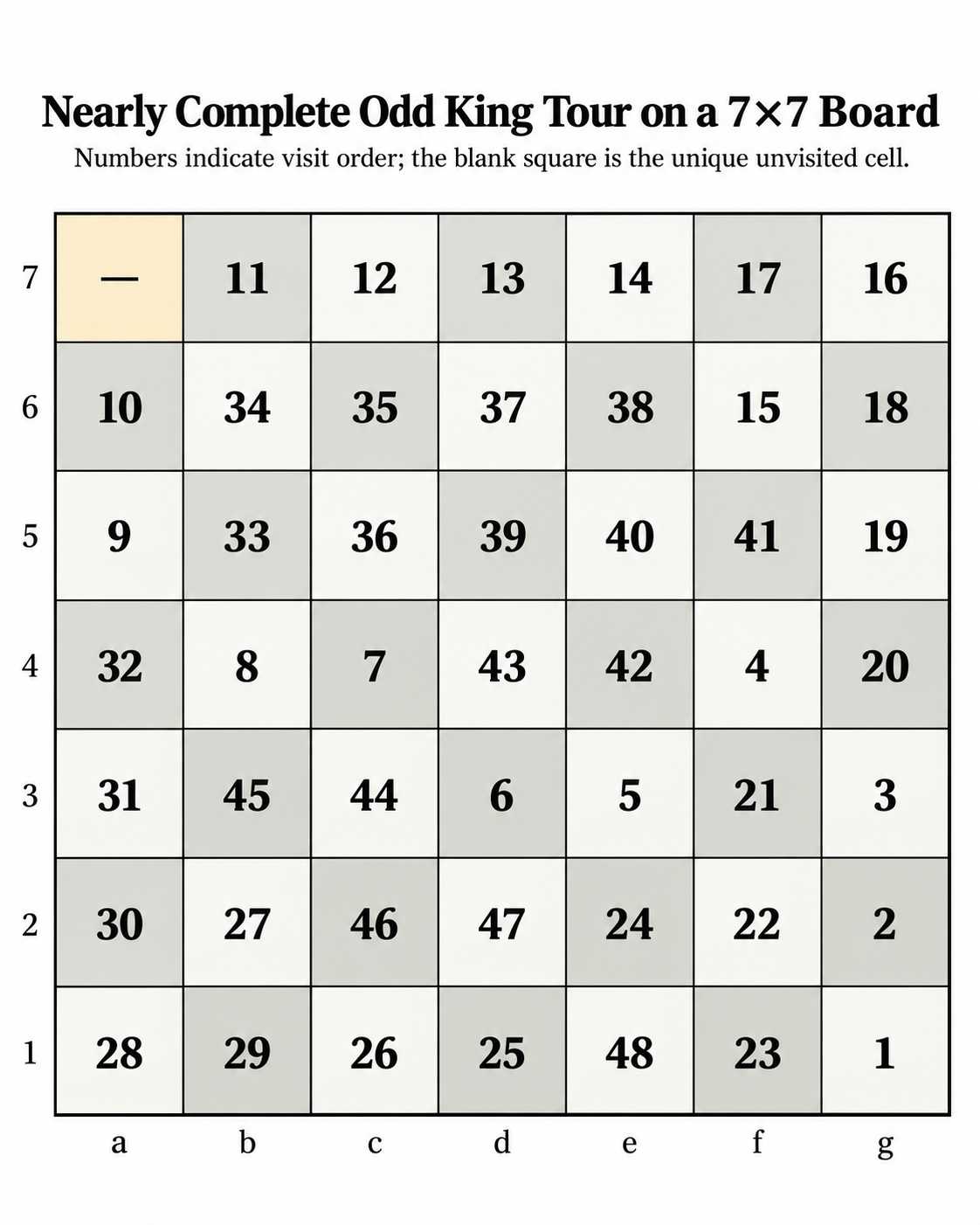
Almost 30 years ago this year, a former student Michael Fourte and I wrote a combinatorics paper (original paper, 1997) with the title above, eventually published in the now defunct Journal of Recreational Mathematics 31(2003)173–177.That paper was a pleasure to write, but was it correct?

With AI tackling open math problems left and right, I asked AI to review our paper and correct it, if any errors were found. In fact, I expected no errors but it turns out the main theorem was not as carefully stated as it should be, and some conjectural statements were not formulated in the best way (though our proofs were correct). A corrected version, made with the help of AI, can be found here: 2026 corrected version. An AI-written report on the paper with some possible directions for further research is here: 2026 AI-written report/review.

“Invariant distributions on the n-fold metaplectic covers of GL(r,F), F p-adic”, revisited

Over 25 years ago I wrote a paper with the pretentious title “Invariant distributions on the n-fold metaplectic covers of GL(r,F), F p-adic” (J. Fourier Anal. and Appl. 7(2001)343-358.). In fact, it was on such invariant distributions restricted to a very special class of functions where everything was much simpler to describe.

Inspired by a blog post of Professor Alonso Castillo-Ramirez, I asked AI to look over this paper. Here, by AI I mean using both chatGPT-Sol and claude-Fable or claude-Opus, teaming one up against the other (so they had to find my errors and, if any, also those of the other AI agent). Apparently, my “simple” argument was a bit confusing to the AI I used. This in turn confused me, until I started to remember the argument. Then I explained the argument to AI, and it got back on track. None-the-less, I’m happy for the diversion because it helped AI look into generalizations. Anything leading to more interesting mathematics is a positive thing, IMHO.

The long story short here is that I was sloppy with some definitions and some hypotheses, and I apologize for that. The usual excuse is that family and work obbligations are to blame but in fact, I love hunting down new and interesting mathematical arguments but I’m less enthusiastic about double-checking details. So, it’s really my fault. However, the overall results are more-or-less correct and even appear (if you believe AI) to generalize significantly. I have not pursued these generalizations. Nor will I, as I’ve been retired and out of that field for some time and no longer have access to the needed literature. For anyone interested, available are the original 2000 paper, the AI-aided corrected paper (2026), and AI-generated notes on generalizing these results are also available. Just email me.
Zeros of some self-reciprocal polynomials, revisited

Inspired by a blog post of Professor Alonso Castillo-Ramirez, I asked AI to look over an old survey paper I wrote in 2012. Long story short, ChatGPT-Sol (OpenAI) and Claude-Fable (Anthropic) found and corrected several errors. Embarrassing. (For the full mea culpa, see the abstract of the pdf of the corrected version.) AI even proved a conjecture I made in the paper and pointed out that another conjecture I made was a consequence of an Annals of Math paper published in 2020 . It’s embarrassing making a mistake, especially in a survey paper (apologies to the original authors!), but there is a rainbow at the end of the road.

On the teaching philosophy of Euphemia Haynes

I’m not an expert on her teaching philosophy but John Stigall is (the author of John Stigall, Euphemia Haynes’ philosophy of mathematics and mathematics education, Journal of Philosophy of Education, 2026). He pointed me to some of Euphemia’s work on the philosophy of teaching. The video below is inspired by, and based on, some of Dr. Haynes’ lectures, research and scholarly work. I could not have made it without AI (mostly Claude).

It’s titled “Euphemia Lofton Haynes – Mathematics as an open door”

Related posts: