Real world applications of representation theory

(Subtitle: Representation theorists will rule the world one day just you wait)


This post describes some applications of representation theory of non-abelian groups to various fields and gives some references.

  • Engineering.
    • Tensegrity – the design of “strut-and-cable” constructions.Want to build a building with cables and struts but don’t know representation theory? Check out these references:
      • R. Connelly and A. Back, “Mathematics and tensegrity”, Amer Scientist, April-May 1998, pages 142-151
      • symmetric tensegrities
    • Telephone network designs.This is the information age with more and more telephone lines needed every day. Want to reach out and touch someone? You need representation theory.
      • F. Bien, “Construction of telephone networks by group representations”, Notices A. M. S. 36(1989)5-22
    • Nonlinear network problems.This is cheating a little since the works in the reference below really use the theory of Lie groups instead of representation theory itself. Still, there is a tangential relation at least between representation theory of Lie groups and the solution to certain nonlinear network problems.
      • C. Desoer, R. Brockett, J. Wood, R. Hirshorn,
        A. Willsky, G. Blankenship, Applications of Lie group theory to nonlinear network problems, (Supplement to IEEE Symposium on Circuit Theory, 1974), Western Periodicals Co., N. Hollywood, CA, 1974
    • Control theory.
      • R. W. Brockett, “Lie theory and control systems defined on spheres”, SIAM J on Applied Math 25(1973) 213-225
    • Robotics.The future is not in plastics (see the movie “The Graduate“) but in robotics.
      How do you figure out their movements before building them? You guessed it, using representation theory.

      • G. Chirikjian, “Determination and synthesis of discretely actuated manipulator workspaces using harmonic analysis”, in Advances in Robotic Kinematics, 5, 1996, Springer-Verlag
      • G. Chirikjian and I. Ebert-Uphoff, “Discretely actuated manipulator workspace generation by closed-form convolution”, in ASME Design Engineering Technical Conference, August 18-22 1996
    • Radar design.W. Schempp, Harmonic analysis on the Heisenberg nilpotent Lie group, with
      applications to signal theory
      , Longman Scientific & Technical, New York (Copublished in the U.S. with Wiley), 1986.
    • Antenna design.B. Hassibi, B. Hochwald, A. Shokrollahi, W. Sweldens, “Representation theory for high-rate multiple antenna code design,” 2000 preprint (see A. Shokrollahi’s site for similar works).
    • Design of stereo systems.We’re talkin’ quadrophonic state-of-the-art.
      • K. Hannabus, “Sound and symmetry”, Math. Intelligencer, 19, Fall 1997, pages 16-20
    • Coding theory. Interesting progress in coding theory has been made using group theory and representation theory. Here are a few selected references.
      • F. MacWilliams and N. Sloane, The Theory of Error-Correcting Codes,
        North-Holland/Elsevier, 1993 (8th printing)
      • I. Blake and R. Mullin, Mathematical Theory of Coding, Academic Press, 1975
        49(1995)215-223
      • J.-P. Tillich and G. Zemor,
        “Optimal cycle codes constructed from Ramanujan graphs,” SIAM J on Disc. Math. 10(1997)447-459
      • H. Ward and J. Wood, “Characters and the equivalence of codes,” J. Combin. Theory A 73348-352
      • J. Lafferty and D. Rockmore, “Spectral Techniques for Expander Codes” , (Extended Abstract) 1997 Symposium on Theory of Computation (available
        at  Dan Rockmore’s web page)
  • Mathematical physics.
    Any complete list of books and papers in this field which use representation theory would be much too long for the limited goal we have here (which is simply
    to list some real-world applications). A small selection is given below.

    • Differential equations (such as the heat equation, Schrodinger wave equation, etc).M. Craddock, “The symmetry groups of linear partial differential equations
      and representation theory, I” J. Diff. Equations 116(1995)202-247
    • Mechanics.
      • D.H. Sattinger, O.L. Weaver, Lie Groups and Algebras With Applications to Physics, Geometry, and Mechanics (Applied Mathematical Sciences, Vol 61) , Springer Verlag, 1986
      • Johan Belinfante, “Lie algebras and inhomogeneous simple materials”,
        SIAM J on Applied Math 25(1973)260-268
    • Models for elementary particles.
    • Quantum mechanics.
      • Eugene Wigner, “Reduction of direct products and restriction of representations to subgroups: the everyday tasks of the quantum theorists”, SIAM J on Applied Math 25(1973) 169-185
      • V. Vladimirov, I. Volovich, and E. Zelenov, “Spectral theory in p-adic quantum mechanics and representation theory,” Soviet Math. Doklady 41(1990)40-44
    • p-adic string theory.
      • Y. Manin, “Reflections on arithmetical physics,” in Conformal invariance and string theory, Academic Press, 1989, pages 293-303
      • V. Vladimirov, I. Volovich, and E. Zelenov, p-adic analysis and mathematical physics, World Scientific, 1994
      • V. Vladimirov, “On the Freund-Witten adelic formula for Veneziano amplitudes,” Letters in Math. Physics 27(1993)123-131
  • Mathematical chemistry.
    • Spectroscopy.B. Judd, “Lie groups in Atomic and molecular spectroscopy”, SIAM J on Applied Math 25(1973) 186-192
    • Crystallography.
      • G. Ramachandran and R. Srinivasan, Fourier methods in crystallography,
        New York, Wiley-Interscience, 1970.
      • T. Janssen, Crystallographic groups, North-Holland Pub., London, 1973.
      • J. Zak, A. Casher, M. Gluck, Y. Gur, The irreducible representations of space groups, W. A. Benjamin, Inc., New York, 1969.
    • Molecular strucure of the Buckyball.
      • F. Chung and S. Sternberg, “Mathematics and the buckyball”, American Scientist 83(1993)56-71
      • F. Chung, B. Kostant, and S. Sternberg, “Groups and the buckyball”, in Lie theory and geometry, (ed. J.-L. Brylinski et al), Birkhauser, 1994
      • G. James, “The representation theory for the Buckminsterfullerene,” J. Alg. 167(1994)803-820
  • Knot theory (which, in turn, has applications to modeling DNA) uses representation theory. F. Constantinescu and F. Toppan, “On the linearized Artin braid representation,” J. Knot Theory and its Ramifications, 2(1993)
  • The Riemann hypothesis.
    Think you’re going to solve the Riemann hypothesis without using
    representation theory? Check this paper out: A. Connes, “Formule de traces en geometrie non-commutative et hypothese de Riemann”, C. R. Acad. Sci. Paris 323 (1996)1231-1236. (For those who argue that this is not a real-world application, we refer to Barry Cipra’s article, “Prime Formula Weds Number Theory and Quantum Physics,” Science, 1996 December 20, 274, no. 5295, page 2014, in Research News.)
  • Circuit design, statistics, signal processing, …
    See the survey paper
    D. Rockmore, “Some applications of generalized FFTs” in Proceedings of the DIMACS
    Workshop on Groups and Computation, June 7-10, 1995 eds. L. Finkelstein and W. Kantor, (1997) 329–369. (available at  Dan Rockmore’s web page)
  • Vision – See the survey papers by Jacek Turski:Geometric Fourier Analysis of the Conformal Camera for Active Vision, SIAM Review, Volume 46 Issue 2 pages 230-255, 2004 Society for Industrial and Applied Mathematics, and, Geometric Fourier Analysis for Computational Vision, JFAA 11, 1-23, 2005.

Complements in the symmetric group

About 20 years ago I was asked a question of Herbert Kociemba, a computer scientist who has one of the best Rubik’s cube solving programs known. Efficient methods of storing permutations in S_E and S_V (the groups of all permutations of the edges E and vertices V, respectively, of the Rubik’s cube) are needed, hence leading naturally to the concept of the complement of S_m in S_n. Specifically, he asked if S_8 has a complement in S_{12} (this terminology is defined below). The answer is,
as we shall see, ”no.” Nonetheless, it turns out to be possible to introduce a slightly more general notion of a “k-tuple of complementary subgroups” (defined below) for which the answer to the analogous question is ”yes.”

This post is a very short summary of a paper I wrote (still unpublished) which can be downloaded here.

Splitting fields of representations of generalized symmetric groups, 8

In this post, we give an example.

Let G=C_3^8\, >\!\!\lhd \, S_8 and let

\pi = \theta_{\mu,\rho}=Ind_{G_\mu}^G(\mu\cdot \tilde{\rho}),

where \mu is a character of C_3^8 and \rho is an irreducible representation of its stabilizer in S_8, (S_8)_\mu.

The real representations \pi of G are the ones for which

  1. \mu is represented by a character of the form

    (1,1,1,1,1,1,\omega,\omega^2)  \ {\rm or}\  (1,1,...,1),

    and \rho anything, or

  2. \mu is represented by a character of the form

    (1,1,1,1,\omega,\omega,\omega^2,\omega^2), \rho_1=(\pi_1,\pi_2,\pi_2)\in (S_4)^*\times (S_2)^*\times (S_2)^*,

    or

  3. \mu is represented by a character of the form

    (\omega,\omega,\omega,\omega,\omega^2,\omega^2,\omega^2,\omega^2), \rho_1=(\pi_2,\pi_2)\in (S_4)^*\times (S_4)^*,

    or

  4. \mu is represented by a character of the form

    (1,1,\omega,\omega,\omega,\omega^2,\omega^2,\omega^2), \rho_1=(\pi_1,\pi_2,\pi_2)\in (S_2)^*\times (S_3)^*\times (S_3)^*.

The complex representations of G are: the representations
whose characters have at least one complex value. Such representations \pi = \theta_{\mu,\rho} are characterized by the fact that (\mu,\rho) is inequivalent to (\overline{\mu},\rho) under the obvious $S_8$-equivalence relation (which can be determined from the equivalence relation for representations in G^*).

The complex representations of G are the remaining representations not included in the above list.

There are no quaternionic representations of G.

The claims above follow from the fact that a representation
\theta_{\rho,\mu} is complex if and only if \mu is not self-dual.

Splitting fields of representations of generalized symmetric groups, 7

In this post, we discover which representations of the generalized symmetric group G = S_n\ wr\ C_\ell = C_\ell^n\, >\!\!\lhd \, S_n can be realized over a given abelian extension of {\mathbb{Q}}.

Let \theta_{\mu,\rho}\in G^* be the representation defined previously, where \rho\in ((S_n)_\mu)^*.

Let K\subset {\mathbb{Q}}(\zeta_\ell) be a subfield, where \zeta_\ell is a primitive \ell^{th} root of unity. Assume K contains the field generated by the values of the character of \theta_{\mu,\rho}. Assume K/{\mathbb{Q}} is Galois and let \Gamma_K=Gal({\mathbb{Q}}(\zeta_\ell)/K). Note if we regard C_\ell as a subset of {\mathbb{Q}}(\zeta_\ell) then there is an induced action of \Gamma_K on C_\ell,

\sigma:\mu \longmapsto \mu^\sigma, \ \ \ \ \ \ \ \ \ \mu\in (C_\ell)^*,\ \ \sigma\in \Gamma_K,

where \mu^\sigma(z)=\mu(\sigma^{-1}(z)), z\in C_\ell. This action extends to an action on (C_\ell^n)^*=(C_\ell^*)^n.

Key Lemma:
In the notation above, \theta_{\mu,\rho}\cong\theta_{\mu,\rho}^\sigma if and only if \mu is equivalent to \mu^\sigma under the action of S_n on (C_\ell^n)^*.

Let

n_\mu(\chi)=|\{i\ |\ 1\leq i\leq n,\ \mu_i=\chi\}|,

where \mu=(\mu_1,...,\mu_n)\in (C_\ell^n)^* and \chi\in C_\ell^*.

Theorem: The character of \theta_{\mu,\rho}\in G^* has values in K if and only if n_\mu(\chi)=n_\mu(\chi^\sigma),
for all \sigma\in \Gamma_K and all \chi\in C_\ell^*.

This theorem is proven in this paper.

We now determine the splitting field of any irreducible character of a generalized symmetric group.

Theorem: Let \chi=tr(\theta_{\rho,\mu}) be an irreducible character of G=S_n\ wr\ C_\ell. We have

Gal({\mathbb{Q}}(\zeta_\ell)/{\mathbb{Q}}(\chi))= Stab_\Gamma(\chi).

This theorem is also proven in this paper.

In the next post we shall give an example.

Splitting fields of representations of generalized symmetric groups, 6

This post shall list some properties of the Schur index m_F(G) in the case where G = S_n\ wr\ C_\ell is a generalized symmetric group and F is either the reals or rationals.

Let \eta_k(z)=z^k, for z\in C_\ell, 1\leq k\leq \ell.

Theorem: Let G = S_n\ wr\ C_\ell. Let \mu=(\eta_{e_1},...,\eta_{e_n})\in (C_\ell^n)^*, for some e_j\in \{0,...,\ell-1\}, and let \rho\in (S_n)_\mu^*. Let
\chi denotes the character of \theta_{\mu,\rho}.

  1. Suppose that one of the following conditions holds:
    1. 4|\ell and \overline{e_1+...+e_n} divides \overline{\ell/4} in {\mathbb{Z}}/\ell {\mathbb{Z}}, or
    2. (e_1+...+e_n,\ell)=1,

    Then m_{\Bbb{Q}}(\chi)=1.

  2. Suppose that one of the following conditions holds:
    1. (n,\ell)=1, 4|\ell, and (e_1+...+e_n)x\equiv \ell /4\ ({\rm mod}\ \ell) is not solvable, or
    2. (n,\ell)=1 and (e_1+...+e_n,\ell)>1.

    Then m_{\mathbb{Q}}(\chi\eta_1)=1.

This theorem is proven in this paper. Benard has shown that m_{\mathbb{Q}}(\chi)=1, for all \chi as in the above theorem.

Since the Schur index over {\mathbb{Q}} of any irreducible character \chi of a generalized symmetric group G is equal to 1, each such character is associated to a representation \pi all of whose matrix coefficients belong to the splitting field {\mathbb{Q}}(\chi).

What is the splitting field {\mathbb{Q}}(\chi), for \chi\in G^*?

This will be addressed in the next post.

Splitting fields of representations of generalized symmetric groups, 5

It is a result of Benard (Schur indices and splitting fields of the unitary reflection groups, J. Algebra, 1976) that the Schur index over {\mathbb{Q}} of any irreducible character of a generalized symmetric group is equal to 1. This post recalls, for the sake of comparison with the literature, other results known about the Schur index in this case.

Suppose that G is a finite group and \pi \in G^* is an irreducible representation of G, \pi :G\rightarrow Aut(V), for some complex vector space V. We say that \pi may be realized over a subfield F\subset {\mathbb{C}} if there is an F-vector space V_0 and an action of G on V_0 such that V and {\mathbb{C}}\otimes V_0 are equivalent representations of G, where G acts on {\mathbb{C}}\otimes V_0 by “extending scalars” in V_0 from F to {\mathbb{C}}. Such a representation is called an F-representation. In other words, \pi is an F-representation provided it is equivalent to a representation which can be written down explicitly using matrices with entries in F.

Suppose that the character \chi of \pi has the property that

\chi(g)\in F, \ \ \ \ \ \ \forall g\in G,

for some subfield F\subset {\mathbb{C}} independent of g. It is unfortunately true that, in general, \pi is not necessarily an F-representation. However, what is remarkable is that, for some m\geq 1, there are m representations, \pi_1,...,\pi_m, all equivalent to \pi, such that \pi_1\oplus ...\oplus \pi_m is an F-representation. The precise theorem is the following remarkable fact.

Theorem: (Schur) Let \chi be an irreducible character and let F be any field containing the values of \chi. There is an integer m \geq 1 such that m\chi is the character of an F-representation.

The smallest m\geq 1 in the above theorem is called the Schur index and denoted m_F(\chi).

Next, we introduce some notation:

  1. let {\mathbb{R}}(\pi) = {\mathbb{R}}(\chi) denote the extension field of {\mathbb{R}} obtained by adjoining all the values of \chi(g)\ ($g\in G$), where \chi is the character of \pi,
  2. let \nu(\pi) = \nu(\chi) denote the Frobenius-Schur indicator of \pi (so \nu(\pi)= {1\over |G|}\sum_{g\in G} \chi(g^2)),
  3. let m_{\mathbb{R}}(\pi) = m_{\mathbb{R}}(\chi) denote the Schur multiplier of \pi (by definition, the smallest integer m\geq 1 such that $m\chi$ can be realized over {\mathbb{R}} (this integer exists, by the above-mentioned theorem of Schur).

The following result shows how the Schur index behaves under induction (see Proposition 14.1.8 in G. Karpilovsky,
Group representations, vol. 3, 1994).

Proposition: Let \chi be an irreducible character of G and let \psi denote an irreducible character of a subgroup H of G. If = 1 then m_{\Bbb{R}}(\chi) divides m_{\Bbb{R}}(\psi).

A future post shall list some properties of the Schur index in the case where G is a generalized symmetric group and F is either the reals or rationals.

Splitting fields of representations of generalized symmetric groups, 4

This post if an aside on cyclotomic fields and Tchebysheff polynomials. Though it seems certain this material is known, I know of no reference.

Let n denote a positive integer divisible by 4, let r=\cos(2\pi/n), s=\sin(2\pi/n), and let d=n/4. If

T_1(x)=x,\ \ T_2(x)=2x^2-1,\ \ T_3(x)=4x^3-3x,\ \  T_4(x)=8x^4-8x^2+1,\ \ ...,

denote the Tchebysheff polynomials (of the 1st kind), defined by

\cos(n\theta)=T_n(\cos(\theta)),

then T_d(r)=0.

Let \zeta_n=exp(2\pi i/n) and let F_n={\mathbb{Q}}(\zeta_n) denote the cyclotomic field of degree \phi(n) over {\mathbb{Q}}. If \sigma_j\in Gal(F_n/{\Bbb{Q}}) is defined by \sigma_j(\zeta_n)=\zeta_n^j then

Gal(F_n/{\Bbb{Q}})\cong ({\Bbb{Z}}/n{\Bbb{Z}})^\times,

where \sigma_j\longmapsto j.

Lemma: Assume n is divisible by 4.

  1. {\mathbb{Q}}(r) is the maximal real subfield of F_n, Galois over {\mathbb{Q}} with

    Gal(F_n/{\Bbb{Q}}(r))=\{1,\tau\},

    where $\tau$ denotes complex conjugation. Under the canonical isomorphism

    Gal(F_n/{\Bbb{Q}})\cong ({\Bbb{Z}}/n{\Bbb{Z}})^\times,

    we have

    Gal({\Bbb{Q}}(r)/{\Bbb{Q}})\cong ({\Bbb{Z}}/n{\Bbb{Z}})^\times/\{\pm 1\}.

  2. If n is divisible by 8 then r and s are conjugate roots of T_d. In particular, s\in {\mathbb{Q}}(r) and T_d(s)=0.

  3. We have \sigma_j(r)=T_j(r).
  4. If n\geq 4 is a power of 2 then T_d is the minimal polynomial of {\mathbb{Q}}(r). Furthermore, in this case

    \cos(\pi/4)=\sqrt{2}/2,\ \  \cos(\pi/8)=\sqrt{2+\sqrt{2}}/2,\ \  \cos(\pi/16)=\sqrt{2+\sqrt{2+\sqrt{2}}}/2,\ \ ... .

Splitting fields of representations of generalized symmetric groups, 4

First a technical definition.

Let A=C_\ell^n. Let \eta_k(z)=z^k, for z\in C_\ell and 1\leq k\leq \ell-1. For \eta\in C_\ell^*, let \mu\otimes \eta =(\mu_1\eta,\mu_2\eta,...,\mu_n\eta) where \mu=(\mu_1,\mu_2,...,\mu_n). This defines an action of C_\ell^* on A^* and hence on the set of equivalence classes of G, G^*. We call two representations \theta_{\mu,\rho}, \theta_{\mu',\rho'} C_\ell^*-equivalent, and write

\theta_{\mu,\rho}\sim_\ell \theta_{\mu',\rho'},

if \rho=\rho' and \mu'=\mu\otimes \eta for some \eta\in C_\ell^*. Similarly, we call two characters \mu, \mu' of C_\ell^n C_\ell^*-equivalent, and write

\mu\sim_\ell \mu',

if \mu'=\mu\otimes \eta for some \eta\in C_\ell^*.

For example, Let \ell =9, n=3 and \mu=(\eta_2,\eta_5,\eta_8). Then \mu\sim \mu\otimes\eta_3.

Let \theta_{\mu,\rho} be as in the previous post. Note that

\theta_{\mu\otimes \eta,\rho} = \theta_{\mu,\rho}\otimes \eta ,

for \eta\in C_\ell^*. Therefore, the matrix representations of two C_\ell^*-equivalent representations differ only
by a character.

Let G=C_\ell^n\, >\!\!\lhd \, S_n.

The results in the above section tells us how to construct all the irreducible representations of G. We must

  1. write down all the characters (i.e., 1-dimensional representations) of A=C_\ell^n,
  2. describe the action of S_n on A^*,
  3. for each \mu\in [A^*], compute the stabilizer (S_n)_{\mu},
  4. describe all irreducible representations of each (S_n)_{\mu},
  5. write down the formula for the character of \theta_{\mu,\rho}.

Write \mu\in [A^*] as \mu=(\mu_1,...,\mu_n), where each component is a character of the cyclic group C_\ell, \mu_j\in C_\ell^*. Let \mu'_1,...,\mu'_r denote all the distinct characters which occur in \mu, so

\{\mu'_1,...,\mu'_r\}=\{ \mu_1,...,\mu_n\}.

Let n_1 denote the number of \mu'_1‘s in \mu, n_2 denote the number of \mu'_2‘s in \mu, …, n_r denote the number of \mu'_r‘s in \mu. Then n=n_1+...+n_r. Call this the partition associated to \mu.

If two characters \mu=(\mu_1,...,\mu_n), \mu'=(\mu'_1,...,\mu'_n) belong to the same class in [(C_\ell^n)^*], under the S_n-equivalence relation, then their associated partitions are equal.

The Frobenius formula for the character of an induced representation gives the following character formula. Let \chi denote the character of \theta_{\mu,\rho}. Then

\chi(\vec{v},p)=\sum_{g\in S_n/(S_n)_\mu} \chi^o_\rho(gpg^{-1})\mu^g(\vec{v}),

for all \vec{v}\in C_\ell^n and p\in S_n. In particular, if p=1 then

\chi(\vec{v},1)=({\rm dim}\ \rho)\sum_{g\in S_n/(S_n)_\mu} \mu^g(\vec{v}).

Splitting fields of representations of generalized symmetric groups, 3

The representations of a semi-direct product of a group H by an abelian group A, written G=A\, >\!\!\lhd \, H (so A is normal in G) can be described explicitly in terms of the representations of A and H. The purpose of this post is to explain how this is done.

Again, a good reference for all this is Serre’s well-known book, Linear representations of finite groups.

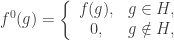
Let f be a class function on $H$. Extend f to G trivially as follows:

f^0(g)= \left\{ \begin{array}{cc} f(g),&g\in H,\\ 0, & g\notin H, \end{array} \right.

for all g\in G. This is not a class function on G in general. To remedy this, we “average over G” using conjugation: Define the function f^G=Ind_H^G(f) induced by f to be

Ind_H^G(f)(g)={1\over |H|}\sum_{x\in G} f^0(x^{-1}gx)=\sum_{x\in G/H}f^0(x^{-1}gx).

This is referred to as the Frobenius formula.

Since A is normal in G, G acts on the vector space of formal complex linear combinations of elements of A^* (=the characters of A),

V={\mathbb{C}}[A^*]=span\{\mu\ |\ \mu\in A^*\},

by

(g\mu)(a)=\mu(g^{-1}ag),\ \ \ \ \forall g\in G,\ a\in A,\ \mu\in A^*.

We may restrict this action to H, giving us a homomorphism \phi^*:H\rightarrow S_{A^*}, where S_{A^*} denotes the symmetric group of all permutations of the set A^*. This restricted action is an equivalence relation on A^* which we refer to below as the H-equivalence relation}. Let [A^*] denote the set of equivalence classes of this equivalence relation. If \mu,\mu' belong to the same equivalence class then we write

\mu'\sim \mu

(or \mu'\sim_H\mu if there is any possible ambiguity). When there is no harm, we identify each element of [A^*] with a character of A.

Suppose that H acts on A by means of the automorphism given by a homomorphism \phi:H\rightarrow S_{A}, where S_{A} denotes the symmetric group of all permutations of the set A. In this case, two characters \tau,\tau'\in A^* are equivalent if there is an element h\in H such that, for all a\in A, we have \tau'(a)=\tau(\phi(h)(a)).

For each \mu\in [A^*], let

H_{\mu}=\{h\in H\ |\ h\mu = \mu\}.

This group is called the stabilizer of \mu in H. Let

G_{\mu}=A\, >\!\!\lhd \, H_{\mu},

for each \mu\in [A^*]. There is a natural projection map

p_{\mu}:G_{\mu}\rightarrow H_{\mu}

given by ah\longmapsto h, i.e., by p_\mu(ah)=a.

Extend each character \mu\in [A^*] from H_{\mu} to G_{\mu} trivially by defining

\mu(ah)=\mu(a),

for all a\in A and h\in H_{\mu}. This defines a character \mu\in G^*_{\mu}. For each \rho\in H_{\mu}^*, say \rho:H_{\mu} \rightarrow Aut(V), let \tilde{\rho}\in G_{\mu}^* denote the representation of G_{\mu} obtained by pulling back \rho via the projection p_\mu:G_{\mu}\rightarrow H_{\mu}, i.e., define

\tilde{\rho}=\rho\circ p_{\mu}.

For each \mu \in [A^*] and \rho\in H_\mu^* as above, let

\theta_{\mu,\rho}=Ind_{G_\mu}^G(\mu\cdot \tilde{\rho}).

Finally, we can completely describe all the irreducible representations of G=A\, >\!\!\lhd \, H. (This is Proposition 25 in chapter 8 of Serre’s book.)

Theorem:

  1. For each \mu \in [A^*] and \rho\in H_\mu^*, as above, then \theta_{\mu,\rho} is an irreducible representation of G.
  2. Suppose \mu_1,\mu_2 \in [A^*], \rho_1\in H_{\mu_1}^*, \rho_2\in H_{\mu_2}^*. If \theta_{\mu_1,\rho_1}\cong  \theta_{\mu_2,\rho_2} then \mu_1\sim \mu_2 and \rho_1\cong \rho_2.
  3. If \pi is an irreducible representation of G then \pi\cong \theta_{\mu,\rho}, for some \mu \in [A^*] and \rho\in H_{\mu}^* as above.

In the next post, we will examine the special case A=C_\ell^n and H=S_n.

Splitting fields of representations of generalized symmetric groups, 2

In general, there are three types of (complex) representations of a finite group G. (A good reference for all this is Serre’s well-known book, Linear representations of finite groups.)

Let \rho:H\rightarrow Aut(W) be an n-dimensional irreducible representation of a finite group G on a complex vector space W. Let \chi denote the character of \rho.

Exactly one of the following possibilities must hold:

  • One of the values of the character \chi is not real. Such representations will be called complex (or type 1 or unitary).
  • All the values of \chi are real and \rho is realizable by a representation over a real vector space. Such representations will be called real (or type 2 or orthogonal).
  • All the values of \chi are real but \rho is not realizable by a representation over a real vector space. Such representations will be called quaternionic (or type 3 or symplectic).

Proposition (Frobenius-Schur): Let \rho:H\rightarrow Aut(W) be an irreducible representation of a finite group G on a complex vector space W with character $\chi$. Then

{1\over |G|} \sum_{g\in G}\chi(g^2)= \left\{ \begin{array}{cc} 0,&\rho\ {\rm complex},\\ 1,&\rho\ {\rm real},\\ -1,&\rho\ {\rm quaternionic}. \end{array} \right.

This quantity is sometimes called the Frobenius-Schur indicator of \rho.

It can be shown that if \rho \rho'\cong \rho are equivalent representations then \rho and \rho' have the same type.

In the next post we will examine the types that the irreducible representations of semi-direct product G=C_\ell^n\, >\!\!\lhd \, S_n fall into.