
God’s number for the Rubik’s cube in the face turn metric
This is an update to the older post.
The story is described well at cube20.org but the bottom line is that Tom Rokicki, Herbert Kociemba, Morley Davidson, and John Dethridge have established that every cube position can be solved in 20 face moves or less. The superflip is known to take 20 moves exactly (in 1995, Michael Reid established this), so 20 is best possible – or God’s number in the face turn algorithm. Google (and, earlier, Sony) contributed computer resources to do the needed massive computations. Congradulations to everyone who worked on this!
This would make a great documentary I think!
uniform matroids and MDS codes
It is known that uniform (resp. paving) matroids correspond to MDS (resp. “almost MDS” codes). This post explains this connection.
An MDS code is an ![[n,k,d]](https://s0.wp.com/latex.php?latex=%5Bn%2Ck%2Cd%5D&bg=ffffff&fg=323232&s=0&c=20201002)


Consider a linear code 



Floyd-Warshall-Roy, 3
As in the previous post, let 


The previous post discussed the following result, due to Sturmfels et al.
Theorem: The entry of the matrix A
This post discusses an implementation in Python/Sage.
Consider the following class definition.
class TropicalNumbers:
    """
    Implements the tropical semiring.

    EXAMPLES:
        sage: T = TropicalNumbers()
        sage: print T
        Tropical Semiring

    """
    def __init__(self):
        self.identity = Infinity

    def __repr__(self):
        """
        Called to compute the "official" string representation of an object.
        If at all possible, this should look like a valid Python expression
        that could be used to recreate an object with the same value.

        EXAMPLES:
            sage: TropicalNumbers()
            TropicalNumbers()

        """
        return "TropicalNumbers()"

    def __str__(self):
        """
        Called to compute the "informal" string description of an object.

        EXAMPLES:
            sage: T = TropicalNumbers()
            sage: print T
            Tropical Semiring

        """
        return "Tropical Semiring"

    def __call__(self, a):
        """
        Coerces a into the tropical semiring.

        EXAMPLES:
            sage: T(10)
            TropicalNumber(10)
            sage: print T(10)
            Tropical element 10 in Tropical Semiring
        """
        return TropicalNumber(a)

    def __contains__(self, a):
        """
        Implements "in".

        EXAMPLES:
            sage: T = TropicalNumbers()
            sage: a = T(10)
            sage: a in T
            True

        """
        if a in RR or a == Infinity:
            return a==Infinity or (RR(a) in RR)
        else:
            return a==Infinity or (RR(a.element) in RR)

class TropicalNumber:
    def __init__(self, a):
        self.element = a
        self.base_ring = TropicalNumbers()

    def __repr__(self):
        """
        Called to compute the "official" string representation of an object.
        If at all possible, this should look like a valid Python expression
        that could be used to recreate an object with the same value.

        EXAMPLES:

        """
        return "TropicalNumber(%s)"%self.element

    def __str__(self):
        """
        Called to compute the "informal" string description of an object.

        EXAMPLES:
            sage: T = TropicalNumbers()
            sage: print T(10)
            Tropical element 10 in Tropical Semiring
        """
        return "%s"%(self.number())

    def number(self):
        return self.element

    def __add__(self, other):
        """
        Implements +. Assumes both self and other are instances of
        TropicalNumber class.

        EXAMPLES:
            sage: T = TropicalNumbers()
            sage: a = T(10)
            sage: a in T
            True
            sage: b = T(15)
            sage: a+b
            10

        """
        T = TropicalNumbers()
        return T(min(self.element,other.element))

    def __mul__(self, other):
        """
        Implements multiplication *.

        EXAMPLES:
            sage: T = TropicalNumbers()
            sage: a = T(10)
            sage: a in T
            True
            sage: b = T(15)
            sage: a*b
            25
        """
        T = TropicalNumbers()
        return T(self.element+other.element)

class TropicalMatrix:
    def __init__(self, A):
        T = TropicalNumbers()
        self.base_ring = T
        self.row_dimen = len(A)
        self.column_dimen = len(A[0])
        # now we coerce the entries into T
        A0 = A
        m = self.row_dimen
        n = self.column_dimen
        for i in range(m):
            for j in range(n):
                A0[i][j] = T(A[i][j])
        self.array = A0

    def matrix(self):
        """
        Returns the entries (as ordinary numbers).

        EXAMPLES:
            sage: A = [[0,1,3,7],[2,0,1,3],[4,5,0,1],[6,3,1,0]]
            sage: AT = TropicalMatrix(A)
            sage: AT.matrix()
            [[0, 1, 3, 7], [2, 0, 1, 3], [4, 5, 0, 1], [6, 3, 1, 0]]
        """
        m = self.row_dim()
        n = self.column_dim()
        A0 = [[0 for i in range(n)] for j in range(m)]
        for i in range(m):
            for j in range(n):
                A0[i][j] = (self.array[i][j]).number()
        return A0

    def row_dim(self):
        return self.row_dimen

    def column_dim(self):
        return self.column_dimen

    def __repr__(self):
        """
        Called to compute the "official" string representation of an object.
        If at all possible, this should look like a valid Python expression
        that could be used to recreate an object with the same value.

        EXAMPLES:

        """
        return "TropicalMatrix(%s)"%self.array

    def __str__(self):
        """
        Called to compute the "informal" string description of an object.

        EXAMPLES:

        """
        return "Tropical matrix %s"%(self.matrix())

    def __add__(self, other):
        """
        Implements +. Assumes both self and other are instances of
        TropicalMatrix class.

        EXAMPLES:
            sage: A = [[1,2,Infinity],[3,Infinity,0]]
            sage: B = [[2,Infinity,1],[3,-1,1]]
            sage: AT = TropicalMatrix(A)
            sage: BT = TropicalMatrix(B)
            sage: AT
            TropicalMatrix([[TropicalNumber(1), TropicalNumber(2), TropicalNumber(+Infinity)],
              [TropicalNumber(3), TropicalNumber(+Infinity), TropicalNumber(0)]])
            sage: AT+BT
            [[TropicalNumber(1), TropicalNumber(2), TropicalNumber(1)],
             [TropicalNumber(3), TropicalNumber(-1), TropicalNumber(0)]]
        """
        A = self.array
        B = other.array
        C = []
        m = self.row_dim()
        n = self.column_dim()
        if m != other.row_dim:
            raise ValueError, "Row dimensions must be equal."
        if n != other.column_dim:
            raise ValueError, "Column dimensions must be equal."
        for i in range(m):
            row = [A[i][j]+B[i][j] for j in range(n)] # + as tropical numbers
            C.append(row)
        return C

    def __mul__(self, other):
        """
        Implements multiplication *.

        EXAMPLES:
            sage: A = [[1,2,Infinity],[3,Infinity,0]]
            sage: AT = TropicalMatrix(A)
            sage: B = [[2,Infinity],[-1,1],[Infinity,0]]
            sage: BT = TropicalMatrix(B)
            sage: AT*BT
             [[TropicalNumber(1), TropicalNumber(3)],
              [TropicalNumber(5), TropicalNumber(0)]]
            sage: A = [[0,1,3,7],[2,0,1,3],[4,5,0,1],[6,3,1,0]]
            sage: AT = TropicalMatrix(A)
            sage: A = [[0,1,3,7],[2,0,1,3],[4,5,0,1],[6,3,1,0]]
            sage: AT = TropicalMatrix(A)
            sage: print AT*AT*AT
            Tropical matrix [[0, 1, 2, 3], [2, 0, 1, 2], [4, 4, 0, 1], [5, 3, 1, 0]]
        """
        T = TropicalNumbers()
        A = self.matrix()
        B = other.matrix()
        C = []
        mA = self.row_dim()
        nA = self.column_dim()
        mB = other.row_dim()
        nB = other.column_dim()
        if nA != mB:
            raise ValueError, "Column dimension of A and row dimension of B must be equal."
        for i in range(mA):
            row = []
            for j in range(nB):
                c = T(Infinity)
                for k in range(nA):
                    c = c+T(A[i][k])*T(B[k][j])
                row.append(c.number())
            C.append(row)
        return TropicalMatrix(C)
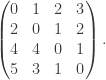
This shows that the shortest distances of digraph with adjacency matrix 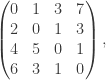
Floyd-Warshall-Roy, 2
Let 


Theorem: The entry of the matrix A
How do you compute the tropical power of a matrix? Tropical matrix arithmetic (addition and multiplication) is the obvious extension of the addition and multiplication operations on the tropical semiring. This semiring, 



At the current time, the complexity of ordinary matrix multiplication is best estimated by either Strassen’s algorithm (for practical use) or the Coppersmith-Winograd algorithm (for theoretically best known). The CW algorithm can multiply two 

Question: Do these complexity estimates extend to tropical matrix multiplication?
If so, then the complexity of computing the matrix A
In fact, these observations seem so “obvious” that the fact that Sturmfels did not mention them in two different books, makes me wonder if the above question is more difficult to answer than it seems!
Floyd-Warshall-Roy
The Floyd-Warshall-Roy algorithm is an algorithm for finding shortest paths in a weighted, directed graph. It allows for negative edge weights and detects a negative weight cycle if one exists. Assuming that there are no negative weight cycles, a single execution of the FWR algorithm will find the shortest paths between all pairs of vertices.
This algorithm is an example of dynamic programming, which allows one to break the computation down to simpler steps using some sort of recursive procedure. If 


Here is a Sage implementation
def floyd_warshall_roy(A):
    """
    Shortest paths

    INPUT:
        A - weighted adjacency matrix

    OUTPUT
        dist  - a matrix of distances of shortest paths
        paths - a matrix of shortest paths

    EXAMPLES:
        sage: A = matrix([[0,1,2,3],[0,0,2,1],[20,10,0,3],[11,12,13,0]]); A
        sage: floyd_warshall_roy(A)
        ([[0, 1, 2, 2], [12, 0, 2, 1], [14, 10, 0, 3], [11, 12, 13, 0]],
          [-1  1  2  1]
          [ 3 -1  2  3]
          [ 3 -1 -1  3]
          [-1 -1 -1 -1])
        sage: A = matrix([[0,1,2,4],[0,0,2,1],[0,0,0,5],[0,0,0,0]])
        sage: floyd_warshall_roy(A)
        ([[0, 1, 2, 2], [+Infinity, 0, 2, 1], [+Infinity, +Infinity, 0, 5],
          [+Infinity, +Infinity, +Infinity, 0]],
          [-1  1  2  1]
          [-1 -1  2  3]
          [-1 -1 -1  3]
          [-1 -1 -1 -1])
        sage: A = matrix([[0,1,2,3],[0,0,2,1],[-5,0,0,3],[1,0,1,0]]); A
        sage: floyd_warshall_roy(A)
        Traceback (click to the left of this block for traceback)
        ...
        ValueError: A negative edge weight cycle exists.
        sage: A = matrix([[0,1,2,3],[0,0,2,1],[-1/2,0,0,3],[1,0,1,0]]); A
        sage: floyd_warshall_roy(A)
        ([[0, 1, 2, 2], [3/2, 0, 2, 1], [-1/2, 1/2, 0, 3/2], [1/2, 3/2, 1, 0]],
          [-1  1  2  1]
          [ 2 -1  2  3]
          [-1  0 -1  1]
          [ 2  2 -1 -1])
    """
    G = Graph(A, format="weighted_adjacency_matrix")
    V = G.vertices()
    E = [(e[0],e[1]) for e in G.edges()]
    n = len(V)
    dist = [[0]*n for i in range(n)]
    paths = [[-1]*n for i in range(n)]
    # initialization step
    for i in range(n):
        for j in range(n):
            if (i,j) in E:
                paths[i][j] = j
            if i == j:
                dist[i][j] = 0
            elif A[i][j] != 0:
                dist[i][j] = A[i][j]
            else:
                dist[i][j] = infinity
    # iteratively finding the shortest path
    for j in range(n):
        for i in range(n):
            if i != j:
                for k in range(n):
                    if k != j:
                        if dist[i][k]>dist[i][j]+dist[j][k]:
                            paths[i][k] = V[j]
                        dist[i][k] = min(dist[i][k], dist[i][j] +dist[j][k])
    for i in range(n):
        if dist[i][i] < 0:
            raise ValueError, "A negative edge weight cycle exists."
    return dist, matrix(paths)
Sage and the future of mathematics
I am not a biologist nor a chemist, and maybe neither are you, but suppose we were. Now, if I described a procedure, in “standard” detail, to produce a result XYZ, you would (based on your reasonably expected expertise in the field), follow the steps you believe were described and either reproduce XYZ or, if I was mistaken, not be able to reproduce XYZ. This is called scientific reproducibility. It is cructial to what I believe is one of the fundamental principles of science, namely Popper’s Falsifiability Criterion.
More and more people are arguing, correctly in my opinion, that in the computational realm, in particular in mathematical research which uses computational experiments, that much higher standards are needed. The Ars Technica article linked above suggests that “it’s time for a major revision of the scientific method.” Also, Victoria Stodden argues one must “facilitate reproducibility. Without this data may be open, but will remain de facto in the ivory tower.” The argument basically is that to reproduce computational mathematical experiments is unreasonably difficult, requiring more that a reasonable expertise. These days, it may in fact (unfortunately) require purchasing very expensive software, or possessing of very sophisticated programming skills, accessibility to special hardware, or (worse) guessing parameters and programming procedures only hinted at by the researcher.
Hopefully, Sage can play the role of a standard bearer for such computational reproducibility. Sage is free, open source and there is a publically available server it runs on (sagenb.org).
What government agencies should require such reproducibility? In my opinion, all scientific funding agencies (NSF, etc) should follow these higher standards of computational accountability.
Bases of representable/vector matroids in Sage
A matroid M is specified by a set X of “points” and a collection B of “bases, where 
One way to construct a matroid, as it turns out, is to consider a matrix M with coefficients in a field F. The column vectors of M are indexed by the numbers 


How do you compute B? The following Sage code should work.
def independent_sets(mat):
    """
    Finds all independent sets in a vector matroid.

    EXAMPLES:
        sage: M = matrix(GF(2), [[1,0,0,1,1,0],[0,1,0,1,0,1],[0,0,1,0,1,1]])
        sage: M
        [1 0 0 1 1 0]
        [0 1 0 1 0 1]
        [0 0 1 0 1 1]
        sage: independent_sets(M)
        [[0, 1, 2], [], [0], [1], [0, 1], [2], [0, 2], [1, 2],
        [0, 1, 4], [4], [0, 4], [1, 4], [0, 1, 5], [5], [0, 5],
        [1, 5], [0, 2, 3], [3], [0, 3], [2, 3], [0, 2, 5], [2, 5],
        [0, 3, 4], [3, 4], [0, 3, 5], [3, 5], [0, 4, 5], [4, 5],
        [1, 2, 3], [1, 3], [1, 2, 4], [2, 4], [1, 3, 4], [1, 3, 5],
        [1, 4, 5], [2, 3, 4], [2, 3, 5], [2, 4, 5]]
        sage: M = matrix(GF(3), [[1,0,0,1,1,0],[0,1,0,1,0,1],[0,0,1,0,1,1]])
        sage: independent_sets(M)
        [[0, 1, 2], [], [0], [1], [0, 1], [2], [0, 2], [1, 2],
        [0, 1, 4], [4], [0, 4], [1, 4], [0, 1, 5], [5], [0, 5],
        [1, 5], [0, 2, 3], [3], [0, 3], [2, 3], [0, 2, 5], [2, 5],
        [0, 3, 4], [3, 4], [0, 3, 5], [3, 5], [0, 4, 5], [4, 5],
        [1, 2, 3], [1, 3], [1, 2, 4], [2, 4], [1, 3, 4], [1, 3, 5],
        [1, 4, 5], [2, 3, 4], [2, 3, 5], [2, 4, 5], [3, 4, 5]]
        sage: M345 = matrix(GF(2), [[1,1,0],[1,0,1],[0,1,1]])
        sage: M345.rank()
        2
        sage: M345 = matrix(GF(3), [[1,1,0],[1,0,1],[0,1,1]])
        sage: M345.rank()
        3
    """
    F = mat.base_ring()
    n = len(mat.columns())
    k = len(mat.rows())
    J = Combinations(n,k)
    indE = []
    for x in J:
        M = matrix([mat.column(x[0]),mat.column(x[1]),mat.column(x[2])])
        if k == M.rank():     # all indep sets of max size
            indE.append(x)
            for y in powerset(x): # all smaller indep sets
                if not(y in indE):
                    indE.append(y)
    return indE

def bases(mat, invariant = False):
    """
    Find all bases in a vector/representable matroid.

    EXAMPLES:
        sage: M = matrix(GF(2), [[1,0,0,1,1,0],[0,1,0,1,0,1],[0,0,1,0,1,1]])
        sage: bases(M)

        [[0, 1, 2],
         [0, 1, 4],
         [0, 1, 5],
         [0, 2, 3],
         [0, 2, 5],
         [0, 3, 4],
         [0, 3, 5],
         [0, 4, 5],
         [1, 2, 3],
         [1, 2, 4],
         [1, 3, 4],
         [1, 3, 5],
         [1, 4, 5],
         [2, 3, 4],
         [2, 3, 5],
         [2, 4, 5]]
        sage: L = [x[1] for x in bases(M, invariant=True)]; L.sort(); L
         [5, 16, 17, 33, 37, 44, 45, 48, 81, 84, 92, 93, 96, 112, 113, 116]
    """
    r = mat.rank()
    ind = independent_sets(mat)
    B = []
    for x in ind:
        if len(x) == r:
            B.append(x)
    B.sort()
    if invariant == True:
        B = [(b,sum([k*2^(k-1) for k in b])) for b in B]
    return B
Evil spkgs?
In Matlab, a plugin is called a “toolkit”. In Photoshop, a plugin is called a plugin:-) As the success of Photoshop and Matlab suggest, plugins are very important. They enable “third party” developers to write specialized applications for your software package.
In Sage, (www.sagemath.org) a plugin is called an “spkg” (short for Sage PacKaGe).
Here is an easy-to-follow recipe for making an evil spkg.
- Make sure that your spkg modifies and existing Python or Cython file in the Sage devel tree. Extra evil bonus points for modifying heavily used files, such as in the plot subdirectory, and the more files touched the more evil points you earn. AFAIK, this will insure that, once your “innocent” spkg is applied to a developers tree, he cannot write a trac patch which can be correctly applied to a fresh clone.
- Make sure you ruin another spkg (surreptitiously, for extra bonus points). The more important the spkg you hose, the more evil points you get.
I wonder how Matlab and Photoshop avoid evil plugins?
Google and the future of academic journals?
Let us assume that google’s basic philosophy is to make information free (see for example http://www.google.com/corporate/tenthings.html) This way they can increase the value of the internet and the value of their search technology.
What can Google do to help the problem of the inflation of academic journals? The fundamental issue is the disparity between the ease of communicating information (scientific information which is, by community consensus, free) and the relatively difficult implementation of the nature human desire to make money by selling access to that information. The basic economic model is that taxpayers are the primary support for academic research at a US class I or a European university (tuition actually only fund a minority share of the cost of running an academic institution). On the other hand, taxpayers also pay for the cost of these journals to these academic institutions. If you, a typical taxpayer, enjoy paying twice or getting double-billed, I have two bridges in Brooklyn I’d like sell you.
In case the typical taxpayer thinks this is an issue they can hide from, I warn you, some of these journals are not cheap (eg, some are on the order of a few thousand dollars per issue). Moreover, some publishers, such as Reed Elsevier not only charge a couple of grand per issue but also publishes bogus journals (see for example (http://laikaspoetnik.wordpress.com/2009/05/08/mercks-ghostwriters-haunted-papers-and-fake-elsevier-journals/) and pays for fake positive reviews (http://golem.ph.utexas.edu/category/2009/07/elsevier_pays_for_favorable_bo.html).
The solution to this dilemma is rather simple, Taxpayers must insist that their research dollars only fund research which is available for free. In other words, the results of the their funded research much be publicly available. This goes for papers and software supported by their funding.
As a matter of complete disclosure, some institutions now require that their faculty post their research papers on free web servers (for example MIT), and some funding agencies require taht thier grantees make available their grantees research papers available on such servers (for example, NIH in the US).
Can Google play a role here? I think so.
 Yet Another Mathblog
You must be logged in to post a comment.