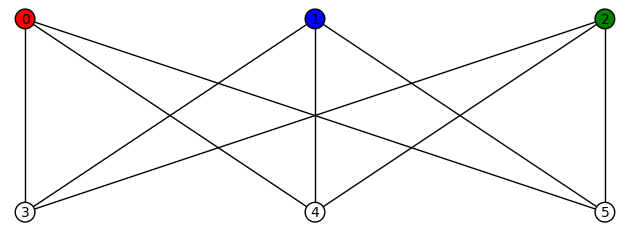
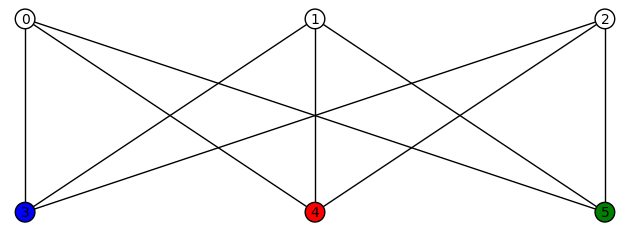
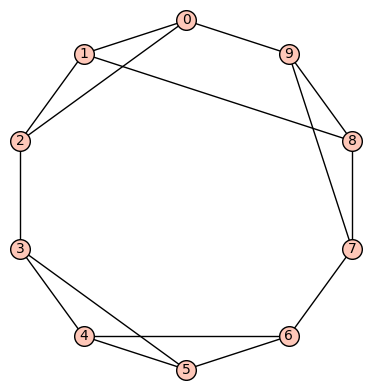
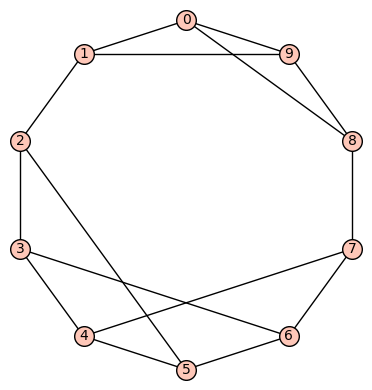
The Elevator Problem

You are on the bottom floor (floor 0, lets call it) of an apartment building with no basement. There are n elevators, which we index 1,2,…,n. Assume the elevators are on floors f1, f2, … , where fk > 0 is the floor elevator k is currently on, 1 <= k <= n. Assume you only like one of the elevators, elevator e.


The way the elevator logic works is this: When you press the elevator button, one closest to you ( = one on floor number min(fk, k>0)) is told to go to 0. If there is a tie then, of those on the same lowest floor, the elevator with the smallest index is told to go to 0.
Move: If you press the button and some other elevator than elevator e arrives, you can tell it to go to any floor you wish.
Taboo: You can press the elevator button if and only if no elevator is moving down.
Goal: You want to use elevator e (for some fixed e=1, 2, …, n).

Problem: Is there a finite sequence of moves that allows you to ride in elevator e?

My plan is to post the answer sometime later, but have fun with it!

In the works: a book “Exploring Graphs via Harmonic Morphisms”

Caroline Melles and I have been working for some years on a 2-volume book in graph theory which investigates harmonic morphisms. These are, roughly speaking, mappings from one graph to another that preserve locally harmonic functions on these graphs. Therefore, this topic fits into the general framework of harmonic analysis on graphs.

This post only concerns the first volume. The intent here is to mention some of the types of results we obtain. Of course, by no means is it intended to be a complete description.

The second volume will be summarized in a separate post.

Graphs in our book are unweighted and, unless stated otherwise, have no loops or multiple edges. The basic idea is this: in chapter 2 we classify harmonic morphisms using a criteria expressed as a matrix identity. For various graph-theoretical constructions (such as edge deletion or join or a graph product or …) that can be performed on a given graph Gamma, we pick a graph morphism associated to the construction (such as sending a vertex in the constructed graph to the given graph). That morphism is associated to a matrix (which we called the vertex map matrix in chapter 3 of our earlier book, Adventures in Graph Theory). When this matrix satisfies the above-mentioned matrix criteria then the associated morphism is harmonic.

Chapter 1 is on Graph Morphisms.

This chapter is devoted to background on graph morphisms and some of the methods we use to study them.

  1. Roughly speaking, a morphism is a mapping between graphs that preserves incidence structure. After defining horizontal and vertical edges, vertical multiplicities, local horizontal multiplicities, it recalls well-known graph families like cycle graphs, path graphs, and complete graphs.
  2. There are a few very useful degree identities. First, there is a fundamental formula relating vertex degrees to multiplicities under morphisms. There is also a formula for the degree
    of the morphism in terms of vertical multiplicities and local horizontal multiplicities.
  3. A topic threading through the book is that of matrix-theoretic methods. This first chapter introduces vertex map matrices and edge map matrices that encode morphisms. After establishing key matrix identities and products, reviews adjacency matrices and their spectra, with detailed analysis of cycle graph eigenvalues using Chebyshev polynomials and complex roots of unity.
  4. It recalls signed and unsigned incidence matrices, with and without edge orientations, and establishes the fundamental Graph Homomorphism Identity relating incidence matrices to morphism matrices,
  5. introduces Laplacian matrices as differences of degree and adjacency matrices, connecting to the incidence matrix framework.
  6. Introduced graph blowup morphisms via a blowup construction where vertices are replaced by independent sets, creating natural homomorphisms with specific structural properties.
  7. Some functorial properties of graph morphisms are established, such as how morphisms behave under graph constructions like subdivisions, smoothing, deletions, and substitutions.
  8. The chapter ends with exercises and a chapter summary.

Chapter 2 on Harmonic Morphisms

    This chapter is devoted to the basics of harmonic morphisms.
  1. Introduces the core definition: a graph morphism is harmonic if local horizontal multiplicities are constant across edges incident to each vertex’s image.
  2. Cycle space and cocycle space – Develops the algebraic framework using homology and cohomology of graphs. Covers Urakawa’s theorem on pullbacks of harmonic 1-forms and Baker-Norin results on divisors and Jacobians.
  3. Matrix-theoretic methods – Establishes the fundamental matrix characterization: a morphism is harmonic iff there exists a diagonal multiplicity matrix satisfying specific adjacency matrix identities. Proves equivalence with an analogous Laplacian matrix identity and an analogous incidence matrix criteria.
  4. The Riemann-Hurwitz formula – Presents the graph-theoretic analogue relating genera of graphs via harmonic morphisms, with matrix proof and applications to regular graphs.
  5. Some functorial consequences – Demonstrates how harmonic morphisms interact with graph constructions like subdivision, edge substitution, leaf addition, and deletion. Shows these
    operations preserve harmonicity under appropriate conditions.
  6. The chapter ends with exercises and a chapter summary.

All harmonic morphisms from this graph to C4 are covers.

  1. Fundamental Problem: Given a graph Gamma1, for which graphs Gamma2 is there a non-trivial harmonic morphism phi from Gamma2 to Gamma1?
  1. Follow-up question: Can the number of such phi be counted?

Chapter 3 on Counting Problems

This chapter looks at various families, such as the path graphs. What is especially remarkable is that, as we will see, the problem of counting harmonic morphisms often boils down to solving certain recurrance relations, some of which arose (in a completely different context of course) in
the work of medieval mathematicians, both in Europe and in India.

  1. Regarding harmonic morphisms between path graphs, we show how to construct and count the harmonic morphisms from longer path graphs to shorter ones.
  2. Regarding harmonic morphisms between cycle graphs, we show how to construct and count the harmonic morphisms from larger cycle graphs (when they exist) to smaller ones. It turns out all such harmonic morphisms are necessarily covers.
  3. Regarding harmonic morphisms between complete graphs, we show how to construct and count the harmonic morphisms from larger complete graphs (when they exist) to smaller ones.
  4. Harmonic morphisms to P2 (arising from the Baker-Norin Theorem) can be counted.
  5. Harmonic morphisms to P3 (the path graph with only 3 vertices) can be counted in special cases.
    There are lots of open questions, such as which trees have a harmonic morphism to P3.
  6. The chapter ends with exercises and a chapter summary.

Chapter 4 on Harmonic Quotient Morphisms

    This chapter studies quotient graphs arising from group actions and from vertex partitions.
  1. Quotient graphs from group actions. Harmonic actions and transitive actions are studied separately.
  2. Quotient graphs from paritions. Orbit partitions and equitable partitions are studied.
  3. As a nice application of harmonic morphisms with particularly nice structural properties, we consider multicovers and blowup graphs.
  4. The last section provides explicit formulas for the eigenvalue spectra of harmonic blowups of bipartite graphs, connecting the eigenvalues of the source and target graphs through the blowup parameters. The main result is the Godsil-McKay Theorem.
  5. The chapter ends with exercises and a chapter summary.

Chapter 5 on Graph Morphisms and Graph Products

    This chapter studies graph morphisms associated to tensor products of graphs and lexicographical products of graphs.

    Roughly speaking, a graph product of Gamma1 with Gamma2 is a graph Gamma3 = (V3, E3), where V3 = V1 x V2 is the Cartesian product and there is a rule for the edges E3 based on some conditions on the vertices. The graph products considered in this book are the disjunctive, Cartesian, tensor, lexicographic, and the strong products.

    The most basic questions one wants answered are these:
    is the projection pr1 : Gamma1 x Gamma2 to Gamma1 harmonic, and
    is the projection pr2 : Gamma1 x Gamma2 to Gamma2 harmonic?
    If they do turn out to be harmonic morphisms, we also want to know the vertical and horizontal multiplicities as well. If they do not turn out to be harmonic morphisms, we also want (if possible) to establish conditions on the graphs under which the projections are harmonic.

    However, we want to not only consider products of graphs but also products of morphisms.
    In this case, the most basic question one wants answered is this:
    Given harmonic morphisms phi : Gamma2 to Gamma1 and phi’ : Gamma2′ to Gamma1′, is the
    product phi x phi’ harmonic?

  1. For example, we show that projection morphisms from tensor products are always harmonic with explicit horizontal multiplicity formulas.
  2. Moreover, we prove that the tensor product of harmonic morphisms (without vertical edges) yields a harmonic morphism with horizontal multiplicity matrix given by the Kronecker product of the original multiplicity matrices.
  3. If Gamma x Gamma’ is a lexicographical product then the projection onto the first factor, pr1, is a harmonic morphism. However, the projection onto the second factor is not in general.
  4. We establish a connection between the balanced blowup graph and a lexicographical product. One corollary of this connection is that the blowdown graph agrees with the first projection of the product, so is a harmonic morphism.

Chapter 6 on More Products and Constructions

  1. This chapter studies graph morphisms associated to Cartesian/strong/disjunctive products of graphs as well as joins and NEPS graphs.
  2. For example, we show that projection morphisms from Cartesian products or from strong products are always harmonic with explicit horizontal multiplicity formulas.
  3. Roughly speaking, one of the results states:
    Given two m-quasi-multicovers phi from Gamma2 to Gamma1 and phi’ from Gamma2′ to Gamma1′, the Cartesian product phi x phi’ is also an m-quasi-multicover (hence harmonic).
  4. Another result, roughly speaking, states:
    Given two harmonic morphisms phi from Gamma2 to Gamma1 and phi’ from Gamma2′ to Gamma1′, the
    strong product phi x phi’ is also harmonic.
  5. Can one classify the graphs for which the disjunctive product projections pr1 or pr2 are graph morphisms?
  6. For example, we show that if phi from Gamma2 to Gamma1 and phi’ from Gamma2′ to Gamma1′ are graph morphisms, then the associated product map from Gamma2 x Gamma2′ to Gamma1 x Gamma1′ (where x is the disjunctive product) is, in general, not a graph morphism.
  7. Given two harmonic morphisms phi from Gamma2 to Gamma1 and phi’ from Gamma2′ to Gamma1′, the join morphism phi wedge phi’ is harmonic if and only if a certain technical condition is true.
  8. A theorem due to Urakawa states that projection morphisms from a NEPS graph to one
    of its factors are always harmonic. Moreover, we give explicit horizontal multiplicity formulas.
  9. The chapter ends with exercises and a chapter summary.

Computations are supported throughout using SageMath and Mathematica. The plan is the publish the volume with Birkhauser. We thank the editors there, especially John Benedetto, for their encouragement and guidance.

A simple trace formula for graphs

Let \Gamma=(V,E) be a simple, connected graph with vertices V={0,1,\dots, n-1} and n\times n adjacency matrix A. We start with the geometric series identity

\frac{1}{I-tA} = \sum_{\ell=0}^\infty t^\ell A^\ell,
where I=I_n is the n\times n identity matrix. Let P denote the orthonormal matrix of normalized eigenvectors, so that

PAP^{-1} = D_\Gamma, D_\Gamma = {diag}(\lambda_1,\dots,\lambda_n),
where diag(…) denotes the diagonal matrix with the given entries on the diagonal. Let the multi-set

Spec(\Gamma)={\lambda_0,\lambda_1\dots,\lambda_{n-1}}
denote the spectrum of \Gamma.

We can conjugate the above equation by P to write

\frac{1}{I-tD_\Gamma}= P\cdot [\sum_{\ell=0}^\infty t^\ell A^\ell]\cdot P^{-1}.
Taking the trace of each side gives

\sum_{j=0}^{n-1} \frac{1}{I-t\lambda_j} = \sum_{\ell=0}^\infty t^\ell tr(A^\ell).
If \Gamma has no eigenvalues equal to 0 (i.e., A is non-singular) then we may also write this as

\sum_{j=0}^{n-1} \frac{\lambda_j^{-1}}{\lambda_j^{-1}-t} = \sum_{\ell=0}^\infty t^\ell tr(A^\ell).

If we multiply both sides of the above equation by a fixed f\in C_c^\infty({\mathbb{R}})
and integrate over t in {\mathbb{R}}, we get,

\sum_{j=0}^{n-1} \lambda_j^{-1}H(f)(\lambda_j^{-1}) = {\frac{1}{\pi}}\sum_{\ell=0}^\infty tr(A^\ell) [M(f)(\ell+1)+(-1)^\ell M(f^*)(\ell+1)],
where H denotes the Hilbert transform

H(f)(z) = \frac{1}{\pi}P.V.\int_{-\infty}^\infty \frac{f(t)}{z-t}\, dt, and M is the Mellin transform

M(f)(z) = \int_{0}^\infty t^{z-1}f(t)\, dt,
and where f^* denotes the negation, f^*(t)=f(-t). Of course, if f is even then M(f)(\ell+1) = M(f^*)(\ell+1), for all \ell.

Note that tr(A^\ell) can be expressed in terms of the number of walks on the graph: If \Gamma is a connected graph and W_\ell=W_\ell(\Gamma) denotes the total number of walks of length \ell on \Gamma then

W_\ell = {\rm tr}(A^\ell)=\sum_{\lambda\in Spec(\Gamma)} \lambda^\ell.

Another mathematician visits the ballpark – WHIP

This is the second in the series of blog posts inspired by the 2004 Ken Ross book entitled A Mathematician at the Ballpark. The first one is here. In this post, again, we illustrate all these notions using the Baltimore Orioles’ 2022 season.

For an experienced baseball fan, baseball is a game of patterns. We “know” what a well-executed pitch looks like, how a double play is to be executed, how a pop-up is to be fielded, and so on. Because of these expected patterns, we know the plays which should emerge and so the desire to track their occurrences should come as no surprise. It’s been done since professional baseball started in the 1870s.
This week we discuss a pitching statistic you see on televised games, WHIP. WHIP is short for “walks plus hits allowed per innings pitched”.

Earned run average

We start off with the most basic pitching statistic, the Earned Run Average or ERA. This is the number of earned runs per 9 innings pitched:

ERA = 9·ER/IP,

where 

  • IP, the number of Innings Pitched,
  • ER, the number of Earned Runs allowed by the pitcher. That is, it counts the number of runs enabled by the offensive team’s production in the face of competent play from the defensive team.

It is possible to have ERA = ∞, since innings are measured by the number of outs achieved (so if the pitcher doesn’t get any batters out, his IP=0). The lower the ERA the better the pitcher. In the 2022 season, right-handed Félix Bautista, who entered late innings as either a closer or a reliever, had an ERA of 2.19. Left-handed closer Cionel Pérez had an ERA of 1.40.

WHIP

We define walks plus hits allowed per innings pitched by:

WHIP = (BB+H)/IP,

where (as in the previous post) BB is the number of walks and H stands for the number of Hits allowed by the pitcher (so, for example, reaching base due to a fielding error doesn’t count). WHIP reflects a pitcher’s propensity for allowing batters to reach base, therefore a lower WHIP indicates better performance.

When we plot the ERA vs the WHIP for the top 20 Orioles pitchers in 2022, we get 

Again, the line shown is the line that best fits the data. As the line of best fit doesn’t fit the date too well, this tells us that these two statistical measurements aren’t too well-correlated. In other words, low ERA indicates a good pitcher and low WHIP indicates a good pitcher, but the values for “average” pitchers seem less related to each other.

Another mathematician visits the ballpark – OPS

Yes, I more-or-less stole the above title from the 2004 Ken Ross book entitled A Mathematician at the Ballpark. Like that book, anyone familiar with middle-school (or junior high school) math, should have no problem with most of what we do here. However, I will try to go into baseball in more detail than the book did.

Paraphrasing slightly, I read somewhere the following facetious remark:

From a survey of 1000 random baseball fans 

across the nation,  183% of them hate math. 

If you are one of these 183%, then this series could be for you. Hopefully, even if you aren’t a baseball expert, but you would like to learn some baseball statistics, (now often called “sabermetrics”), these posts will help. I’m no expert myself, so we’ll learn together.

In this series of blog posts, each post will introduce a particular metric in baseball statistics as well as some of the math and baseball behind it. We illustrate all these notions using the Baltimore Orioles’ 2022 season.

This week we look at one of the most popular statistics you see on televised games: OPS or “On-base Plus Slugging,” which is short for on-base percentage plus slugging percentage. Don’t worry, we’ll explain all these terms as we go. 

On-base percentage

First, On-Base Percentage or OBP is a more recent version of On-Base Average or OBA (the same as OBP but the SF term is omitted). We define 

OBP = (H + BB + HBP)/(AB + BB + HBP + SF), 

where 

  • H is the number of Hits (the times the batter reaches base because of a batted, fair ball without error by the defense), 
  • BB is the number of Base-on-Balls (or walks), where a batter receives four pitches that the umpire calls balls, and is in turn awarded first base,
  • HBP, or Hit By Pitch, counts the times this hitter is touched by a pitch and awarded first base as a result, and 
  • SF is the number of Sacrifice Flies and AB the number of At-Bats, which are more complicated to carefully define.

The official scorer keeps track of all these numbers, and more, as the baseball game is played. We still have to define the expressions AB and SF.

First, SF, or Sacrifice Flies, counts the number of fly balls hit to the outfield for which both of the following are true:

  • this fly is caught for an out, and a baserunner scores after the catch (so there must be at most one hit at the time),
  • the fly is dropped, and a runner scores, if in the scorer’s judgment the runner could have scored after the catch had the fly ball been caught.

A sacrifice fly is only credited if a runner scores on the play. (By the way, this is a “recent” statistic, as they weren’t tabulated before 1954. Between 1876, when the major league baseball national league was born, and 1954 baseball analysts used the OBA instead.)

Second, AB, or At-Bats, counts those plate appearances that are not one of the following:

  • A walk,
  • being hit by a pitch,
  • a bunt (or Sacrifice Hit, SH),
  • a sacrifice fly,
  • interference (the catcher hitting the bat with his glove, for example), or
  • an obstruction (by the first baseman blocking the base path, for example).

Incidentally, the self-explanatory number Plate Appearances, or PA, can differ from AB by as much as 10%, mostly due to the number of walks that a batter can draw.

The main terms in the OBP expression are H and AB. So we naturally expect OBP to be approximately equal to the Batting Average, defined by

BA = H/AB,

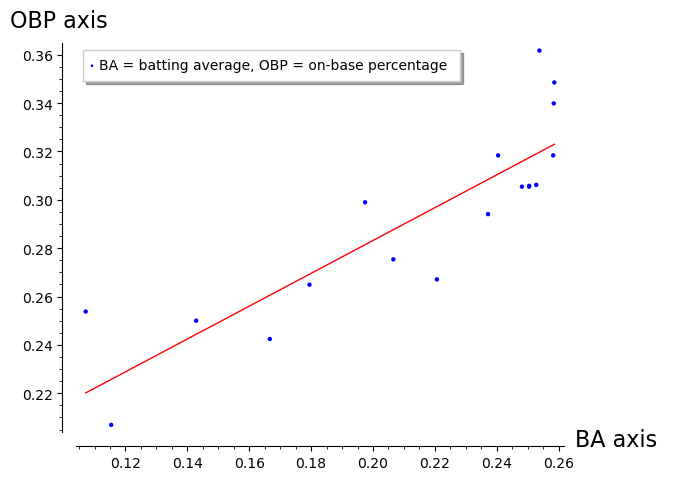
For example, if we take the top 18 Orioles players and plot the BA vs the OBP, we get the following graph:

The line shown above is simply the line of best fit to visually indicate the correlation.

Example: As an example, let’s look at the Orioles’ All-Star center fielder,  Curtis Mullins, who had 672 plate appearances and 608 at bats, for a difference of 672 − 608 = 64. He had 1 bunt, 5 sacrifice flies, he was hit by a pitch 9 times, and walked 47 times. These add up to 62, so (using the above definition of AB) the number of times he was awarded 1st base due to interference or obstruction was 64 − 62 = 2.

Mullins’ H = 157 hits break down into 105 singles, 32 doubles, 4 triples, and 16 home runs.

Second, let’s add to these his 126 strikeouts, for a total of 157+126+64 = 347.

The remaining 608 − 347 = 261 plate appearances were pitches hit by Mullins, but either caught on the fly but a fielder or the ball landed fair and Mullins was thrown out at a base.

These account for all of Mullins’ plate appearances. Mullins has a batting average of BA = 157/608 = 0.258 and an on-base percentage of OBP = 0.318.

Slugging percentage

The slugging percentage, SLG, (SLuGging) is the total bases achieved on hits divided by at-bats:

SLG = TB/AB.

Here, TB or Total Bases, is the weighted sum

TB = 1B + 2*2B + 3*3B + 4*HR,

where

  • 1B is the number of “singles” (hits where the batter makes it to 1st Base),
  • 2B is the number of doubles,
  • 3B is the number of triples, and
  • HR denotes the number of Home Runs.

On-base Plus Slugging

With all these definitions under own belt, finally we are ready to compute “on-base plus slugging”, that is the on-base percentage plus slugging percentage:

OPS = OBP + SLG.

Example: Again, let’s consider Curtis Mullins. He had 1B = 105 singles, 2B = 32 doubles, 3B = 4 triples, and HR = 16 home runs, so his TB = 105+64+12+64 = 245. Therefore, his SLG = 245/608 = 0.403, so his on-base plus slugging is OPS = OBP + SLG = 0.318 + 0.403 = 0.721.

This finishes our discussion of OPS. I hope this helps explain it better. For more, see the OPS page at the MLB site or the wikipedia page for OPS

A table of small quartic graphs

This page is modeled after the handy wikipedia page Table of simple cubic graphs of “small” connected 3-regular graphs, where by small I mean at most 11 vertices.

These graphs are obtained using the SageMath command graphs(n, [4]*n), where n = 5,6,7,… .

5 vertices: Let V=\{0,1,2,3,4\} denote the vertex set. There is (up to isomorphism) exactly one 4-regular connected graphs on 5 vertices. By Ore’s Theorem, this graph is Hamiltonian. By Euler’s Theorem, it is Eulerian.
4reg5a: The only such 4-regular graph is the complete graph \Gamma = K_5.
graph4reg5
We have

  • diameter = 1
  • girth = 3
  • If G denotes the automorphism group then G has cardinality 120 and is generated by (3,4), (2,3), (1,2), (0,1). (In this case, clearly, G = S_5.)
  • edge set: \{(0, 1), (0, 2), (0, 3), (0, 4), (1, 2), (1, 3), (1, 4), (2, 3), (2, 4), (3, 4)\}

6 vertices: Let V=\{0,1,\dots, 5\} denote the vertex set. There is (up to isomorphism) exactly one 4-regular connected graphs on 6 vertices. By Ore’s Theorem, this graph is Hamiltonian. By Euler’s Theorem, it is Eulerian.
4reg6a: The first (and only) such 4-regular graph is the graph \Gamma having edge set: \{(0, 1), (0, 2), (0, 4), (0, 5), (1, 2), (1, 3), (1, 4), (2, 3), (2, 5), (3, 4), (3, 5), (4, 5)\}.
graph4reg6
We have

  • diameter = 2
  • girth = 3
  • If G denotes the automorphism group then G has cardinality 48 and is generated by (2,4), (1,2)(4,5), (0,1)(3,5).

7 vertices: Let V=\{0,1,\dots, 6\} denote the vertex set. There are (up to isomorphism) exactly 2 4-regular connected graphs on 7 vertices. By Ore’s Theorem, these graphs are Hamiltonian. By Euler’s Theorem, they are Eulerian.
4reg7a: The 1st such 4-regular graph is the graph \Gamma having edge set: \{(0, 1), (0, 3), (0, 5), (0, 6), (1, 2), (1, 3), (1, 5), (2, 3), (2, 4), (2, 6), (3, 4), (4, 5), (4, 6), (5, 6)\}. This is an Eulerian, Hamiltonian (by Ore’s Theorem), vertex transitive (but not edge transitive) graph.
graph4reg7a
We have

  • diameter = 2
  • girth = 3
  • If G denotes the automorphism group then G has cardinality 14 and is generated by (1,5)(2,4)(3,6), (0,1,3,2,4,6,5).

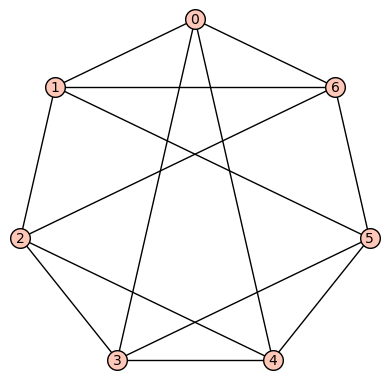
4reg7b: The 2nd such 4-regular graph is the graph \Gamma having edge set: \{(0, 1), (0, 3), (0, 4), (0, 6), (1, 2), (1, 5), (1, 6), (2, 3), (2, 4), (2, 6), (3, 4), (3, 5), (4, 5), (5, 6)\}. This is an Eulerian, Hamiltonian graph (by Ore’s Theorem) which is neither vertex transitive nor edge transitive.
graph4reg7b
We have

  • diameter = 2
  • girth = 3
  • If G denotes the automorphism group then G has cardinality 48 and is generated by (3,4), (2,5), (1,3)(4,6), (0,2)

8 vertices: Let V=\{0,1,\dots, 7\} denote the vertex set. There are (up to isomorphism) exactly six 4-regular connected graphs on 8 vertices. By Ore’s Theorem, these graphs are Hamiltonian. By Euler’s Theorem, they are Eulerian.
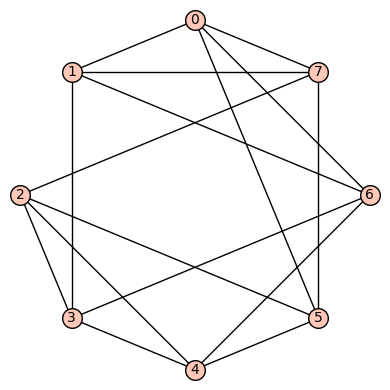
4reg8a: The 1st such 4-regular graph is the graph \Gamma having edge set: \{(0, 1), (0, 5), (0, 6), (0, 7), (1, 3), (1, 6), (1, 7), (2, 3), (2, 4), (2, 5), (2, 7), (3, 4), (3, 6), (4, 5), (4, 6), (5, 7)\}. This is vertex transitive but not edge transitive.
graph4reg8a
We have

  • diameter = 2
  • girth = 3
  • If G denotes the automorphism group then G has cardinality 16 and is generated by (1,7)(2,3)(5,6) and (0,1)(2,4)(3,5)(6,7).

4reg8b: The 2nd such 4-regular graph is the graph \Gamma having edge set: \{(0, 1), (0, 5), (0, 6), (0, 7), (1, 3), (1, 6), (1, 7), (2, 3), (2, 4), (2, 5), (2, 7), (3, 4), (3, 6), (4, 5), (4, 6), (5, 7)\}. This is a vertex transitive (but not edge transitive) graph.
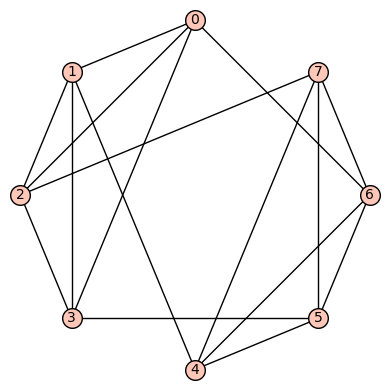
graph4reg8b
We have

  • diameter = 2
  • girth = 3
  • If G denotes the automorphism group then G has cardinality 48 and is generated by (2,3)(5,7), (1,3)(4,5), (0,1,3)(4,5,6), (0,4)(1,6)(2,5)(3,7).

4reg8c: The 3rd such 4-regular graph is the graph \Gamma having edge set: \{(0, 1), (0, 2), (0, 5), (0, 6), (1, 3), (1, 4), (1, 7), (2, 3), (2, 4), (2, 7), (3, 5), (3, 6), (4, 5), (4, 6), (5, 7), (6, 7)\}. This is a strongly regular (with “trivial” parameters (8, 4, 0, 4)), vertex transitive, edge transitive graph.
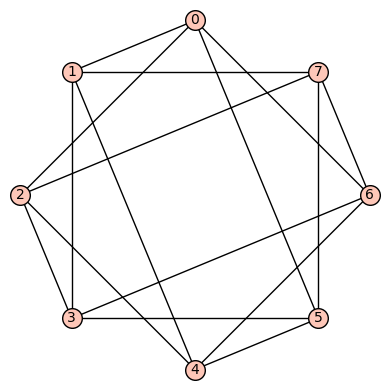
graph4reg8c
We have

  • diameter = 2
  • girth = 4
  • If G denotes the automorphism group then G has cardinality 1152=2^7\cdot 3^2 and is generated by (5,6), (4,7), (3,4), (2,5), (1,2), (0,1)(2,3)(4,5)(6,7).

4reg8d: The 4th such 4-regular graph is the graph \Gamma having edge set: \{(0, 1), (0, 2), (0, 4), (0, 6), (1, 3), (1, 5), (1, 6), (2, 3), (2, 5), (2, 7), (3, 4), (3, 7), (4, 5), (4, 6), (5, 7), (6, 7)\}. This graph is not vertex transitive, nor edge transitive.
graph4reg8d
We have

  • diameter = 2
  • girth = 3
  • If G denotes the automorphism group then G has cardinality 16 and is generated by (3,5), (1,4), (0,2)(1,3)(4,5)(6,7), (0,6)(2,7).

4reg8e: The 5th such 4-regular graph is the graph \Gamma having edge set: \{(0, 1), (0, 2), (0, 6), (0, 7), (1, 3), (1, 4), (1, 5), (2, 3), (2, 4), (2, 7), (3, 5), (3, 7), (4, 5), (4, 6), (5, 6), (6, 7)\}. This graph is not vertex transitive, nor edge transitive.
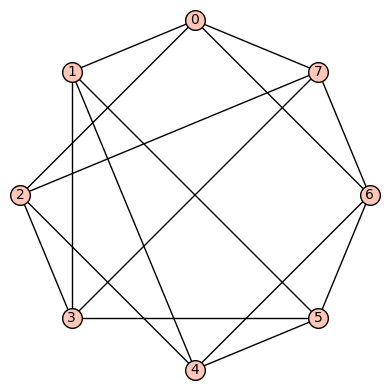
graph4reg8e
We have

  • diameter = 2
  • girth = 3
  • If G denotes the automorphism group then G has cardinality 4 and is generated by (0,1)(2,4)(3,6)(5,7), (0,2)(1,4)(3,6).

4reg8f: The 6th (and last) such 4-regular graph is the bipartite graph \Gamma=K_{4,4} having edge set: \{(0, 1), (0, 2), (0, 6), (0, 7), (1, 2), (1, 3), (1, 4), (2, 3), (2, 4), (3, 5), (3, 7), (4, 5), (4, 6), (5, 6), (5, 7), (6, 7)\}. This graph is not vertex transitive, nor edge transitive.
graph4reg8f
We have

  • diameter = 2
  • girth = 3
  • If G denotes the automorphism group then G has cardinality 12 and is generated by (3,4)(6,7), (1,2), (0,3)(5,6).

9 vertices: Let V=\{0,1,\dots, 8\} denote the vertex set. There are (up to isomorphism) exactly 16 4-regular connected graphs on 9 vertices. Perhaps the most interesting of these is the strongly regular graph with parameters (9, 4, 1, 2) (also distance regular, as well as vertex- and edge-transitive). It has an automorphism group of cardinality 72, and is referred to as d4reg9-14 below.

Without going into details, it is possible to theoretically prove that there are no harmonic morphisms from any of these graphs to either the cycle graph C_4 or the complete graph K_4. However, both d4reg9-3 and d4reg9-14 not only have harmonic morphisms to C_3, they each may be regarded as a multicover of C_3.

d4reg9-1
Gamma edges: E1 = [(0, 1), (0, 2), (0, 7), (0, 8), (1, 2), (1, 3), (1, 7), (2, 3), (2, 8), (3, 4), (3, 5), (4, 5), (4, 6), (4, 8), (5, 6), (5, 7), (6, 7), (6, 8)] 
diameter:  2 
girth:  3 
is connected:  True 
aut gp size:  12 
aut gp gens:  [(1,2)(4,5)(7,8), (0,1)(3,8)(5,6), (0,4)(1,5)(2,6)(3,7)] 

d4reg9_1

d4reg9-2 
Gamma edges: E1 = [(0, 1), (0, 3), (0, 7), (0, 8), (1, 2), (1, 3), (1, 7), (2, 3), (2, 5), (2, 8), (3, 4), (4, 5), (4, 6), (4, 8), (5, 6), (5, 7), (6, 7), (6, 8)] 
diameter:  2 
girth:  3 
is connected:  True 
aut gp size:  2 
aut gp gens:  [(0,5)(1,6)(2,8)(3,4)] 

d4reg9_2

d4reg9-3 
Gamma edges: E1 = [(0, 1), (0, 2), (0, 7), (0, 8), (1, 2), (1, 3), (1, 4), (2, 3), (2, 8), (3, 4), (3, 5), (4, 5), (4, 6), (5, 6), (5, 7), (6, 7), (6, 8), (7, 8)] 
diameter:  2 
girth:  3 
is connected:  True 
aut gp size:  18 
aut gp gens:  [(1,7)(2,8)(3,6)(4,5), (0,1,4,6,8,2,3,5,7)] 

d4reg9_3

d4reg9-4 
Gamma edges: E1 = [(0, 1), (0, 5), (0, 7), (0, 8), (1, 2), (1, 4), (1, 7), (2, 3), (2, 4), (2, 5), (3, 4), (3, 6), (3, 8), (4, 5), (5, 6), (6, 7), (6, 8), (7, 8)] 
diameter:  2 
girth:  3 
is connected:  True 
aut gp size:  4 
aut gp gens:  [(2,4), (0,6)(1,3)(7,8)] 
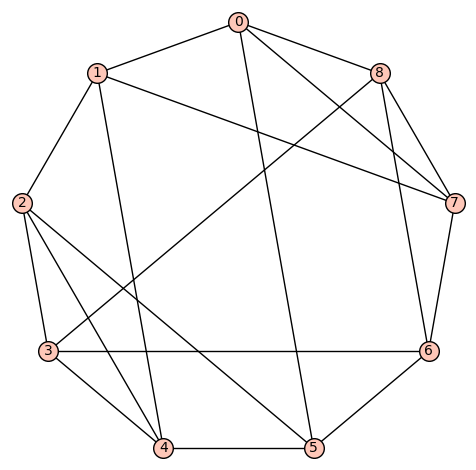
d4reg9_4

d4reg9-5 
Gamma edges: E1 = [(0, 1), (0, 3), (0, 5), (0, 8), (1, 2), (1, 4), (1, 7), (2, 3), (2, 5), (2, 7), (3, 4), (3, 8), (4, 5), (4, 6), (5, 6), (6, 7), (6, 8), (7, 8)] 
diameter:  2 
girth:  3 
is connected:  True 
aut gp size:  12 
aut gp gens:  [(1,5)(2,4)(6,7), (0,1)(2,3)(4,5)(7,8)] 

d4reg9_5

d4reg9-6 
Gamma edges: E1 = [(0, 1), (0, 3), (0, 7), (0, 8), (1, 2), (1, 5), (1, 6), (2, 3), (2, 5), (2, 6), (3, 4), (3, 8), (4, 5), (4, 7), (4, 8), (5, 6), (6, 7), (7, 8)] 
diameter:  2 
girth:  3 
is connected:  True 
aut gp size:  8 
aut gp gens:  [(2,6)(3,7), (0,3)(1,2)(4,7)(5,6)] 

d4reg9_6

d4reg9-7 
Gamma edges: E1 = [(0, 1), (0, 3), (0, 4), (0, 8), (1, 2), (1, 3), (1, 6), (2, 3), (2, 5), (2, 7), (3, 4), (4, 5), (4, 8), (5, 6), (5, 7), (6, 7), (6, 8), (7, 8)] 
diameter:  2 
girth:  3 
is connected:  True 
aut gp size:  2 
aut gp gens:  [(0,3)(1,4)(2,8)(5,6)] 

d4reg9_7

d4reg9-8 
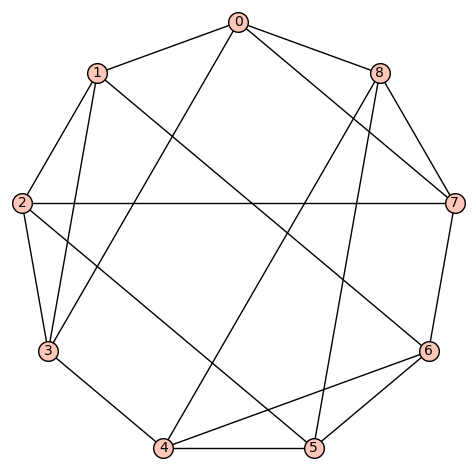
Gamma edges: E1 = [(0, 1), (0, 3), (0, 7), (0, 8), (1, 2), (1, 3), (1, 6), (2, 3), (2, 5), (2, 7), (3, 4), (4, 5), (4, 6), (4, 8), (5, 6), (5, 8), (6, 7), (7, 8)] 
diameter:  2 
girth:  3 
is connected:  True 
aut gp size:  2 
aut gp gens:  [(0,8)(1,5)(2,6)(3,4)] 
d4reg9_8

d4reg9-9 
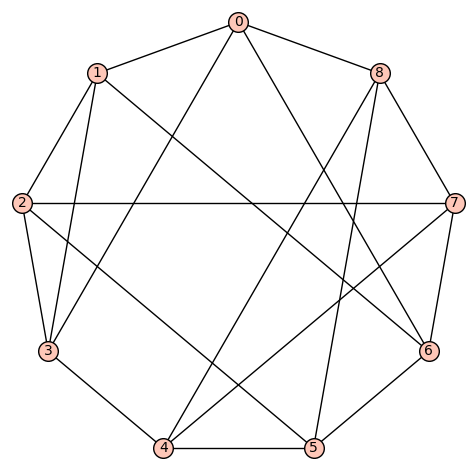
Gamma edges: E1 = [(0, 1), (0, 3), (0, 6), (0, 8), (1, 2), (1, 3), (1, 6), (2, 3), (2, 5), (2, 7), (3, 4), (4, 5), (4, 7), (4, 8), (5, 6), (5, 8), (6, 7), (7, 8)] 
diameter:  2 
girth:  3 
is connected:  True 
aut gp size:  4 
aut gp gens:  [(5,7), (0,3)(2,6)(4,8)] 
d4reg9_9

d4reg9-10 
Gamma edges: E1 = [(0, 1), (0, 3), (0, 5), (0, 8), (1, 2), (1, 4), (1, 6), (2, 3), (2, 5), (2, 7), (3, 4), (3, 7), (4, 5), (4, 8), (5, 6), (6, 7), (6, 8), (7, 8)] 
diameter:  2 
girth:  3 
is connected:  True 
aut gp size:  16 
aut gp gens:  [(2,6)(3,8), (1,5), (0,1)(2,3)(4,5)(6,8)] 

d4reg9_10

d4reg9-11 
Gamma edges: E1 = [(0, 1), (0, 3), (0, 7), (0, 8), (1, 2), (1, 4), (1, 6), (2, 3), (2, 5), (2, 7), (3, 4), (3, 5), (4, 5), (4, 8), (5, 6), (6, 7), (6, 8), (7, 8)] 
diameter:  2 
girth:  3 
is connected:  True 
aut gp size:  8 
aut gp gens:  [(2,4)(7,8), (0,2)(3,7)(4,6)(5,8)] 

d4reg9_11

d4reg9-12 
Gamma edges: E1 = [(0, 1), (0, 3), (0, 6), (0, 8), (1, 2), (1, 4), (1, 6), (2, 3), (2, 5), (2, 7), (3, 4), (3, 7), (4, 5), (4, 8), (5, 6), (5, 8), (6, 7), (7, 8)] 
diameter:  2 
girth:  3 
is connected:  True 
aut gp size:  18 
aut gp gens:  [(1,6)(2,5)(3,8)(4,7), (0,1,6)(2,7,3)(4,5,8), (0,2)(1,3)(5,8(6,7)] 

d4reg9_12

d4reg9-13 
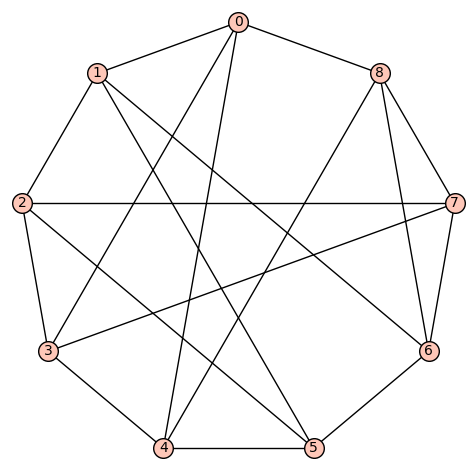
Gamma edges: E1 = [(0, 1), (0, 3), (0, 4), (0, 8), (1, 2), (1, 5), (1, 6), (2, 3), (2, 5), (2, 7), (3, 4), (3, 7), (4, 5), (4, 8), (5, 6), (6, 7), (6, 8), (7, 8)] 
diameter:  2 
girth:  3 
is connected:  True 
aut gp size:  8 
aut gp gens:  [(2,6)(3,8), (0,1)(2,3)(4,5)(6,8), (0,4)(1,5)] 
d4reg9_13

d4reg9-14 
Gamma edges: E1 = [(0, 1), (0, 3), (0, 4), (0, 8), (1, 2), (1, 5), (1, 8), (2, 3), (2, 5), (2, 7), (3, 4), (3, 7), (4, 5), (4, 6), (5, 6), (6, 7), (6, 8), (7, 8)] 
diameter:  2 
girth:  3 
is connected:  True 
aut gp size:  72 
aut gp gens:  [(2,5)(3,4)(6,7), (1,3)(4,8)(5,7), (0,1)(2,3)(4,5)] 

d4reg9_14

d4reg9-15 
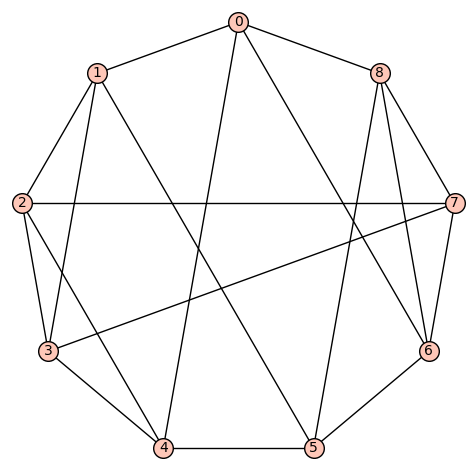
Gamma edges: E1 = [(0, 1), (0, 4), (0, 6), (0, 8), (1, 2), (1, 3), (1, 5), (2, 3), (2, 4), (2, 7), (3, 4), (3, 7), (4, 5), (5, 6), (5, 8), (6, 7), (6, 8), (7, 8)] 
diameter:  2 
girth:  3 
is connected:  True 
aut gp size:  32 
aut gp gens:  [(6,8), (2,3), (1,4), (0,1)(2,6)(3,8)(4,5)] 
d4reg9_15

d4reg9-16 
Gamma edges: E1 = [(0, 1), (0, 3), (0, 7), (0, 8), (1, 2), (1, 4), (1, 5), (2, 3), (2, 4), (2, 5), (3, 7), (3, 8), (4, 5), (4, 6), (5, 6), (6, 7), (6, 8), (7, 8)] 
diameter:  2 
girth:  3 
is connected:  True 
aut gp size:  16 
aut gp gens:  [(7,8), (4,5), (0,1)(2,3)(4,7)(5,8), (0,2)(1,3)(4,7)(5,8)] 

d4reg9_16

10 vertices: Let V=\{0,1,\dots, 9\} denote the vertex set. There are (up to isomorphism) exactly 59 4-regular connected graphs on 10 vertices. One of these actually has an automorphism group of cardinality 1. According to SageMath: Only three of these are vertex transitive, two (of those 3) are symmetric (i.e., arc transitive), and only one (of those 2) is distance regular.

Example 1: The quartic, symmetric graph on 10 vertices that is not distance regular is depicted below. It has diameter 2, girth 4, chromatic number 3, and has an automorphism group of order 320 generated by \{(7,8), (4,6), (1,2), (1,7)(2,8)(3,4)(5,6), (0,1,3,4,7)(2,5,6,8,9)\}.

d4reg10-46a

Example 2: The quartic, distance regular, symmetric graph on 10 vertices is depicted below. It has diameter 3, girth 4, chromatic number 2, and has an automorphism group of order 240 generated by \{(2,5)(4,7), (2,8)(3,4), (1,5)(7,9), (0,1,3,2,7,6,9,8,4,5)\}.

d4reg10-51a

11 vertices: There are (up to isomorphism) exactly 265 4-regular connected graphs on 11 vertices. Only two of these are vertex transitive. None are distance regular or edge transitive.

Example 1: One of the vertex transitive graphs is depicted below. It has diameter 2, girth 4, chromatic number 3, and has an automorphism group of order 22 generated by \{(1,10)(2,9)(3,4)(5,6)(7,8), (0,1,5,4,2,7,8,9,3,6,10)\}.

Example 2:The second vertex transitive graph is depicted below. It has diameter 3, girth 3, chromatic number 4, and has an automorphism group of order 22 generated by \{(1,5)(2,7)(3,6)(4,8)(9,10), (0,1,3,2,4,10,9,8,7,6,5)\}.

Harmonic morphisms to D_3 – examples

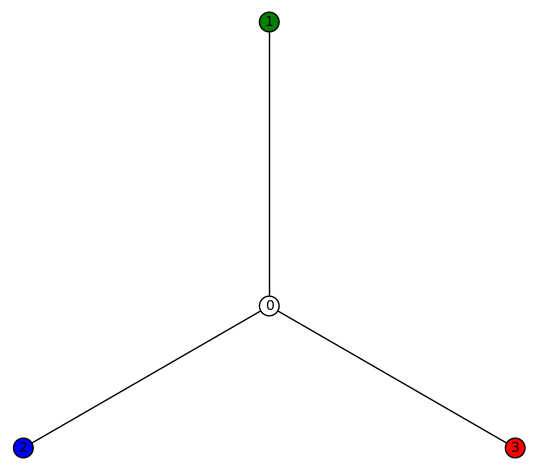
This post expands on a previous post and gives more examples of harmonic morphisms to the tree \Gamma_2=D_3. This graph is also called a star graph Star_3 on 3+1=4 vertices, or the bipartite graph K_{1,3}.
D3-0123

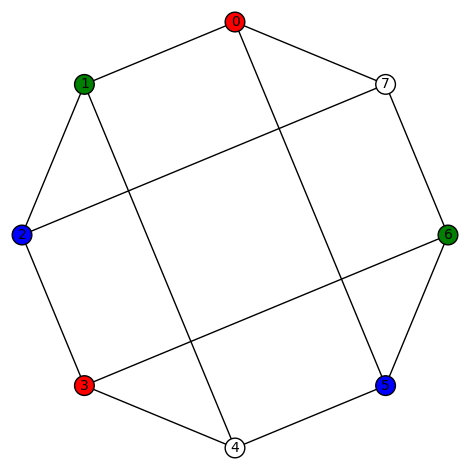
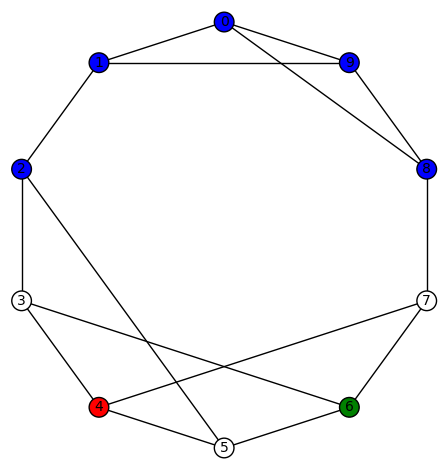
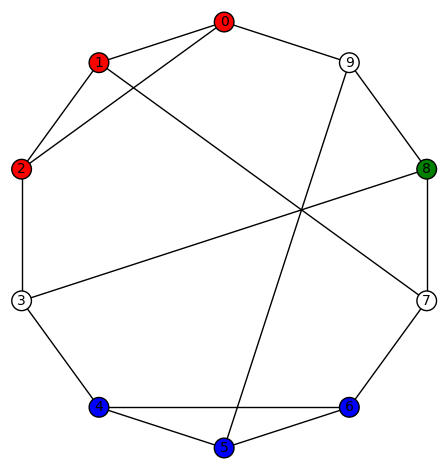
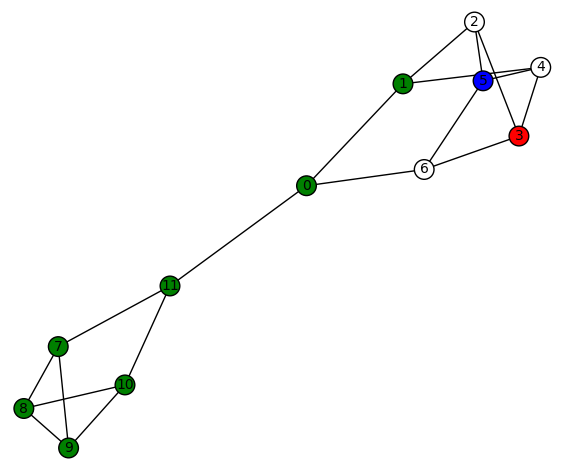
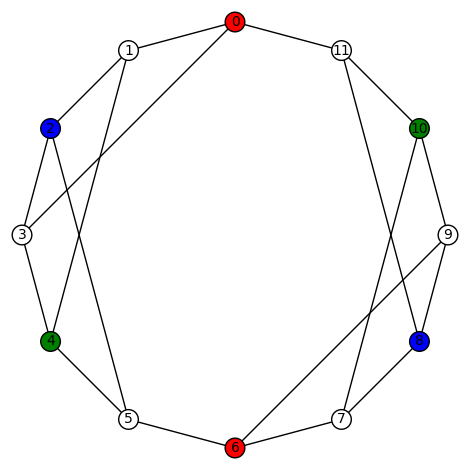
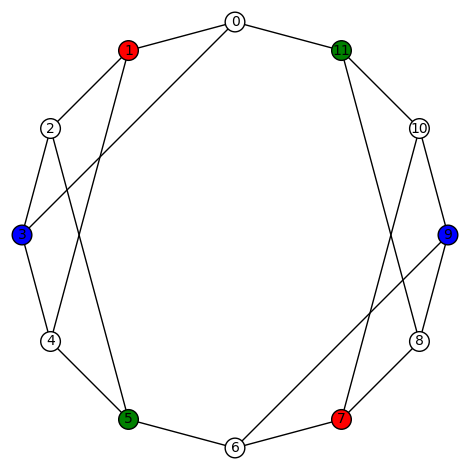
We indicate a harmonic morphism by a vertex coloring. An example of a harmonic morphism can be described in the plot below as follows: \phi:\Gamma_1\to \Gamma_2=D_3 sends the red vertices in \Gamma_1 to the red vertex of \Gamma_2=D_3 (we let 3 be the numerical notation for the color red), the blue vertices in \Gamma_1 to the blue vertex of \Gamma_2=D_3 (we let 2 be the numerical notation for the color blue), the green vertices in \Gamma_1 to the green vertex of \Gamma_2=D_3 (we let 1 be the numerical notation for the color green), and the white vertices in \Gamma_1 to the white vertex of \Gamma_2=D_3 (we let 0 be the numerical notation for the color white).

First, a simple remark about harmonic morphisms in general: roughly speaking, they preserve adjacency. Suppose \phi:\Gamma_1\to \Gamma_2 is a harmonic morphism. Let v,w\in V_1 be adjacent vertices of \Gamma_1. Then either (a) \phi(v)=\phi(w) and \phi “collapses” the edge (vertical) (v,w) or (b) \phi(v)\not= \phi(w) and the vertices \phi(v) and \phi(w) are adjacent in \Gamma_2. In the particular case of this post (ie, the case of \Gamma_2=D_3), this remark has the following consequence: since in D_3 the green vertex is not adjacent to the blue or red vertex, none of the harmonic colored graphs below can have a green vertex adjacent to a blue or red vertex. In fact, any colored vertex can only be connected to a white vertex or a vertex of like color.

To get the following data, I wrote programs in Python using SageMath.

Example 1: There are only the 4 trivial harmonic morphisms Star_4 \to D_3, plus the “obvious” ones obtained from that below and those induced by permutations of the vertices:
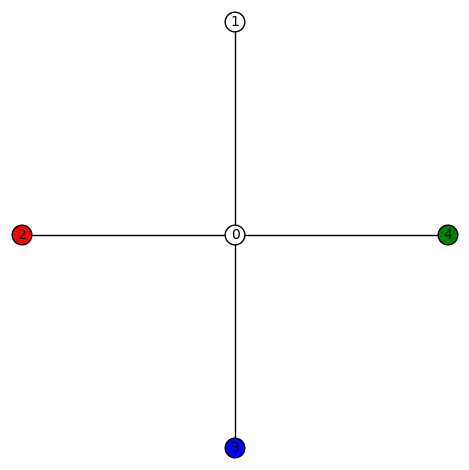
Star4-D3-00321.

My guess is that the harmonic morphisms Star_5\to D_3 can be described in a similar manner. Likewise for the higher Star_n graphs. Given a star graph \Gamma with a harmonic morphism to D_3, a leaf (connected to the center vertex 0) can be added to \Gamma and preserve “harmonicity” if its degree 1 vertex is colored 0. You can try to “collapse” such leafs, without ruining the harmonicity property.

Example 2: For graphs like \Gamma_1=
C3LeafLeafLeaf-D3-000321
there are only the 4 trivial harmonic morphisms \Gamma_1 \to D_3, plus the “obvious” ones obtained from that above and those induced by permutations of the vertices with a non-zero color.
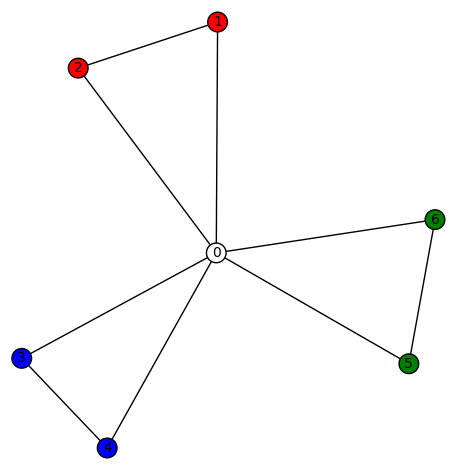
Example 2.5: Likewise, for graphs like \Gamma_1=
3C3-D3-0332211
there are only the 4 trivial harmonic morphisms \Gamma_1 \to D_3, plus the “obvious” ones obtained from that above and those induced by permutations of the vertices with a non-zero color.

Example 3: This is really a non-example. There are no harmonic morphisms from the (3-dimensional) cube graph (whose vertices are those of the unit cube) to D_3.
More generally, take two copies of a cyclic graph on n vertices, C_n, one hovering over the other. Now, connect each vertex of the top copy to the corresponding vertex of the bottom copy. This is a cubic graph that can be visualized as a “thick” regular polygon. (The cube graph is the case n=4.) I conjecture that there is no harmonic morphism from such a graph to D_3.

Example 4: There are 30 non-trivial harmonic morphisms \Gamma_1 \to D_3 for the Peterson graph (the last of the 19 simple cubic graphs on 10 vertices listed on this wikipedia page). Here is an example:
petersen-D3-0330120021
Another interesting fact is that this graph has an automorphism group (isomorphic to the symmetric group on 5 letters) which acts transitively on the vertices.

Example 5: There are 12 non-trivial harmonic morphisms \Gamma_1=K_{3,3} \to D_3 for the complete bipartite (“utility”) graph K_{3,3}. They are all obtained from either
K_3_3-D3-321000
or
K_3_3-D3-000231
by permutations of the vertices with a non-zero color (3!+3!=12).

Example 6: There are 6 non-trivial harmonic morphisms \Gamma_1 \to D_3 for the cubic graph \Gamma_1=(V,E), where V=\{0,1,\dots, 9\} and E = \{(0, 3), (0, 4), (0, 6), (1, 2), (1, 5), (1, 9), (2, 3), (2, 7), (3, 6), (4, 5), (4, 9), (5, 8), (6, 7), (7, 8), (8, 9)\}. This graph has diameter 3, girth 3, and edge-connectivity 3. It’s automorphism group is size 4, generated by (5,9) and (1,8)(2,7)(3,6). The harmonic morphisms are all obtained from
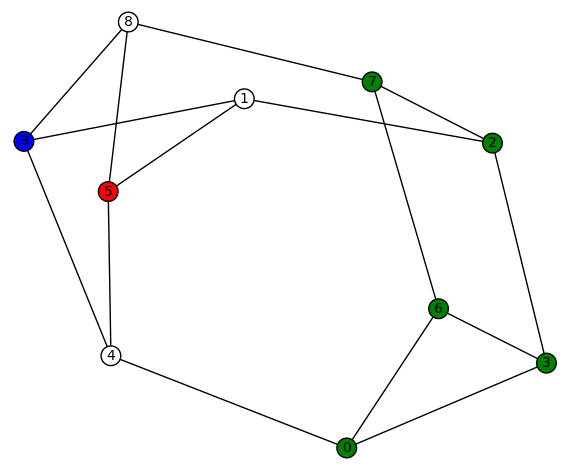
random3regular10e-D3-1011031102
by permutations of the vertices with a non-zero color (3!=6). This graph might be hard to visualize but it is isomorphic to the simple cubic graph having LCF notation [−4, 3, 3, 5, −3, −3, 4, 2, 5, −2]:
random3regular10e2
which has a nice picture. This is the ninth of the 19 simple cubic graphs on 10 vertices listed on this wikipedia page.

Example 7: (a) The first of the 19 simple cubic graphs on 10 vertices listed on this wikipedia page is the graph \Gamma_1 depicted as:
3regular10f
This graph has diameter 5, automorphism group generated by (7,8), (6,9), (3,4), (2,5), (0,1)(2,6)(3,7)(4,8)(5,9). There are no non-trivial harmonic morphisms \Gamma_1\to D_3.
(b) The second of the 19 simple cubic graphs on 10 vertices listed on this wikipedia page is the graph \Gamma_1 depicted as:
3regular10g
This graph has diameter 4, girth 3, automorphism group generated by (7,8), (0,5)(1,2)(6,9). There are no non-trivial harmonic morphisms \Gamma_1\to D_3.
(c) The third of the 19 simple cubic graphs on 10 vertices listed on this wikipedia page is the graph \Gamma_1 depicted as:
3regular10h
This graph has diameter 3, girth 3, automorphism group generated by (4,5), (0,1)(8,9), (0,8)(1,9)(2,7)(3,6). There are no non-trivial harmonic morphisms \Gamma_1\to D_3.

Example 8: The fourth of the 19 simple cubic graphs on 10 vertices listed on this wikipedia page is the graph \Gamma_1 depicted as:
3regular10i
This graph has diameter 3, girth 3, automorphism group generated by (4,6), (3,5), (1,8)(2,7)(3,4)(5,6), (0,9). There are 12 non-trivial harmonic morphisms \Gamma_1\to D_3. For example,
3regular10i-D3-2220301022
and the remaining (3!=6 total) colorings obtained by permutating the non-zero colors. Another example is
3regular10i-D3-1103020111
and the remaining (3!=6 total) colorings obtained by permutating the non-zero colors.

Example 9: (a) The fifth of the 19 simple cubic graphs on 10 vertices listed on this wikipedia page is the graph \Gamma_1 depicted as:
3regular10j
Its SageMath command is Gamma1 = graphs.LCFGraph(10,[2,2,-2,-2,5],2) There are no non-trivial harmonic morphisms \Gamma_1\to D_3.
(b) The sixth of the 19 simple cubic graphs on 10 vertices listed on this wikipedia page is the graph \Gamma_1 depicted as:
3regular10k
Its SageMath command is Gamma1 = graphs.LCFGraph(10,[2,3,-2,5,-3],2) There are no non-trivial harmonic morphisms \Gamma_1\to D_3.

Example 10: The seventh of the 19 simple cubic graphs on 10 vertices listed on this wikipedia page is the graph \Gamma_1 depicted as:
3regular10l-D3-3330222010
Its SageMath command is Gamma1 = graphs.LCFGraph(10,[2,3,-2,5,-3],2). Its automorphism group is order 12, generated by (1,2)(3,7)(4,6), (0,1)(5,6)(7,9), (0,4)(1,6)(2,5)(3,9). There are 6 non-trivial harmonic morphisms \Gamma_1\to D_3, each obtained from the one above by permuting the non-zero colors.

Example 11: The eighth of the 19 simple cubic graphs on 10 vertices listed on this wikipedia page is the graph \Gamma_1 depicted as:
3regular10m
Its SageMath command is Gamma1 = graphs.LCFGraph(10,[5, 3, 5, -4, -3, 5, 2, 5, -2, 4],1). Its automorphism group is order 2, generated by (0,3)(1,4)(2,5)(6,7). There are no non-trivial harmonic morphisms \Gamma_1\to D_3.

Example 12: (a) The tenth (recall the 9th was mentioned above) of the 19 simple cubic graphs on 10 vertices listed on this wikipedia page is the graph \Gamma_1 depicted as:
3regular10o
Its SageMath command is Gamma1 = graphs.LCFGraph(10,[3, -3, 5, -3, 2, 4, -2, 5, 3, -4],1). Its automorphism group is order 6, generated by (2,8)(3,9)(4,5), (0,2)(5,6)(7,9). There are no non-trivial harmonic morphisms \Gamma_1\to D_3.
(b) The 11th of the 19 simple cubic graphs on 10 vertices listed on this wikipedia page is the graph \Gamma_1 depicted as:
3regular10p
Its SageMath command is Gamma1 = graphs.LCFGraph(10,[-4, 4, 2, 5, -2],2). Its automorphism group is order 4, generated by (0,1)(2,9)(3,8)(4,7)(5,6), (0,5)(1,6)(2,7)(3,8)(4,9). There are no non-trivial harmonic morphisms \Gamma_1\to D_3.
(c) The 12th of the 19 simple cubic graphs on 10 vertices listed on this wikipedia page is the graph \Gamma_1 depicted as:
3regular10q
Its SageMath command is Gamma1 = graphs.LCFGraph(10,[5, -2, 2, 4, -2, 5, 2, -4, -2, 2],1). Its automorphism group is order 6, generated by (1,9)(2,8)(3,7)(4,6), (0,4,6)(1,3,8)(2,7,9). There are no non-trivial harmonic morphisms \Gamma_1\to D_3.
(d) The 13th of the 19 simple cubic graphs on 10 vertices listed on this wikipedia page is the graph \Gamma_1 depicted as:
3regular10r
Its SageMath command is Gamma1 = graphs.LCFGraph(10,[2, 5, -2, 5, 5],2). Its automorphism group is order 8, generated by (4,8)(5,7), (0,2)(3,9), (0,5)(1,6)(2,7)(3,8)(4,9). There are no non-trivial harmonic morphisms \Gamma_1\to D_3.

Example 13: The 14th of the 19 simple cubic graphs on 10 vertices listed on this wikipedia page is the graph \Gamma_1 depicted as:
3regular10s-D3-2033020110
By permuting the non-zero colors, we obtain 3!=6 harmonic morphisms from this one. Another harmonic morphism \Gamma_1\to D_3 is depicted as:
3regular10s-D3-0302222201
By permuting the non-zero colors, we obtain 3!=6 harmonic morphisms from this one. And another harmonic morphism \Gamma_1\to D_3 is depicted as:
3regular10s-D3-1110302011
By permuting the non-zero colors, we obtain 3!=6 harmonic morphisms from this one. Its SageMath command is Gamma1 = graphs.LCFGraph(10,[5, -3, -3, 3, 3],2). Its automorphism group is order 48, generated by (4,6), (2,8)(3,7), (1,9), (0,2)(3,5), (0,3)(1,4)(2,5)(6,9)(7,8). There are a total of 18=3!+3!+3! non-trivial harmonic morphisms \Gamma_1\to D_3.

Example 14: The 15th of the 19 simple cubic graphs on 10 vertices listed on this wikipedia page is the graph \Gamma_1 depicted as:
3regular10t-D3-2033020110
By permuting the non-zero colors, we obtain 3!=6 harmonic morphisms from this one. Its SageMath command is Gamma1 = graphs.LCFGraph(10,[5, -4, 4, -4, 4],2). Its automorphism group is order 8, generated by (2,7)(3,8), (1,9)(2,3)(4,6)(7,8), (0,5)(1,4)(2,3)(6,9)(7,8). There are a total of 6=3! non-trivial harmonic morphisms \Gamma_1\to D_3.

Example 15: (a) The 16th of the 19 simple cubic graphs on 10 vertices listed on this wikipedia page is the graph \Gamma_1 depicted as:
3regular10u
Its SageMath command is Gamma1 = graphs.LCFGraph(10,[5, -4, 4, 5, 5],2). Its automorphism group is order 4, generated by (0,3)(1,2)(4,9)(5,8)(6,7), (0,5)(1,6)(2,7)(3,8)(4,9). There are no non-trivial harmonic morphisms \Gamma_1\to D_3.
(b) The 17th of the 19 simple cubic graphs on 10 vertices listed on this wikipedia page is the graph \Gamma_1 depicted as:
3regular10v
Its SageMath command is Gamma1 = graphs.LCFGraph(10,[5, 5, -3, 5, 3],2). Its automorphism group is order 20, generated by (2,6)(3,7)(4,8)(5,9), (0,1)(2,5)(3,4)(6,9)(7,8), (0,2)(1,9)(3,5)(6,8). This group acts transitively on the vertices. There are no non-trivial harmonic morphisms \Gamma_1\to D_3.
(c) The 18th of the 19 simple cubic graphs on 10 vertices listed on this wikipedia page is the graph \Gamma_1 depicted as:
3regular10w
This is an example of a “thick polygon” graph, already mentioned in Example 3 above. Its SageMath command is Gamma1 = graphs.LCFGraph(10,[-4, 4, -3, 5, 3],2). Its automorphism group is order 20, generated by (2,5)(3,4)(6,9)(7,8), (0,1)(2,6)(3,7)(4,8)(5,9), (0,2)(1,9)(3,6)(4,7)(5,8). This group acts transitively on the vertices. There are no non-trivial harmonic morphisms \Gamma_1\to D_3.
(d) The 19th in the list of 19 is the Petersen graph, already in Example 4 above.

We now consider some examples of the cubic graphs having 12 vertices. According to the House of Graphs there are 109 of these, but we use the list on this wikipedia page.

Example 16: I wrote a SageMath program that looked for harmonic morphisms on a case-by-case basis. If there is no harmonic morphism \Gamma_1\to D_3 then, instead of showing a graph, I’ll list the edges (of course, the vertices are 0,1,…,11) and the SageMath command for it.

  1. \Gamma_1=(V_1,E_1), where E_1=\{ (0, 1), (0, 2), (0, 11), (1, 2), (1, 6), (2, 3), (3, 4), (3, 5), (4, 5), (4, 6), (5, 6), (7, 8), (7, 9), (7, 11), (8, 9), (8, 10), (9, 10), (10, 11)\}.
    SageMath command:
    V1 = [0,1,2,3,4,5,6,7,8,9,10,11]
    E1 = [(0, 1), (0, 2), (0, 11), (1, 2), (1, 6), (2, 3), (3, 4), (3, 5), (4, 5), (4, 6), (5, 6), (7, 8), (7, 9), (7, 11), (8, 9), (8, 10), (9, 10), (10, 11)]
    Gamma1 = Graph([V1,E1])

    (Not in LCF notation since it doesn’t have a Hamiltonian cycle.)
  2. \Gamma_1=(V_1,E_1), where E_1=\{(0, 1), (0, 6), (0, 11), (1, 2), (1, 3), (2, 3), (2, 5), (3, 4), (4, 5), (4, 6), (5, 6), (7, 8), (7, 9), (7, 11), (8, 9), (8, 10), (9, 10), (10, 11)\}.
    SageMath command:
    V1 = [0,1,2,3,4,5,6,7,8,9,10,11]
    E1 = [(0, 1), (0, 6), (0, 11), (1, 2), (1, 3), (2, 3), (2, 5), (3, 4), (4, 5), (4, 6), (5, 6), (7, 8), (7, 9), (7, 11), (8, 9), (8, 10), (9, 10), (10, 11)]
    Gamma1 = Graph([V1,E1])

    (Not in LCF notation since it doesn’t have a Hamiltonian cycle.)
  3. \Gamma_1=(V_1,E_1), where E_1=\{(0,1),(0,3),(0,11),(1,2),(1,6),(2,3),(2,5),(3,4),(4,5),(4,6),(5,6),(7,8),(7,9),(7,11),(8,9),(8,10),(9,10),(10,11)\}.
    SageMath command:
    V1 = [0,1,2,3,4,5,6,7,8,9,10,11]
    E1 = [(0,1),(0,3),(0,11),(1,2),(1,6),(2,3),(2,5),(3,4),(4,5),(4,6),(5,6),(7,8),(7,9),(7,11),(8,9),(8,10),(9,10),(10,11)]
    Gamma1 = Graph([V1,E1])

    (Not in LCF notation since it doesn’t have a Hamiltonian cycle.)
  4. This example has 12 non-trivial harmonic morphisms.
    SageMath command:
    V1 = [0,1,2,3,4,5,6,7,8,9,10,11]
    E1 = [(0,1),(0,3),(0,11),(1,2),(1,6),(2,3),(2,5),(3,4),(4,5),(4,6),(5,6),(7,8),(7,9),(7,11),(8,9),(8,10),(9,10),(10,11)]
    Gamma1 = Graph([V1,E1])

    (Not in LCF notation since it doesn’t have a Hamiltonian cycle.) We show two such morphisms:
    3regular12d-D3-110302011111
    3regular12d-D3-103020111111
    The other non-trivial harmonic morphisms are obtained by permuting the non-zero colors. There are 3!=6 for each graph above, so the total number of harmonic morphisms (including the trivial ones) is 6+6+4=16.
  5. \Gamma_1=(V_1,E_1), where E_1=\{(0, 1), (0, 3), (0, 11), (1, 2), (1, 11), (2, 3), (2, 10), (3, 4), (4, 5), (4, 8), (5, 6), (5, 7), (6, 7), (6, 9), (7, 8), (8, 9), (9, 10), (10, 11)\}.
    SageMath command:
    Gamma1 = graphs.LCFGraph(12, [3, -2, -4, -3, 4, 2], 2)
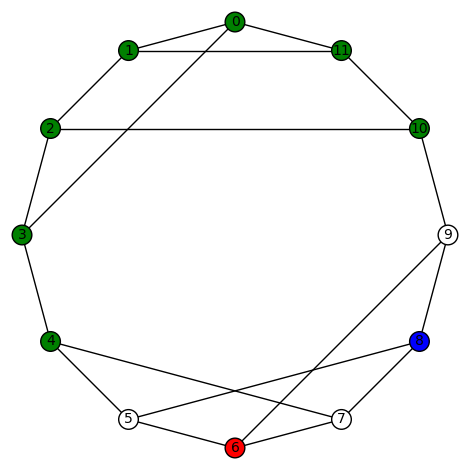
  6. This example has 12 non-trivial harmonic morphisms. \Gamma_1=(V_1,E_1), where E_1=\{(0, 1), (0, 3), (0, 11), (1, 2), (1, 11), (2, 3), (2, 10), (3, 4), (4, 5), (4, 7), (5, 6), (5, 8), (6, 7), (6, 9), (7, 8), (8, 9), (9, 10), (10, 11)\}. (This only differs by one edge from the one above.)
    SageMath command:
    Gamma1 = graphs.LCFGraph(12, [3, -2, -4, -3, 3, 3, 3, -3, -3, -3, 4, 2], 1)
    We show two such morphisms:
    3regular12f-D3-111103020111
    3regular12f-D3-111110302011
    And here is another plot of the last colored graph:
    3regular12f2-D3-111110302011
    The other non-trivial harmonic morphisms are obtained by permuting the non-zero colors. There are 3!=6 for each graph above, so the total number of harmonic morphisms (including the trivial ones) is 6+6+4=16.
  7. \Gamma_1=(V_1,E_1), where E_1=\{(0, 1), (0, 4), (0, 11), (1, 2), (1, 3), (2, 3), (2, 5), (3, 4), (4, 5), (5, 6), (6, 7), (6, 8), (7, 8), (7, 10), (8, 9), (9, 10), (9, 11), (10, 11)\}.
    SageMath command:
    Gamma1 = graphs.LCFGraph(12, [4, 2, 3, -2, -4, -3, 2, 3, -2, 2, -3, -2], 1)
  8. This example has 48 non-trivial harmonic morphisms. \Gamma_1=(V_1,E_1), where E_1=\{(0, 1), (0, 3), (0, 11), (1, 2), (1, 4), (2, 3), (2, 5), (3, 4), (4, 5), (5, 6), (6, 7), (6, 9), (7, 8), (7, 10), (8, 9), (8, 11), (9, 10), (10, 11)\}.
    SageMath command:
    Gamma1 = graphs.LCFGraph(12, [3, 3, 3, -3, -3, -3], 2)
    This example is also interesting as it has a large number of automorphisms – its automorphism group is size 64, generated by (8,10), (7,9), (2,4), (1,3), (0,5)(1,2)(3,4)(6,11)(7,8)(9,10), (0,6)(1,7)(2,8)(3,9)(4,10)(5,11). Here are examples of some of the harmonic morphisms using vertex-colored graphs:
    3regular12h-D3-302010302010
    3regular12h-D3-333333302010
    3regular12h-D3-030201030201
    3regular12h-D3-103020111111
    I think all the other non-trivial harmonic morphisms are obtained by (a) permuting the non-zero colors, or (b) applying a element of the automorphism group of the graph.
  9. (list under construction)

NCF Boolean functions

I recently learned about a new class of seemingly complicated, but in fact very simple functions which are called by several names, but perhaps most commonly as NCF Boolean functions (NCF is an abbreviation for “nested canalyzing function,” a term used by mathematical biologists). These functions were independently introduced by theoretical computer scientists in the 1960s using the term unate cascade functions. As described in [JRL2007] and [LAMAL2013], these functions have applications in a variety of scientific fields. This post describes these functions.

A Boolean function of n variables is simply a function f:GF(2)^n\to GF(2). Denote the GF(2)-vector space of such functions by B(n). We write an element of this space as f(x_1,x_2,\dots,x_n), where the variables x_i will be called coordinate variables. Let
Res_{x_i=a}:B(n)\to B(n-1)
denote the restriction map sending f(x_1,x_2,\dots,x_n) to f(x_1,x_2,\dots,x_{i-1},a,x_{i+1},\dots, x_n). In this post, the cosets
H_{i,a,n}=\{x=(x_1,x_2,\dots,x_n) \in GF(2)^n\ |\ x_i=a\}
will be called coordinate hyperplanes (a \in GF(2), 1\leq i\leq n). A function in B(n) which is constant along some coordinate hyperplane is called canalyzing. An NCF function is a function f\in B(n) which (a) is constant along some coordinate hyperplane H_{i_1,a_1,n}, (b) whose restriction f_1 = Res_{x_{i_1}=a_1}(f)\in B(n-1) is constant along some coordinate hyperplane H_{i_2,a_2,n-1}\subset GF(2)^{n-1}, (c) whose restriction f_2 = Res_{x_{i_2}=a_2}(f_1)\in B(n-2) is constant along some coordinate hyperplane H_{i_2,a_2,n-2}\subset GF(2)^{n-2}, (d) and so on. This “nested” inductive definition might seem complicated, but to a computer it’s pretty simple and, to boot, it requires little memory to store.


If 1\leq i\leq n and x=(x_1,x_2,\dots,x_n) \in GF(2)^n then let x^i\in GF(2)^n denote the vector whose i-th coordinate is flipped (bitwise). The sensitivity of f\in B(n) at x is
s(f,x) = |\{i\ |\ 1\leq i\leq n, f(x)\not= f(x^i)\}|. Roughly speaking, it’s the number of single-bit changes in x that change the value of f(x). The (maximum) sensitivity is the quantity

s(f)=max_x s(f,x). The block sensitivity is defined similarly, but you allow blocks of indices of coordinates to by flipped bitwise, as opposed to only one. It’s possible to

  • compute the sensitivity of any NCF function,
  • show the block sensitivity is equal to the sensitivity,
  • compute the cardinality of the set of all monotone NCF functions.

For details, see for example Li and Adeyeye [LA2012].

REFERENCES
[JRL2007] A.S. Jarrah, B. Raposa, R. Laubenbachera, “Nested Canalyzing, Unate Cascade, and Polynomial Functions,” Physica D. 2007 Sep 15; 233(2): 167–174.

[LA2012] Y. Li, J.O. Adeyeye, “Sensitivity and block sensitivity of nested canalyzing function,” ArXiV 2012 preprint. (A version of this paper was published later in Theoretical Comp. Sci.)

[LAMAL2013] Y. Li, J.O. Adeyeye, D. Murrugarra, B. Aguilar, R. Laubenbacher, “Boolean nested canalizing functions: a comprehensive analysis,” ArXiV, 2013 preprint.

Expected maximums and fun with Faulhaber’s formula

A recent Futility Closet post inspired this one. There, Greg Ross mentioned a 2020 paper by P Sullivan titled “Is the Last Banana Game Fair?” in Mathematics Teacher. (BTW, it’s behind a paywall and I haven’t seen that paper).

Suppose Alice and Bob don’t want to share a banana. They each have a fair 6-sided die to throw. To decide who gets the banana, each of them rolls their die. If the largest number rolled is a 1, 2, 3, or 4, then Alice wins the banana. If the largest number rolled is a 5 or 6, then Bob wins. This is the last banana game. In this post, I’m not going to discuss the last banana game specifically, but instead look at a related question.

Let’s define things more generally. Let I_n=\{1,2,...,n\}, let X,Y be two independent, uniform random variables taken from I_n, and let Z=max(X,Y). The last banana game concerns the case n=6. Here, I’m interested in investigating the question: What is E(Z)?

Computing this isn’t hard. By definition of independent and max, we have
P(Z\leq z)=P(X\leq z)P(Y\leq z).
Since P(X\leq z)=P(Y\leq z)={\frac{z}{n}}, we have
P(Z\leq z)={\frac{z^2}{n^2}}.
The expected value of Z is defined as \sum kP(Z=k), but there’s a handy-dandy formula we can use instead:
E(Z)=\sum_{k=0}^{n-1} P(Z>k)=\sum_{k=0}^{n-1}[1-P(Z\leq k)].
Now we use the previous computation to get
E(Z)=n-{\frac{1}{n^2}}\sum_{k=1}^{n-1}k^2=n-{\frac{1}{n^2}}{\frac{(n-1)n}{6}}={\frac{2}{3}}n+{\frac{1}{2}}-{\frac{1}{6n}}.
This solves the problem as stated. But this method generalizes in a straightforward way to selecting m independent r.v.s in I_n, so let’s keep going.

First, let’s pause for some background and history. Notice how, in the last step above, we needed to know the formula for the sum of the squares of the first n consecutive positive integers? When we generalize this to selecting m integers, we need to know the formula for the sum of the m-th powers of the first n consecutive positive integers. This leads to the following topic.

Faulhaber polynomials are, for this post (apparently the terminology is not standardized) the sequence of polynomials F_m(n) of degree m+1 in the variable n that gives the value of the sum of the m-th powers of the first n consecutive positive integers:

\sum_{k=1}^{n} k^m=F_m(n).

(It is not immediately obvious that they exist for all integers m\geq 1 but they do and Faulhaber’s results establish this existence.) These polynomials were discovered by (German) mathematician Johann Faulhaber in the early 1600s, over 400 years ago. He computed them for “small” values of m and also discovered a sort of recursive formula relating F_{2\ell +1}(n) to F_{2\ell}(n). It was about 100 years later, in the early 1700s, that (Swiss) mathematician Jacob Bernoulli, who referenced Faulhaber, gave an explicit formula for these polynomials in terms of the now-famous Bernoulli numbers. Incidentally, Bernoulli numbers were discovered independently around the same time by (Japanese) mathematician Seki Takakazu. Concerning the Faulhaber polys, we have
F_1(n)={\frac{n(n+1)}{2}},
F_2(n)={\frac{n(n+1)(2n+1)}{6}},
and in general,
F_m(n)={\frac{n^{m+1}}{m+1}}+{\frac{n^m}{2}}+ lower order terms.

With this background aside, we return to the main topic of this post. Let I_n=\{1,2,...,n\}, let X_1,X_2,...,x_m be m independent, uniform random variables taken from I_n, and let Z=max(X_1,X_2,...,X_m). Again we ask: What is E(Z)? The above computation in the m=2 case generalizes to:

E(Z)=n-{\frac{1}{n^m}}\sum_{k=1}^{n-1}k^m=n-{\frac{1}{n^m}}F_m(n-1).

For m fixed and n “sufficiently large”, we have

E(Z)={\frac{m}{m+1}}n+O(1).

I find this to be an intuitively satisfying result. The max of a bunch of independently chosen integers taken from I_n should get closer and closer to n as (the fixed) m gets larger and larger.

Harmonic morphisms to P_4 – examples

This post expands on a previous post and gives more examples of harmonic morphisms to the path graph \Gamma_2=P_4.
path4-0123

First, a simple remark about harmonic morphisms in general: roughly speaking, they preserve adjacency. Suppose \phi:\Gamma_1\to \Gamma_2 is a harmonic morphism. Let v,w\in V_1 be adjacent vertices of \Gamma_1. Then either (a) \phi(v)=\phi(w) and \phi “collapses” the edge (vertical) (v,w) or (b) \phi(v)\not= \phi(w) and the vertices \phi(v) and \phi(w) are adjacent in \Gamma_2. In the particular case of this post (ie, the case of \Gamma_2=P_4), this remark has the following consequence: since in P_4 the white vertex is not adjacent to the blue or red vertex, none of the harmonic colored graphs below can have a white vertex adjacent to a blue or red vertex.

We first consider the cyclic graph on k vertices, C_k as the domain in this post. However, before we get to examples (obtained by using SageMath), I’d like to state a (probably naive) conjecture.

Let \phi:\Gamma_1 \to \Gamma_2=P_k be a harmonic morphism from a graph \Gamma_1 with n=|V_1| vertices to the path graph having k>2 vertices. Let f:V_2 \to V_1 be the coloring map (identified with an n-tuple whose coordinates are in \{0,1,\dots ,k-1\}). Associated to f is a partition \Pi_f=[n_0,\dots,n_{k-1}] of n (here [...] is a multi-set, so repetition is allowed but the ordering is unimportant): n=n_0+n_1+...+n_{k-1}, where n_j is the number of times j occurs in f. We call this the partition invariant of the harmonic morphism.

Definition: For any two harmonic morphisms \phi:\Gamma_1 \to P_k, \phi:\Gamma'_1 \to P_k, with associated
colorings f, f' whose corresponding partitions agree, \Pi_f=\Pi_{f'} then we say f' and f are partition equivalent.

What can be said about partition equivalent harmonic morphisms? Caroline Melles has given examples where partition equivalent harmonic morphisms are not induced from an automorphism.

Now onto the \Gamma_1 \to P_4 examples!

There are no non-trivial harmonic morphisms C_5 \to P_4, so we start with C_6. We indicate a harmonic morphism by a vertex coloring. An example of a harmonic morphism can be described in the plot below as follows: \phi:\Gamma_1\to \Gamma_2=P_4 sends the red vertices in \Gamma_1 to the red vertex of \Gamma_2=P_4 (we let 3 be the numerical notation for the color red), the blue vertices in \Gamma_1 to the blue vertex of \Gamma_2=P_4 (we let 2 be the numerical notation for the color blue), the green vertices in \Gamma_1 to the green vertex of \Gamma_2=P_4 (we let 1 be the numerical notation for the color green), and the white vertices in \Gamma_1 to the white vertex of \Gamma_2=P_4 (we let 0 be the numerical notation for the color white).

To get the following data, I wrote programs in Python using SageMath.

Example 1: There are only the 4 trivial harmonic morphisms C_6 \to P_4, plus that induced by f = (1, 2, 3, 2, 1, 0) and all of its cyclic permutations (4+6=10). This set of 6 permutations is closed under the automorphism of P_4 induced by the transposition (0,3)(1,2) (so total = 10).cyclic6-123210

Example 2: There are only the 4 trivial harmonic morphisms, plus f = (1, 2, 3, 2, 1, 0, 0) and all of its cyclic permutations (4+7=11). This set of 7 permutations is not closed under the automorphism of P_4 induced by the transposition (0,3)(1,2), so one also has f = (2, 1, 0, 1, 2, 3, 3) and all 7 of its cyclic permutations (total = 7+11 = 18).
cyclic7-1232100
cyclic7-1233210

Example 3: There are only the 4 trivial harmonic morphisms, plus f = (1, 2, 3, 2, 1, 0, 0, 0) and all of its cyclic permutations (4+8=12). This set of 8 permutations is not closed under the automorphism of P_4 induced by the transposition (0,3)(1,2), so one also has f = (1, 2, 3, 3, 3, 2, 1, 0) and all of its cyclic permutations (12+8=20). In addition, there is f = (1, 2, 3, 3, 2, 1, 0, 0) and all of its cyclic permutations (20+8 = 28). The latter set of 8 cyclic permutations of (1, 2, 3, 3, 2, 1, 0, 0) is closed under the transposition (0,3)(1,2) (total = 28).
cyclic8-12321000
cyclic8-12333210
cyclic8-12332100

Example 4: There are only the 4 trivial harmonic morphisms, plus f = (1, 2, 3, 2, 1, 0, 0, 0, 0) and all of its cyclic permutations (4+9=13). This set of 9 permutations is not closed under the automorphism of P_4 induced by the transposition (0,3)(1,2), so one also has f = (1, 2, 3, 3, 2, 1, 0, 0, 0) and all 9 of its cyclic permutations (9+13 = 22). This set of 9 permutations is not closed under the automorphism of P_4 induced by the transposition (0,3)(1,2), so one also has f = (1, 2, 3, 3, 3, 2, 1, 0, 0) and all 9 of its cyclic permutations (9+22 = 31). This set of 9 permutations is not closed under the automorphism of P_4 induced by the transposition (0,3)(1,2), so one also has f = (1, 2, 3, 3, 3, 3, 2, 1, 0) and all 9 of its cyclic permutations (total = 9+31 = 40). cyclic9-123210000cyclic9-123321000cyclic9-123332100cyclic9-123333210

Next we consider some cubic graphs.

Example 5: There are 5 cubic graphs on 8 vertices, as listed on this wikipedia page. I wrote a SageMath program that looked for harmonic morphisms on a case-by-case basis. There are no non-trivial harmonic morphisms from any one of these 5 graphs to P_4.

Example 6: There are 19 cubic graphs on 10 vertices, as listed on this wikipedia page. I wrote a SageMath program that looked for harmonic morphisms on a case-by-case basis. The only one of these 19 cubic graphs \Gamma_1 having a harmonic morphism \phi:\Gamma_1\to P_4 is the graph whose SageMath command is graphs.LCFGraph(10,[5, -3, -3, 3, 3],2). It has diameter 3, girth 4, and automorphism group of order 48 generated by (4,6), (2,8)(3,7), (1,9), (0,2)(3,5), (0,3)(1,4)(2,5)(6,9)(7,8). There are eight non-trivial harmonic morphisms \phi:\Gamma_1\to P_4. They are depicted as follows:
3regular10nn-P4-1112322210
3regular10nn-P4-1112223210
3regular10nn-P4-1012322211
3regular10nn-P4-1012223211
3regular10nn-P4-2321110122
3regular10nn-P4-2321011122
3regular10nn-P4-2221110123
3regular10nn-P4-2221011123
Note that the last four are obtained from the first 4 by applying the permutation (0,3)(1,2) to the colors (where 0 is white, etc, as above).

We move to cubic graphs on 12 vertices. There are quite a few of them – according to the House of Graphs page on connected cubic graphs, there are 109 of them (if I counted correctly).

Example 7: The cubic graphs on 12 vertices are listed on this wikipedia page. I wrote a SageMath program that looked for harmonic morphisms on a case-by-case basis. If there is no harmonic morphism \Gamma_1\to P_4 then, instead of showing a graph, I’ll list the edges (of course, the vertices are 0,1,…,11) and the SageMath command for it.

  1. \Gamma_1=(V_1,E_1), where E_1=\{ (0, 1), (0, 2), (0, 11), (1, 2), (1, 6), (2, 3), (3, 4), (3, 5), (4, 5), (4, 6), (5, 6), (7, 8), (7, 9), (7, 11), (8, 9), (8, 10), (9, 10), (10, 11)\}.
    SageMath command:
    V1 = [0,1,2,3,4,5,6,7,8,9,10,11]
    E1 = [(0,1), (0,2), (0,11), (1,2), (1,6),(2,3), (3,4), (3,5), (4,5), (4,6), (5,6), (7,8), (7,9), (7,11), (8,9),(8,10), (9,10), (10,11)]
    Gamma1 = Graph([V1,E1])

    (Not in LCF notation since it doesn’t have a Hamiltonian cycle.)
  2. \Gamma_1=(V_1,E_1), where E_1=\{ (0, 1), (0, 6), (0, 11), (1, 2), (1, 3), (2, 3), (2, 5), (3, 4), (4, 5), (4, 6), (5, 6), (7, 8), (7, 9), (7, 11), (8, 9), (8, 10), (9, 10), (10, 11)\}.
    SageMath command:
    V1 = [0,1,2,3,4,5,6,7,8,9,10,11]
    E1 = [(0, 1), (0, 6), (0, 11), (1, 2), (1, 3), (2, 3), (2, 5), (3, 4), (4, 5), (4, 6), (5, 6), (7, 8), (7, 9), (7, 11), (8, 9), (8, 10), (9, 10), (10, 11)]
    Gamma1 = Graph([V1,E1])

    (Not in LCF notation since it doesn’t have a Hamiltonian cycle.)
  3. \Gamma_1=(V_1,E_1), where E_1=\{(0,1),(0,3),(0,11),(1,2),(1,6),(2,3),(2,5),(3,4),(4,5),(4,6),(5,6),(7,8),(7,9),(7,11),(8,9),(8,10),(9,10),(10,11)\}.
    SageMath command:
    V1 = [0,1,2,3,4,5,6,7,8,9,10,11]
    E1 = [(0,1),(0,3),(0,11),(1,2),(1,6),(2,3),(2,5),(3,4),(4,5),(4,6),(5,6),(7,8),(7,9),(7,11),(8,9),(8,10),(9,10),(10,11)]
    Gamma1 = Graph([V1,E1])

    (Not in LCF notation since it doesn’t have a Hamiltonian cycle.)
  4. \Gamma_1=(V_1,E_1), where E_1=\{(0, 1), (0, 3), (0, 11), (1, 2), (1, 11), (2, 3), (2, 10), (3, 4), (4, 5), (4, 8), (5, 6), (5, 7), (6, 7), (6, 9), (7, 8), (8, 9), (9, 10), (10, 11)\}.
    SageMath command:
    Gamma1 = graphs.LCFGraph(12, [3, -2, -4, -3, 4, 2], 2)
  5. \Gamma_1=(V_1,E_1), where E_1=\{(0, 1), (0, 3), (0, 11), (1, 2), (1, 11), (2, 3), (2, 10), (3, 4), (4, 5), (4, 7), (5, 6), (5, 8), (6, 7), (6, 9), (7, 8), (8, 9), (9, 10), (10, 11)\}.
    SageMath command:
    Gamma1 = graphs.LCFGraph(12, [3, -2, -4, -3, 3, 3, 3, -3, -3, -3, 4, 2], 1)
  6. \Gamma_1=(V_1,E_1), where E_1=\{(0, 1), (0, 4), (0, 11), (1, 2), (1, 3), (2, 3), (2, 5), (3, 4), (4, 5), (5, 6), (6, 7), (6, 8), (7, 8), (7, 10), (8, 9), (9, 10), (9, 11), (10, 11)\}.
    SageMath command:
    Gamma1 = graphs.LCFGraph(12, [4, 2, 3, -2, -4, -3, 2, 3, -2, 2, -3, -2], 1)
  7. \Gamma_1=(V_1,E_1), where E_1=\{(0, 1), (0, 3), (0, 11), (1, 2), (1, 4), (2, 3), (2, 5), (3, 4), (4, 5), (5, 6), (6, 7), (6, 9), (7, 8), (7, 10), (8, 9), (8, 11), (9, 10), (10, 11)\}.
    SageMath command:
    Gamma1 = graphs.LCFGraph(12, [3, 3, 3, -3, -3, -3], 2)
  8. (list under construction)