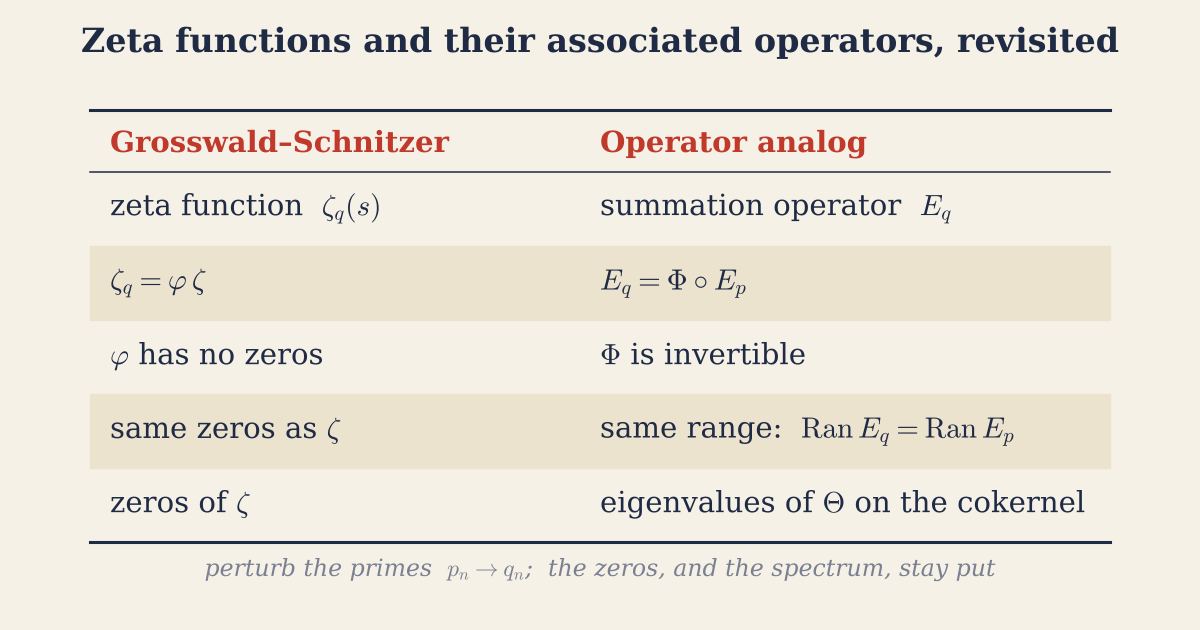
In 1981, as an undergraduate at Georgia Tech, I wrote a typewritten manuscript called “Zeta functions and their associated operators.” I’m not going to post it here. I think only Johan Belinfante (my professor at Georgia Tech) and John Benedetto (my PhD advisor at Univ Maryland) read it, and I hope to keep it that way! The notation is poor, the statements are poorly formulated, and the organization is worse.
But I remember what I was trying to say, and AI (mostly Opus-Claude, but also a lot of chatGPT) has the skills I lacked. This new paper, “A Grosswald–Schnitzer Invariance Theorem for Arithmetic Summation Operators,” is here: pdf.
I have to say, this co-working with AI was a very satisfying experience. I was able to take a paper I wrote as an undergraduate, which I still think has cool ideas, and put it into the form I like. Rereading that paper, I’m frustrated by my lack of skill as a writer and a disciplined thinker. It’s a huge relief to have something to show for all the thinking I did on it back in 1980-1981. The only thing I would not have dreamed of writing back then is (thanks to Opus-Claude) itemized in the “Future Directions” section at the end. Speculations of possible results that could be accomplished by going deeper with some of the ideas. I’ll come back to that later, but I’d also be happy if someone beats me to it.