I recently went back to revise, verify, and expand two unpublished group theory expository papers from decades ago—one originally drafted in 1997 and the other in 2000—with the help of AI refereeing workflows and Python verification scripts. Although the two notes started from completely different questions, expanding them in 2026 revealed a shared thread: in both settings, rigid subgroup intersection properties govern induced representations and produce Baker–Norine harmonic morphisms between graphs.
The first paper, Which have a complement in
?, began in 1997 with an email from Herbert Kociemba, the author of the well-known Rubik’s Cube solving program. Because a Rubik’s Cube has
edges and
corners, a solver has to index elements of
and
efficiently. If a group splits as an exact factorization
with
(without needing either subgroup to be normal), every element
can be stored as a unique pair of coordinates
. Kociemba asked me whether the standard subgroup
has a complement in
.
It turns out that complements to the standard subgroup are rare because a subgroup
complements
if and only if
acts sharply
-transitively on
. Feeding the classical classification of sharply multiply transitive groups into this criterion settles the problem completely:
- Universal complements: For every
, the cyclic group
complements
and the alternating group
complements
.
- Prime-power families: For
, the only other complements are
when
(
a prime power) and
when
(
a prime power).
- Low-degree exceptions: For
, the Mathieu groups
,
, and
contribute sharp
-,
-, and
-transitive complements.
- A three-factor substitute for
: Because
has no complement in
, I constructed a bijective ordered factorization
using
and
.
In the new final section, I translated the complement question into algebraic graph theory via the arrangement graph on ordered
-tuples and the Johnson graph
on unordered
-subsets. Because
is a vertex stabilizer in
, any complement
acts regularly on the vertices, turning
—and every
-invariant coset graph on
—into a Cayley graph of
whose connection set is a union of
subgroups minus the identity. Curiously, the converse fails for six specific pairs—
,
,
,
,
, and
—where
is a Cayley graph via a subgroup of
even though
has no complement in
. Using the Cayley structure, the Fourier blocks of the adjacency matrix become sums of projections, bounding all eigenvalues below by
and giving the exact spectrum of
by hand. Finally, taking the quotient by the free coordinate action of
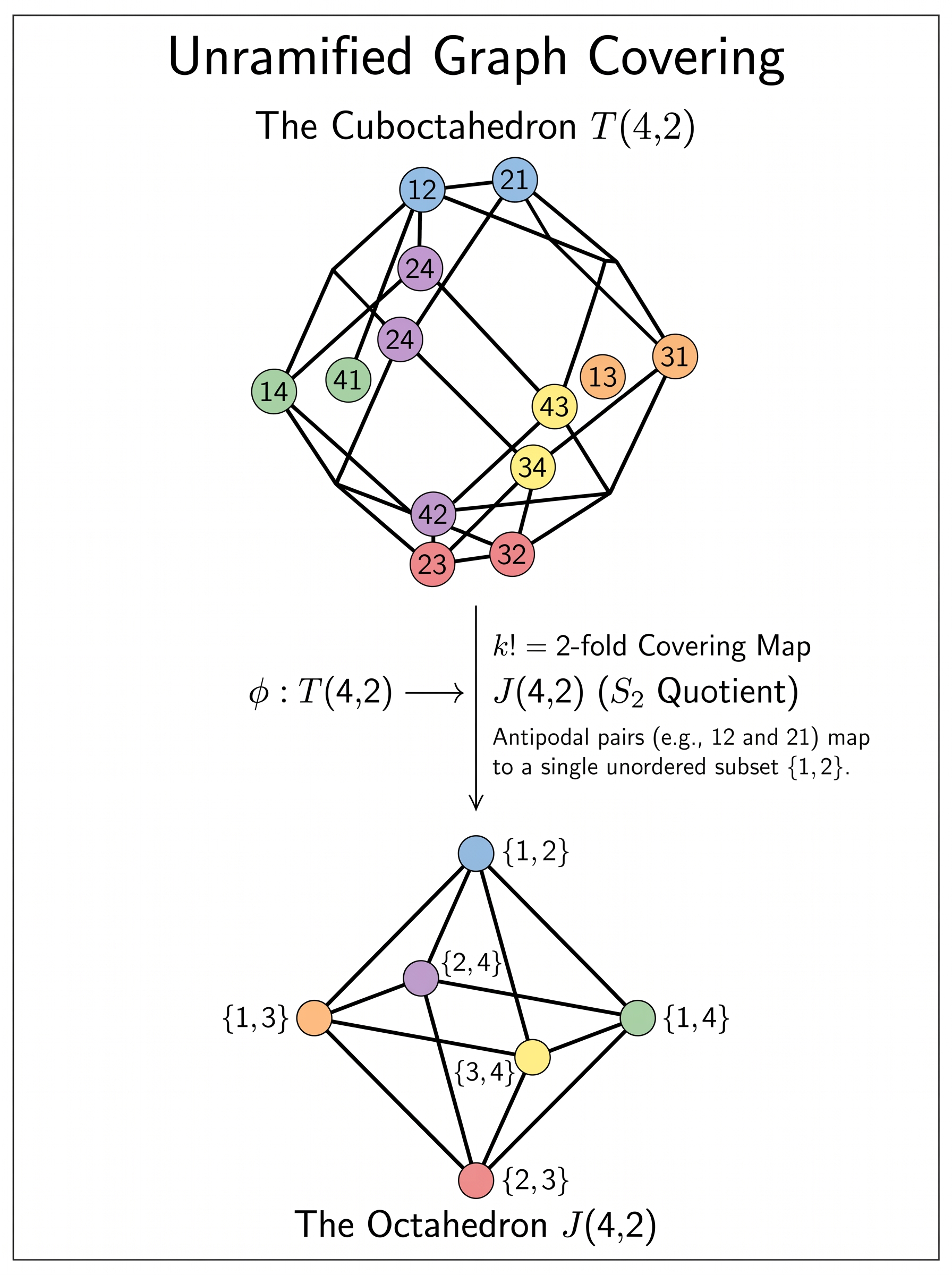
produces a
-fold unramified covering
, a clean example of a harmonic morphism.

The second note, The representation theory of finite commutation transitive groups, dates back to a preliminary draft from August 2000. That project grew out of conversations with Jill McGowan, Dennis Spellman, and my friend (and then-colleague at the USNA) Tony Gaglione. It was through Tony that I got to know Ben Fine, who had coined the term “commutative transitive” (CT) in 1983 while studying Fuchsian and Kleinian groups, and who collaborated extensively with Tony and Dennis on CT groups and the commutative transitive kernel.
A group is commutative transitive (CT) if commuting is transitive on non-identity elements—equivalently, every non-identity element has an abelian centralizer. It is commutation transitive if the same holds for all non-central elements. Non-abelian CT groups always have trivial center
, whereas groups like
,
,
, and
are commutation transitive with non-trivial center. By classical results of Weisner, Suzuki, Brauer–Suzuki–Wall, and Wu, every finite CT group is either abelian, a Frobenius group
with abelian kernel
and cyclic complement
, or
for
. Along the way, I framed several tempting guesses as “naive conjectures” and settled them: for odd
,
is never CT,
is CT only for
, and passing from
to
shows that quotienting by the center can destroy commutation transitivity.
Because distinct conjugate centralizers meet only in the center (), inducing linear characters
from centralizers organizes the representation theory remarkably well:
- Short character sums: On non-central elements meeting
, the induced character
collapses to an orbit sum over
.
- Irreducibility: In a non-abelian finite CT group, Mackey’s criterion implies
is irreducible if and only if
and
, so never in
.
- Supports and spanning: Representative permutation characters
are linearly independent, centralizer support vectors in
span dimension at most
, and
spans the full character ring
over
.
On the graph side, the commuting graph on
splits into disjoint complete graphs
. Because
acts freely on
, sending each element to its conjugacy class gives a harmonic morphism
onto the commuting conjugacy class graph. By contrast, on the complementary non-commuting graph
, collapsing each centralizer part to a vertex is harmonic only when all non-central centralizers have the same order—which works for
and
(folding the octahedron
onto a triangle
), but fails for every non-abelian CT group.
Putting both revisions side by side highlights four sharp mathematical contrasts across group actions, linear groups, characters, and graphs:
- Two kinds of trivial intersection: The symmetric group paper relies on two different subgroups meeting trivially (
) to build global coordinates and Cayley graphs. The CT paper relies on a single subgroup meeting its distinct conjugates trivially modulo the center (
) to tame Mackey double cosets.
- Characteristic-free vs. characteristic
: In the complement paper,
and
supply sharp transitivity across all prime powers
. In the CT paper, characteristic
is decisive:
is CT for all
, whereas odd characteristic
introduces non-abelian dihedral centralizers.
- Diagonalizing matrices vs. spanning
: For arrangement graphs, inducing the trivial character
and restricting to a complement
gives the regular representation
, diagonalizing adjacency spectra. For CT groups, permutation characters
cannot separate classes like
and
in
, making non-trivial characters
essential to span
.
- Unramified coverings vs. vertical collapses: Both papers showcase the octahedron—first as
doubly covered by the cuboctahedron
with no vertical edges, and second as
folding onto
. Meanwhile, the CT class map
stays harmonic even when centralizer sizes vary, precisely because conjugate commuting elements absorb the size differences into collapsed vertical edges.