While living in Princeton in the late 1980s, just before moving to Annapolis for my first tenure-track job, I wrote a paper called “On the metaplectic analog of Kazhdan’s ‘endoscopic’ lifting”, published in 1988. I thought I knew the material well, but was overconfident and did a sloppy job writing it up.
I wonder if there is a rare psychological disorder called Metaplectic Moronicity, characterized by being around a lot of smart people who know a lot about metaplectic groups, the Langlands Program, and the beautiful number theory and function theory on such groups. This association, if it exists, thereby causes the afflicted person (me) to think they are also smart when they are really as thick as a brick. In any case, whether I had it or not, I think with such strong AI models available, I should do the honest thing and try to find corrections to the mathematical mistakes that crept into that paper.
In some sense, the Langlands Philosophy is a template for generating conjectures on the number theory and function theory of reductive algebraic groups. The hope back in the 1980s was to try to extend this to metaplectic covers (which are not algebraic), and I thought I could contribute to this maybe in some special cases, like SL(2) or GL(r). The above-mentioned paper was published in Isr. J. Math. 61 (1988)113-154. The AI-aided revision and correction is available at this link (pdf).
True story: when work begun on the AI-aided revision I thought the paper had so many errors, it going to take a book to fix them! Not true. The original paper’s errors were patched (12 drafts, of going from one AI agent to referee the latest draft, another one to write a revision, and repeat) without serious difficulty. The mistake I made was in thinking an open problem mentioned at the end of the revised draft was actually a To Do item needed to complete the revision. No, it was just a related open problem that others can work on if they want (most of the AI-aided revisions I’ve been posting have such a section). Being confused, I actually kept the AI agents (Fable-claude, Carbon- and Argon-gemini, and Sol-chatgpt) working and working and they eventually turned it into a book!
To explain this very, very, very technical material in the book, I’m going to give some details. Sorry for this very long and technical blog (written with extensive help from the AI model Claude). It describes the above-mentioned paper and the book-length extension.
A metaplectic Jacquet–Langlands transfer: what is proved, what is open
The remainder of this post summarizes the mathematics in the book draft On a metaplectic Jacquet–Langlands transfer for division algebras of prime degree (Draft 4, November 2026), which is posted at github.com/wdjoyner/metaplectic-jl. It then compares the book with the 1988 Israel J. Math. paper, whose corrected 2026 version is the starting point of the book.
Every result in the book carries a status label: (P) proved here, (E) established in the literature, (O) proof outlined, (C) conjectural, and (P^c) proved modulo an exhaustive exact computation whose script is in the repository. I keep those labels below. The book does not claim the full metaplectic Jacquet–Langlands correspondence, and none of it has yet had independent human review.
The setting
Let  be a totally imaginary number field containing the group
 of
 -th roots of unity, with odd. Let
 be a prime with
 , and let
 be a central division algebra of degree over , ramified at a finite set
 of places, with a cyclic maximal subfield
 .
The classical Jacquet–Langlands correspondence matches automorphic representations of  with those of
 . The metaplectic question replaces both groups by -fold covers: the cover
 of
 constructed in the 1988 paper, and the Kazhdan–Patterson cover of
 with twisting parameter
 . One then asks whether genuine representations (those on which acts through a fixed faithful character) still match. The twisting parameter is chosen so that
 . That condition does not make the cocycle exist (it is a cocycle for every ); it makes the whole preimage of the scalar matrices central.
A place  of is tame if its residual characteristic does not divide , and wild if it does. The wild places are where most of the difficulty lives.
The running example.  ,
 ,
 ,
 , and the quaternion algebra
 . Since
 , the algebra ramifies exactly at the prime
 above 3 (wild) and a prime
 above 7 (tame). Every chapter tests its constructions on this one example.
What the book proves
Chapter 4: one ambient cover, regular matching, and a conditional transfer.
- Both covers sit inside a single cover of
 . This settles an identification problem that comes before any harmonic analysis: an isomorphism of central extensions is only determined up to a character valued in , so comparing “the same” genuine function on two differently built covers needs a canonical choice. (P)
- Theorem A: for every maximal subfield
 the two covered elliptic tori have the same commutator pairing and the same good elements, namely the preimage of
 , of index
 . (P) In the running example the covered tori are non-abelian at (index 9, irreducibles of dimension 3) and abelian at .
- Theorem B: genuine test functions supported on the regular set match, with the sign
 . (P)
- Theorem C: a genuine automorphic representation of
 with a supercuspidal component at some auxiliary place
 transfers to a genuine cuspidal representation of the cover of with the same components outside , provided its packet satisfies a non-cancellation hypothesis
 . That hypothesis holds when the packet is finite. (P under the hypothesis)
Chapter 5: matching of arbitrary functions.
- Theorem D: at every finite place, including the wild ones, a canonical -th root near the unipotent set gives a section that transports genuine orbital integrals near the center to linear germ expansions. The germs are the Shalika germs of
 ; on the side only the trivial germ occurs. (P)
- Theorem E: every genuine test function on either side has a matching function on the other, including functions that do not vanish near the identity. The matching function on the side has the form
 , a Steinberg-type piece plus a regular-supported piece. (P, using two linear inputs from the literature)
- Theorem C’: the global transfer now needs elliptic support at only one place of , under a weaker hypothesis
 . That hypothesis fails exactly when the multiplicities at are proportional to the Plancherel weights, and it holds whenever the levels at are bounded. (P under the hypothesis)
Chapter 6: matching individual representations on the division-algebra side.
The chapter builds a unitary transform  from class functions on
 to genuine class functions on its cover, with normalizing constant
 forced by unitarity. The question is whether sends irreducible characters to irreducible genuine characters (“integrality”).
- At tame places it does, bijectively and preserving dimensions. Composing with the classical Jacquet–Langlands correspondence and Zou’s corrected Flicker–Kazhdan correspondence gives the local character relation in the range where that correspondence is available. (P)
- At wild places the tame argument breaks down for a concrete reason. The cover no longer splits over the norm-one group, and every genuine irreducible has dimension divisible by
 . If integrality held, each irreducible
 would go to an irreducible
 with
 , where
 . At that means
 and
 , so the trivial representation would have to go to an irreducible genuine representation of dimension 27. Wild integrality in general is (C).
Chapter 7: toral positivity.
For a quadratic extension  of odd residual characteristic and any odd with
 , the discriminant ratio
 is a permutation character of a finite quotient of
 . So its Fourier coefficients are nonnegative integers, even at wild places. (P) The chapter also shows that wild integrality is equivalent to every transferred character being positive definite. Positivity on each torus does not imply positivity on the whole nonabelian cover; the book gives small counterexamples showing the gap is real. The chapter ends with a conditional global character comparison.
Chapter 8: the wild place of the running example.
At  , with and :
- Target A:
 is the character of a single genuine irreducible representation of dimension 27, induced from an explicit genuine character of a congruence subgroup. (P^c) The proof combines a Brauer reduction to the pro-3 Sylow subgroup, a finite design problem on
 with a unique solution up to sign, and an explicit Hilbert-symbol computation.
- Target B: for every irreducible trivial on the third congruence subgroup
 (levels 0, 1 and 2), and every norm twist of one,
 is a genuine irreducible character of dimension
 . (P^c)
- Levels 3 and higher are open.
Open problems, and how feasible they look
What follows is my assessment, not a claim made in the book.
- Level 3 at . The first unresolved case is an irreducible representation trivial on
 but not on . The local structure is explicit, so a computational attack in the style of Chapter 8 is plausible. But the book stopped at level two deliberately: the finite design grows quickly, and the authors judged that an inductive mechanism in the level is needed rather than one more case. Feasibility: within reach for a single level with more computation; not a route to the general case.
- Wild integrality in general. This means every wild place, every prime degree and every admissible odd . Chapter 8 notes that its Brauer reduction should be uniform but its finite design is not. Even toral positivity, which is the necessary first step, is open for
 . The book reformulates the problem as the statement that an explicit kernel is the character of a representation, which would then have a Howe-duality-type multiplicity-one property. Feasibility: the hardest problem in the book; it probably needs a structural idea, not more computation.
- Removing the auxiliary supercuspidal place and the packet hypotheses. Theorems C and C’ fix an auxiliary place
 with a supercuspidal component and assume or . The natural tool is W.-W. Li’s invariant trace formula for covering groups. Feasibility: the tools exist, but it is long and technical work. A proof that packets are finite would remove the non-cancellation hypothesis on its own and may be the quicker target.
- Split and archimedean places. A complete global comparison also needs local character comparison at the finite places outside (formulated conditionally in Chapter 7) and at the complex places. Feasibility: the complex places should be the easier part, since the cover splits there. The split finite places tie into the corrected Flicker–Kazhdan correspondence and inherit its current range.
- Composing with the 1988 lifting. This is the step that would finish the original program: torus, then the cover of , then the cover of , then itself, landing on automorphic induction. Feasibility: mostly bookkeeping once 3 and 4 are done, but it also depends on how much of Flicker–Kazhdan’s global correspondence survives Zou’s corrections.
Comparison with the 1988 paper (corrected 2026)
What the 1988 paper does. It proves a metaplectic analog of Kazhdan’s lifting, from the covered torus  attached to to the cover of
 . Under the same standing assumptions as the book (and with the same cover), every genuine automorphic representation
 of the covered torus whose components at are not Galois-conjugate to themselves lifts to an
 -invariant genuine automorphic representation
 , where is the order- character attached to . The unramified components are explicit: at split places, the unramified constituent of a genuine principal series; at inert places, the unique -invariant unramified genuine representation with the given central character. There is a converse. The local inputs are:
- twisted orbital integrals vanish at elements that are not good;
- a metaplectic unit-element identity deduced from Kazhdan’s, using ;
- uniqueness of -invariant unramified representations;
- the metaplectic fundamental lemma for the whole spherical Hecke algebra, proved directly at split places and by a globalization argument at inert places.
Different comparisons. The 1988 paper compares an -twisted trace formula on the cover of with the trace formula of a torus, the analog of automorphic induction. The book compares untwisted trace formulas of two different groups, the cover of and the cover of , the analog of Jacquet–Langlands. The 1988 paper names this second step as the missing piece and sketches it in eight steps (its Remark 10.3); the book is a sustained attack on that sketch.
The trace formulas. In the 1988 paper both sides have compact quotient, so the trace formula is simple with no conditions on the test functions. In the book the side is not compact. That is why the book’s global theorems need an auxiliary supercuspidal place and a packet hypothesis, while the 1988 main theorem needs neither.
Separating representations. The 1988 paper separates its spectral identity using automorphic induction and strong multiplicity one for the linear group ; no metaplectic multiplicity-one theorem is needed. The book cannot borrow those tools for the cover of , and the packet non-cancellation hypotheses take their place.
Where the local difficulty sits. In the 1988 paper the hard local work is at unramified places (the fundamental lemma). At the ramified places of , transfer is easy, because twisted orbital integrals on a compact-mod-center group vanish near the center. In the book it is the reverse: unramified places are routine, and the ramified places carry all the weight, including matching across the center via germs and the wild places above .
The 1988 roadmap against the book. Remark 10.3 expected steps (1), (3) and (6) to be the hard ones, and the rest routine. In the book:
- Step (1), local matching at , is fully done (Theorems A, B, D, E).
- Step (3), the trace formulas, is done only with an auxiliary supercuspidal place.
- Step (5), the spectral comparison, gives Theorems C and C’ under packet hypotheses.
- Step (6), local character relations, is done at tame places in the range of the corrected Flicker–Kazhdan correspondence, and at the wild place of the running example for levels at most two.
- Steps (7) and (8), composing with Flicker–Kazhdan and identifying the result with automorphic induction, are still open.
The main surprise relative to the 1988 sketch is the wild place. The remark expected a local Jacquet–Langlands correspondence via orthogonality relations, as in the linear case. The book shows that at wild places the covered side has a forced dimension factor (, and  in dimensions), so the correspondence cannot be a naive bijection of characters there. Making it work even for the trivial representation required the explicit 27-dimensional construction of Chapter 8.
Status. The 1988 paper’s main theorem is presented as proved, with one caveat recorded in the paper: the inert-place fundamental lemma rests on its global argument, and an independent explicit check is still wanted. The book’s local theorems are proved, but its global theorems are conditional, and its wild results depend on exact computations (P^c) that have not yet been rerun independently.


, the cyclic group
complements
and the alternating group
complements
.
, the only other complements are
when
(
when
(
a prime power).
, the Mathieu groups
,
, and
contribute sharp
-,
-, and
-transitive complements.
using
and
.




, the induced character
collapses to an orbit sum over
.
and
, so never in
are linearly independent, centralizer support vectors in
span dimension at most
over
.


: In the complement paper,
and
supply sharp transitivity across all prime powers
introduces non-abelian dihedral centralizers.
and restricting to a complement
, diagonalizing adjacency spectra. For CT groups, permutation characters
cannot separate classes like
and
in
, making non-trivial characters
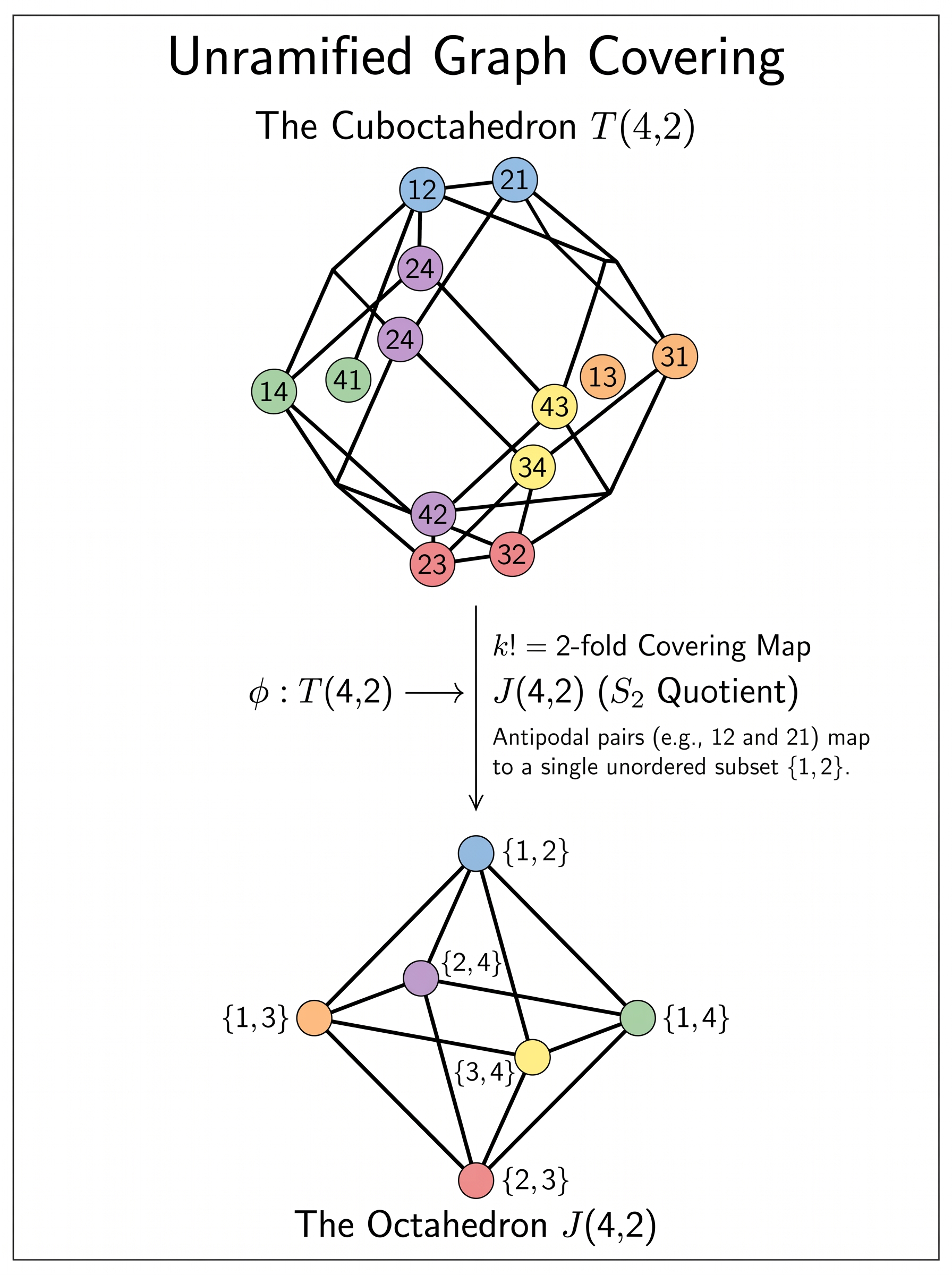
doubly covered by the cuboctahedron
with no vertical edges, and second as
folding onto
stays harmonic even when centralizer sizes vary, precisely because conjugate commuting elements absorb the size differences into collapsed vertical edges.

 . Remarkably, the number of rational points on these curves is closely related to the weights of codewords in certain binary linear codes, called quasi-quadratic residue (QQR) codes. This means that a problem about constructing good codes can be translated into a problem about counting solutions to polynomial equations.
 of any binary linear block code
 , where
 A refinement of the Bazzi-Mitter conjecture is given below and is still open.
 for infinitely many primes p ≡ ±3 (mod 8).
 for some fixed
 , for infinitely many such p.
 (which is about 1.779), then Goppa’s conjecture is false.
 over a finite field to construct good decoding methods for the associated Goppa code. The basic idea is that by permuting the coordinates of a received codeword message, with possible errors in transmission, to permute its error coordinates out of a chosen information set, making decoding simpler.
 as I could. It was amazing to me then and now how much number-theoretic information a single function like that could encode. The non-trivial zeros
 of
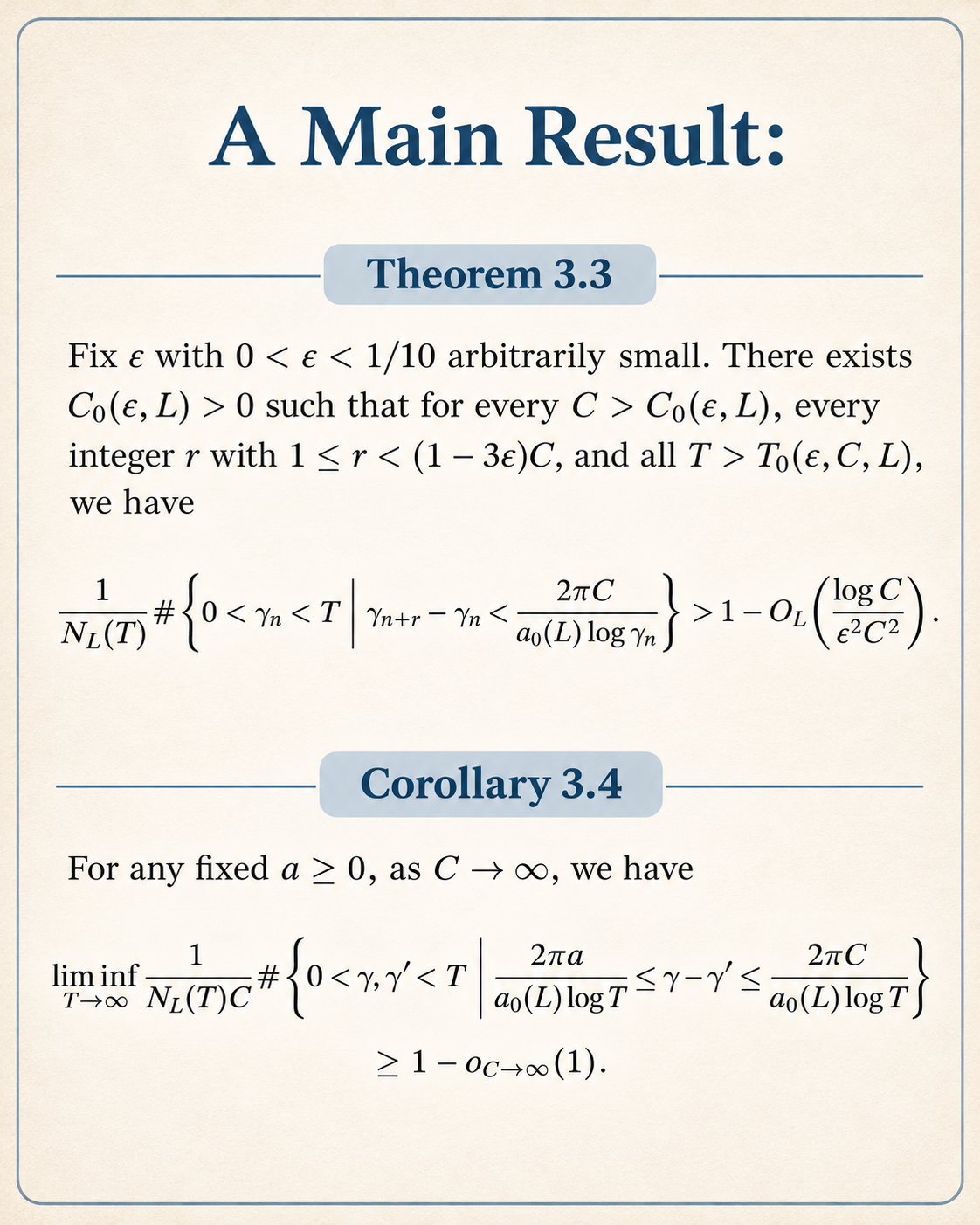
 . Using arguments of A. Fujii (On the difference between r consecutive ordinates of the zeros of the Riemann zeta function, Proc. Japan Acad., 1975) and A. Ghosh (On the Riemann zeta function—mean value theorems and the distribution of |S(t)|, J. Number Theory, 1983), I wrote a preprint A note on gaps between zeros of L-functions (


You must be logged in to post a comment.