The Elevator Problem

You are on the bottom floor (floor 0, lets call it) of an apartment building with no basement. There are n elevators, which we index 1,2,…,n. Assume the elevators are on floors f1, f2, … , where fk > 0 is the floor elevator k is currently on, 1 <= k <= n. Assume you only like one of the elevators, elevator e.


The way the elevator logic works is this: When you press the elevator button, one closest to you ( = one on floor number min(fk, k>0)) is told to go to 0. If there is a tie then, of those on the same lowest floor, the elevator with the smallest index is told to go to 0.
Move: If you press the button and some other elevator than elevator e arrives, you can tell it to go to any floor you wish.
Taboo: You can press the elevator button if and only if no elevator is moving down.
Goal: You want to use elevator e (for some fixed e=1, 2, …, n).

Problem: Is there a finite sequence of moves that allows you to ride in elevator e?

My plan is to post the answer sometime later, but have fun with it!

In the works: a book “Exploring Graphs via Harmonic Morphisms”

Caroline Melles and I have been working for some years on a 2-volume book in graph theory which investigates harmonic morphisms. These are, roughly speaking, mappings from one graph to another that preserve locally harmonic functions on these graphs. Therefore, this topic fits into the general framework of harmonic analysis on graphs.

This post only concerns the first volume. The intent here is to mention some of the types of results we obtain. Of course, by no means is it intended to be a complete description.

The second volume will be summarized in a separate post.

Graphs in our book are unweighted and, unless stated otherwise, have no loops or multiple edges. The basic idea is this: in chapter 2 we classify harmonic morphisms using a criteria expressed as a matrix identity. For various graph-theoretical constructions (such as edge deletion or join or a graph product or …) that can be performed on a given graph Gamma, we pick a graph morphism associated to the construction (such as sending a vertex in the constructed graph to the given graph). That morphism is associated to a matrix (which we called the vertex map matrix in chapter 3 of our earlier book, Adventures in Graph Theory). When this matrix satisfies the above-mentioned matrix criteria then the associated morphism is harmonic.

Chapter 1 is on Graph Morphisms.

This chapter is devoted to background on graph morphisms and some of the methods we use to study them.

  1. Roughly speaking, a morphism is a mapping between graphs that preserves incidence structure. After defining horizontal and vertical edges, vertical multiplicities, local horizontal multiplicities, it recalls well-known graph families like cycle graphs, path graphs, and complete graphs.
  2. There are a few very useful degree identities. First, there is a fundamental formula relating vertex degrees to multiplicities under morphisms. There is also a formula for the degree
    of the morphism in terms of vertical multiplicities and local horizontal multiplicities.
  3. A topic threading through the book is that of matrix-theoretic methods. This first chapter introduces vertex map matrices and edge map matrices that encode morphisms. After establishing key matrix identities and products, reviews adjacency matrices and their spectra, with detailed analysis of cycle graph eigenvalues using Chebyshev polynomials and complex roots of unity.
  4. It recalls signed and unsigned incidence matrices, with and without edge orientations, and establishes the fundamental Graph Homomorphism Identity relating incidence matrices to morphism matrices,
  5. introduces Laplacian matrices as differences of degree and adjacency matrices, connecting to the incidence matrix framework.
  6. Introduced graph blowup morphisms via a blowup construction where vertices are replaced by independent sets, creating natural homomorphisms with specific structural properties.
  7. Some functorial properties of graph morphisms are established, such as how morphisms behave under graph constructions like subdivisions, smoothing, deletions, and substitutions.
  8. The chapter ends with exercises and a chapter summary.

Chapter 2 on Harmonic Morphisms

    This chapter is devoted to the basics of harmonic morphisms.
  1. Introduces the core definition: a graph morphism is harmonic if local horizontal multiplicities are constant across edges incident to each vertex’s image.
  2. Cycle space and cocycle space – Develops the algebraic framework using homology and cohomology of graphs. Covers Urakawa’s theorem on pullbacks of harmonic 1-forms and Baker-Norin results on divisors and Jacobians.
  3. Matrix-theoretic methods – Establishes the fundamental matrix characterization: a morphism is harmonic iff there exists a diagonal multiplicity matrix satisfying specific adjacency matrix identities. Proves equivalence with an analogous Laplacian matrix identity and an analogous incidence matrix criteria.
  4. The Riemann-Hurwitz formula – Presents the graph-theoretic analogue relating genera of graphs via harmonic morphisms, with matrix proof and applications to regular graphs.
  5. Some functorial consequences – Demonstrates how harmonic morphisms interact with graph constructions like subdivision, edge substitution, leaf addition, and deletion. Shows these
    operations preserve harmonicity under appropriate conditions.
  6. The chapter ends with exercises and a chapter summary.

All harmonic morphisms from this graph to C4 are covers.

  1. Fundamental Problem: Given a graph Gamma1, for which graphs Gamma2 is there a non-trivial harmonic morphism phi from Gamma2 to Gamma1?
  1. Follow-up question: Can the number of such phi be counted?

Chapter 3 on Counting Problems

This chapter looks at various families, such as the path graphs. What is especially remarkable is that, as we will see, the problem of counting harmonic morphisms often boils down to solving certain recurrance relations, some of which arose (in a completely different context of course) in
the work of medieval mathematicians, both in Europe and in India.

  1. Regarding harmonic morphisms between path graphs, we show how to construct and count the harmonic morphisms from longer path graphs to shorter ones.
  2. Regarding harmonic morphisms between cycle graphs, we show how to construct and count the harmonic morphisms from larger cycle graphs (when they exist) to smaller ones. It turns out all such harmonic morphisms are necessarily covers.
  3. Regarding harmonic morphisms between complete graphs, we show how to construct and count the harmonic morphisms from larger complete graphs (when they exist) to smaller ones.
  4. Harmonic morphisms to P2 (arising from the Baker-Norin Theorem) can be counted.
  5. Harmonic morphisms to P3 (the path graph with only 3 vertices) can be counted in special cases.
    There are lots of open questions, such as which trees have a harmonic morphism to P3.
  6. The chapter ends with exercises and a chapter summary.

Chapter 4 on Harmonic Quotient Morphisms

    This chapter studies quotient graphs arising from group actions and from vertex partitions.
  1. Quotient graphs from group actions. Harmonic actions and transitive actions are studied separately.
  2. Quotient graphs from paritions. Orbit partitions and equitable partitions are studied.
  3. As a nice application of harmonic morphisms with particularly nice structural properties, we consider multicovers and blowup graphs.
  4. The last section provides explicit formulas for the eigenvalue spectra of harmonic blowups of bipartite graphs, connecting the eigenvalues of the source and target graphs through the blowup parameters. The main result is the Godsil-McKay Theorem.
  5. The chapter ends with exercises and a chapter summary.

Chapter 5 on Graph Morphisms and Graph Products

    This chapter studies graph morphisms associated to tensor products of graphs and lexicographical products of graphs.

    Roughly speaking, a graph product of Gamma1 with Gamma2 is a graph Gamma3 = (V3, E3), where V3 = V1 x V2 is the Cartesian product and there is a rule for the edges E3 based on some conditions on the vertices. The graph products considered in this book are the disjunctive, Cartesian, tensor, lexicographic, and the strong products.

    The most basic questions one wants answered are these:
    is the projection pr1 : Gamma1 x Gamma2 to Gamma1 harmonic, and
    is the projection pr2 : Gamma1 x Gamma2 to Gamma2 harmonic?
    If they do turn out to be harmonic morphisms, we also want to know the vertical and horizontal multiplicities as well. If they do not turn out to be harmonic morphisms, we also want (if possible) to establish conditions on the graphs under which the projections are harmonic.

    However, we want to not only consider products of graphs but also products of morphisms.
    In this case, the most basic question one wants answered is this:
    Given harmonic morphisms phi : Gamma2 to Gamma1 and phi’ : Gamma2′ to Gamma1′, is the
    product phi x phi’ harmonic?

  1. For example, we show that projection morphisms from tensor products are always harmonic with explicit horizontal multiplicity formulas.
  2. Moreover, we prove that the tensor product of harmonic morphisms (without vertical edges) yields a harmonic morphism with horizontal multiplicity matrix given by the Kronecker product of the original multiplicity matrices.
  3. If Gamma x Gamma’ is a lexicographical product then the projection onto the first factor, pr1, is a harmonic morphism. However, the projection onto the second factor is not in general.
  4. We establish a connection between the balanced blowup graph and a lexicographical product. One corollary of this connection is that the blowdown graph agrees with the first projection of the product, so is a harmonic morphism.

Chapter 6 on More Products and Constructions

  1. This chapter studies graph morphisms associated to Cartesian/strong/disjunctive products of graphs as well as joins and NEPS graphs.
  2. For example, we show that projection morphisms from Cartesian products or from strong products are always harmonic with explicit horizontal multiplicity formulas.
  3. Roughly speaking, one of the results states:
    Given two m-quasi-multicovers phi from Gamma2 to Gamma1 and phi’ from Gamma2′ to Gamma1′, the Cartesian product phi x phi’ is also an m-quasi-multicover (hence harmonic).
  4. Another result, roughly speaking, states:
    Given two harmonic morphisms phi from Gamma2 to Gamma1 and phi’ from Gamma2′ to Gamma1′, the
    strong product phi x phi’ is also harmonic.
  5. Can one classify the graphs for which the disjunctive product projections pr1 or pr2 are graph morphisms?
  6. For example, we show that if phi from Gamma2 to Gamma1 and phi’ from Gamma2′ to Gamma1′ are graph morphisms, then the associated product map from Gamma2 x Gamma2′ to Gamma1 x Gamma1′ (where x is the disjunctive product) is, in general, not a graph morphism.
  7. Given two harmonic morphisms phi from Gamma2 to Gamma1 and phi’ from Gamma2′ to Gamma1′, the join morphism phi wedge phi’ is harmonic if and only if a certain technical condition is true.
  8. A theorem due to Urakawa states that projection morphisms from a NEPS graph to one
    of its factors are always harmonic. Moreover, we give explicit horizontal multiplicity formulas.
  9. The chapter ends with exercises and a chapter summary.

Computations are supported throughout using SageMath and Mathematica. The plan is the publish the volume with Birkhauser. We thank the editors there, especially John Benedetto, for their encouragement and guidance.

A simple trace formula for graphs

Let \Gamma=(V,E) be a simple, connected graph with vertices V={0,1,\dots, n-1} and n\times n adjacency matrix A. We start with the geometric series identity

\frac{1}{I-tA} = \sum_{\ell=0}^\infty t^\ell A^\ell,
where I=I_n is the n\times n identity matrix. Let P denote the orthonormal matrix of normalized eigenvectors, so that

PAP^{-1} = D_\Gamma, D_\Gamma = {diag}(\lambda_1,\dots,\lambda_n),
where diag(…) denotes the diagonal matrix with the given entries on the diagonal. Let the multi-set

Spec(\Gamma)={\lambda_0,\lambda_1\dots,\lambda_{n-1}}
denote the spectrum of \Gamma.

We can conjugate the above equation by P to write

\frac{1}{I-tD_\Gamma}= P\cdot [\sum_{\ell=0}^\infty t^\ell A^\ell]\cdot P^{-1}.
Taking the trace of each side gives

\sum_{j=0}^{n-1} \frac{1}{I-t\lambda_j} = \sum_{\ell=0}^\infty t^\ell tr(A^\ell).
If \Gamma has no eigenvalues equal to 0 (i.e., A is non-singular) then we may also write this as

\sum_{j=0}^{n-1} \frac{\lambda_j^{-1}}{\lambda_j^{-1}-t} = \sum_{\ell=0}^\infty t^\ell tr(A^\ell).

If we multiply both sides of the above equation by a fixed f\in C_c^\infty({\mathbb{R}})
and integrate over t in {\mathbb{R}}, we get,

\sum_{j=0}^{n-1} \lambda_j^{-1}H(f)(\lambda_j^{-1}) = {\frac{1}{\pi}}\sum_{\ell=0}^\infty tr(A^\ell) [M(f)(\ell+1)+(-1)^\ell M(f^*)(\ell+1)],
where H denotes the Hilbert transform

H(f)(z) = \frac{1}{\pi}P.V.\int_{-\infty}^\infty \frac{f(t)}{z-t}\, dt, and M is the Mellin transform

M(f)(z) = \int_{0}^\infty t^{z-1}f(t)\, dt,
and where f^* denotes the negation, f^*(t)=f(-t). Of course, if f is even then M(f)(\ell+1) = M(f^*)(\ell+1), for all \ell.

Note that tr(A^\ell) can be expressed in terms of the number of walks on the graph: If \Gamma is a connected graph and W_\ell=W_\ell(\Gamma) denotes the total number of walks of length \ell on \Gamma then

W_\ell = {\rm tr}(A^\ell)=\sum_{\lambda\in Spec(\Gamma)} \lambda^\ell.

Harmonic quotients of regular graphs – examples

Caroline Melles and I have written a preprint that collects numerous examples of harmonic quotient morphisms \phi : \Gamma_2 \to \Gamma_1, where \Gamma_1=\Gamma_2/G is a quotient graph obtained from some subgroup G \subset Aut(\Gamma_2). The examples are for graphs having a small number of vertices (no more than 12). For the most part, we also focused on regular graphs with small degree (no more than 5). They were all computed using SageMath and a module of special purpose Python functions I’ve written (available on request). I’ve not counted, but the number of examples is relatively large, maybe over one hundred.

I’ll post it to the math arxiv at some point but if you are interested now, here’s a copy: click here for pdf.

A graph_id function in SageMath

While GAP has a group_id function which locates a “small” group in a small groups database (see the SageMath page or the GAP page for more info), AFAIK, SageMath doesn’t have something similar. I’ve written one (see below) based on the mountain of hard work done years ago by Emily Kirkman.

def graph_id_graph6(Gamma, verbose=False):
    """
    Returns the graph6 id of Gamma = (V,E).
    If verbose then it also displays the table of all graphs with
    |V| vertices and |E| edges.

    Assumes Gamma is a "small" graph.

    EXAMPLES:
    sage: Gamma = graphs.HouseGraph()
    sage: graph_id_graph6(Gamma, verbose=False)
    'Dbk'
    sage: graph_id_graph6(Gamma, verbose=True)

     graphs with 5 vertices and 6 edges:

    Graph6               Aut Grp Size         Degree Sequence     
    ------------------------------------------------------------
    DB{                  2                    [1, 2, 2, 3, 4]     
    DFw                  12                   [2, 2, 2, 3, 3]     
    DJ[                  24                   [0, 3, 3, 3, 3]     
    DJk                  2                    [1, 2, 3, 3, 3]     
    DK{                  8                    [2, 2, 2, 2, 4]     
    Dbk                  2                    [2, 2, 2, 3, 3]     


    'Dbk'

"""
n = len(Gamma.vertices())
m = len(Gamma.edges())
ds = Gamma.degree_sequence()
Q = GraphQuery(display_cols=['graph6', 'aut_grp_size', 'degree_sequence'], num_edges=['=', m], num_vertices=["=", n])
for g in Q:
    if g.is_isomorphic(Gamma):
        if verbose:
            print("\n graphs with %s vertices"%n+" and %s edges:\n"%m)
            Q.show()
            print("\n")
        return g.graph6_string()

Harmonic morphisms to P_4 – examples

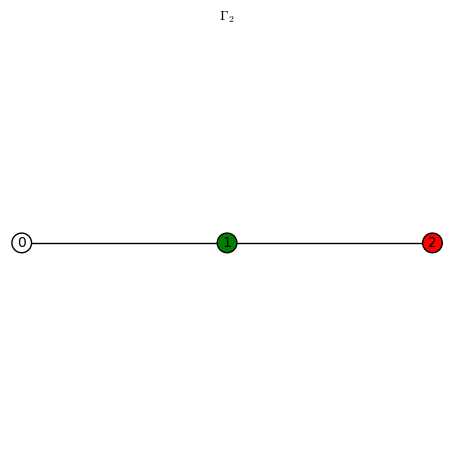
This post expands on a previous post and gives more examples of harmonic morphisms to the path graph \Gamma_2=P_4.
path4-0123

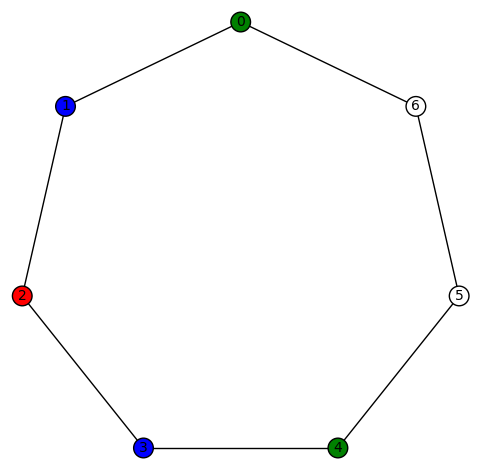
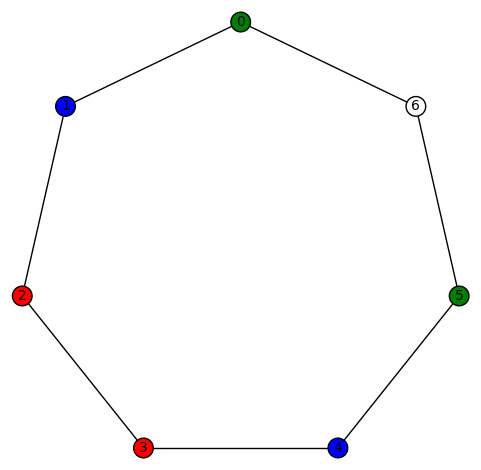
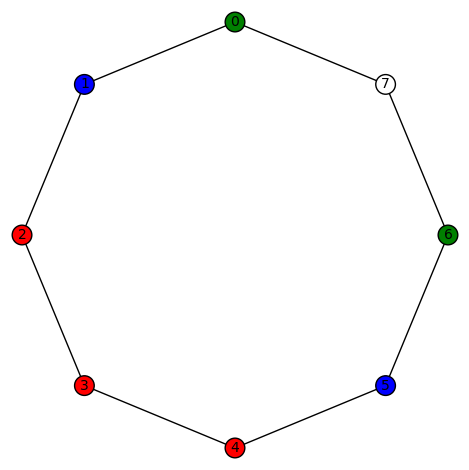
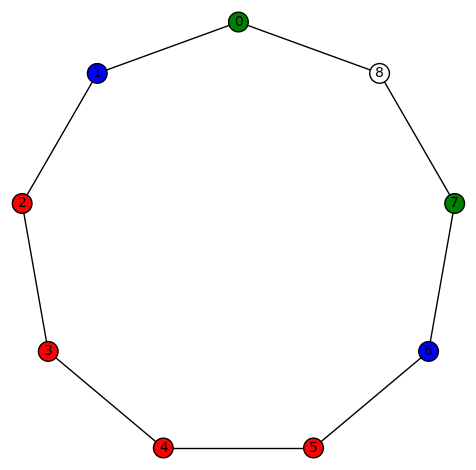
First, a simple remark about harmonic morphisms in general: roughly speaking, they preserve adjacency. Suppose \phi:\Gamma_1\to \Gamma_2 is a harmonic morphism. Let v,w\in V_1 be adjacent vertices of \Gamma_1. Then either (a) \phi(v)=\phi(w) and \phi “collapses” the edge (vertical) (v,w) or (b) \phi(v)\not= \phi(w) and the vertices \phi(v) and \phi(w) are adjacent in \Gamma_2. In the particular case of this post (ie, the case of \Gamma_2=P_4), this remark has the following consequence: since in P_4 the white vertex is not adjacent to the blue or red vertex, none of the harmonic colored graphs below can have a white vertex adjacent to a blue or red vertex.

We first consider the cyclic graph on k vertices, C_k as the domain in this post. However, before we get to examples (obtained by using SageMath), I’d like to state a (probably naive) conjecture.

Let \phi:\Gamma_1 \to \Gamma_2=P_k be a harmonic morphism from a graph \Gamma_1 with n=|V_1| vertices to the path graph having k>2 vertices. Let f:V_2 \to V_1 be the coloring map (identified with an n-tuple whose coordinates are in \{0,1,\dots ,k-1\}). Associated to f is a partition \Pi_f=[n_0,\dots,n_{k-1}] of n (here [...] is a multi-set, so repetition is allowed but the ordering is unimportant): n=n_0+n_1+...+n_{k-1}, where n_j is the number of times j occurs in f. We call this the partition invariant of the harmonic morphism.

Definition: For any two harmonic morphisms \phi:\Gamma_1 \to P_k, \phi:\Gamma'_1 \to P_k, with associated
colorings f, f' whose corresponding partitions agree, \Pi_f=\Pi_{f'} then we say f' and f are partition equivalent.

What can be said about partition equivalent harmonic morphisms? Caroline Melles has given examples where partition equivalent harmonic morphisms are not induced from an automorphism.

Now onto the \Gamma_1 \to P_4 examples!

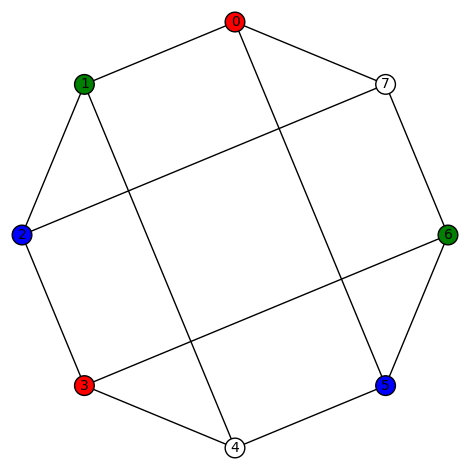
There are no non-trivial harmonic morphisms C_5 \to P_4, so we start with C_6. We indicate a harmonic morphism by a vertex coloring. An example of a harmonic morphism can be described in the plot below as follows: \phi:\Gamma_1\to \Gamma_2=P_4 sends the red vertices in \Gamma_1 to the red vertex of \Gamma_2=P_4 (we let 3 be the numerical notation for the color red), the blue vertices in \Gamma_1 to the blue vertex of \Gamma_2=P_4 (we let 2 be the numerical notation for the color blue), the green vertices in \Gamma_1 to the green vertex of \Gamma_2=P_4 (we let 1 be the numerical notation for the color green), and the white vertices in \Gamma_1 to the white vertex of \Gamma_2=P_4 (we let 0 be the numerical notation for the color white).

To get the following data, I wrote programs in Python using SageMath.

Example 1: There are only the 4 trivial harmonic morphisms C_6 \to P_4, plus that induced by f = (1, 2, 3, 2, 1, 0) and all of its cyclic permutations (4+6=10). This set of 6 permutations is closed under the automorphism of P_4 induced by the transposition (0,3)(1,2) (so total = 10).cyclic6-123210

Example 2: There are only the 4 trivial harmonic morphisms, plus f = (1, 2, 3, 2, 1, 0, 0) and all of its cyclic permutations (4+7=11). This set of 7 permutations is not closed under the automorphism of P_4 induced by the transposition (0,3)(1,2), so one also has f = (2, 1, 0, 1, 2, 3, 3) and all 7 of its cyclic permutations (total = 7+11 = 18).
cyclic7-1232100
cyclic7-1233210

Example 3: There are only the 4 trivial harmonic morphisms, plus f = (1, 2, 3, 2, 1, 0, 0, 0) and all of its cyclic permutations (4+8=12). This set of 8 permutations is not closed under the automorphism of P_4 induced by the transposition (0,3)(1,2), so one also has f = (1, 2, 3, 3, 3, 2, 1, 0) and all of its cyclic permutations (12+8=20). In addition, there is f = (1, 2, 3, 3, 2, 1, 0, 0) and all of its cyclic permutations (20+8 = 28). The latter set of 8 cyclic permutations of (1, 2, 3, 3, 2, 1, 0, 0) is closed under the transposition (0,3)(1,2) (total = 28).
cyclic8-12321000
cyclic8-12333210
cyclic8-12332100

Example 4: There are only the 4 trivial harmonic morphisms, plus f = (1, 2, 3, 2, 1, 0, 0, 0, 0) and all of its cyclic permutations (4+9=13). This set of 9 permutations is not closed under the automorphism of P_4 induced by the transposition (0,3)(1,2), so one also has f = (1, 2, 3, 3, 2, 1, 0, 0, 0) and all 9 of its cyclic permutations (9+13 = 22). This set of 9 permutations is not closed under the automorphism of P_4 induced by the transposition (0,3)(1,2), so one also has f = (1, 2, 3, 3, 3, 2, 1, 0, 0) and all 9 of its cyclic permutations (9+22 = 31). This set of 9 permutations is not closed under the automorphism of P_4 induced by the transposition (0,3)(1,2), so one also has f = (1, 2, 3, 3, 3, 3, 2, 1, 0) and all 9 of its cyclic permutations (total = 9+31 = 40). cyclic9-123210000cyclic9-123321000cyclic9-123332100cyclic9-123333210

Next we consider some cubic graphs.

Example 5: There are 5 cubic graphs on 8 vertices, as listed on this wikipedia page. I wrote a SageMath program that looked for harmonic morphisms on a case-by-case basis. There are no non-trivial harmonic morphisms from any one of these 5 graphs to P_4.

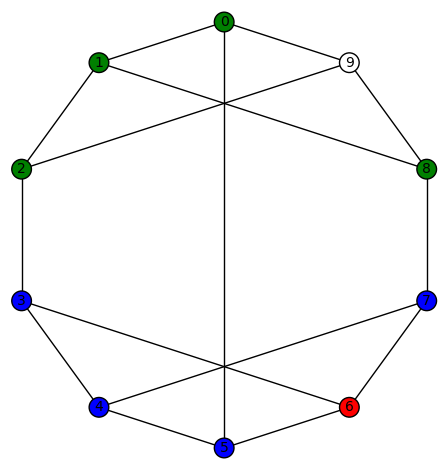
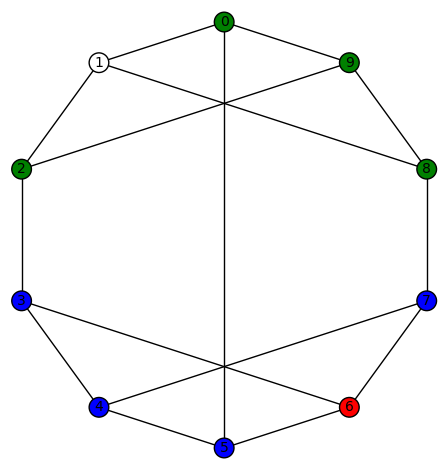
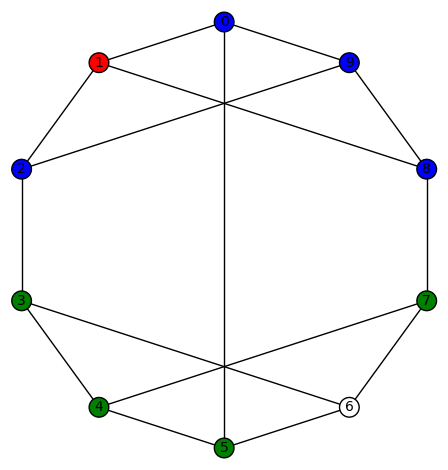
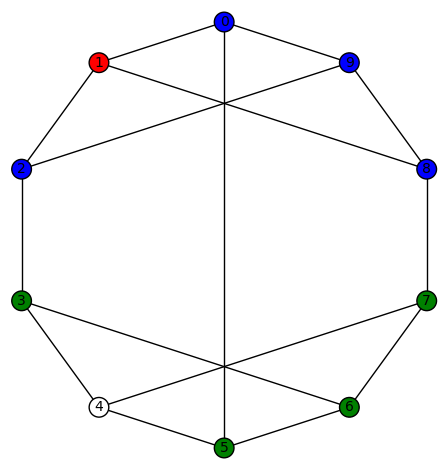
Example 6: There are 19 cubic graphs on 10 vertices, as listed on this wikipedia page. I wrote a SageMath program that looked for harmonic morphisms on a case-by-case basis. The only one of these 19 cubic graphs \Gamma_1 having a harmonic morphism \phi:\Gamma_1\to P_4 is the graph whose SageMath command is graphs.LCFGraph(10,[5, -3, -3, 3, 3],2). It has diameter 3, girth 4, and automorphism group of order 48 generated by (4,6), (2,8)(3,7), (1,9), (0,2)(3,5), (0,3)(1,4)(2,5)(6,9)(7,8). There are eight non-trivial harmonic morphisms \phi:\Gamma_1\to P_4. They are depicted as follows:
3regular10nn-P4-1112322210
3regular10nn-P4-1112223210
3regular10nn-P4-1012322211
3regular10nn-P4-1012223211
3regular10nn-P4-2321110122
3regular10nn-P4-2321011122
3regular10nn-P4-2221110123
3regular10nn-P4-2221011123
Note that the last four are obtained from the first 4 by applying the permutation (0,3)(1,2) to the colors (where 0 is white, etc, as above).

We move to cubic graphs on 12 vertices. There are quite a few of them – according to the House of Graphs page on connected cubic graphs, there are 109 of them (if I counted correctly).

Example 7: The cubic graphs on 12 vertices are listed on this wikipedia page. I wrote a SageMath program that looked for harmonic morphisms on a case-by-case basis. If there is no harmonic morphism \Gamma_1\to P_4 then, instead of showing a graph, I’ll list the edges (of course, the vertices are 0,1,…,11) and the SageMath command for it.

  1. \Gamma_1=(V_1,E_1), where E_1=\{ (0, 1), (0, 2), (0, 11), (1, 2), (1, 6), (2, 3), (3, 4), (3, 5), (4, 5), (4, 6), (5, 6), (7, 8), (7, 9), (7, 11), (8, 9), (8, 10), (9, 10), (10, 11)\}.
    SageMath command:
    V1 = [0,1,2,3,4,5,6,7,8,9,10,11]
    E1 = [(0,1), (0,2), (0,11), (1,2), (1,6),(2,3), (3,4), (3,5), (4,5), (4,6), (5,6), (7,8), (7,9), (7,11), (8,9),(8,10), (9,10), (10,11)]
    Gamma1 = Graph([V1,E1])

    (Not in LCF notation since it doesn’t have a Hamiltonian cycle.)
  2. \Gamma_1=(V_1,E_1), where E_1=\{ (0, 1), (0, 6), (0, 11), (1, 2), (1, 3), (2, 3), (2, 5), (3, 4), (4, 5), (4, 6), (5, 6), (7, 8), (7, 9), (7, 11), (8, 9), (8, 10), (9, 10), (10, 11)\}.
    SageMath command:
    V1 = [0,1,2,3,4,5,6,7,8,9,10,11]
    E1 = [(0, 1), (0, 6), (0, 11), (1, 2), (1, 3), (2, 3), (2, 5), (3, 4), (4, 5), (4, 6), (5, 6), (7, 8), (7, 9), (7, 11), (8, 9), (8, 10), (9, 10), (10, 11)]
    Gamma1 = Graph([V1,E1])

    (Not in LCF notation since it doesn’t have a Hamiltonian cycle.)
  3. \Gamma_1=(V_1,E_1), where E_1=\{(0,1),(0,3),(0,11),(1,2),(1,6),(2,3),(2,5),(3,4),(4,5),(4,6),(5,6),(7,8),(7,9),(7,11),(8,9),(8,10),(9,10),(10,11)\}.
    SageMath command:
    V1 = [0,1,2,3,4,5,6,7,8,9,10,11]
    E1 = [(0,1),(0,3),(0,11),(1,2),(1,6),(2,3),(2,5),(3,4),(4,5),(4,6),(5,6),(7,8),(7,9),(7,11),(8,9),(8,10),(9,10),(10,11)]
    Gamma1 = Graph([V1,E1])

    (Not in LCF notation since it doesn’t have a Hamiltonian cycle.)
  4. \Gamma_1=(V_1,E_1), where E_1=\{(0, 1), (0, 3), (0, 11), (1, 2), (1, 11), (2, 3), (2, 10), (3, 4), (4, 5), (4, 8), (5, 6), (5, 7), (6, 7), (6, 9), (7, 8), (8, 9), (9, 10), (10, 11)\}.
    SageMath command:
    Gamma1 = graphs.LCFGraph(12, [3, -2, -4, -3, 4, 2], 2)
  5. \Gamma_1=(V_1,E_1), where E_1=\{(0, 1), (0, 3), (0, 11), (1, 2), (1, 11), (2, 3), (2, 10), (3, 4), (4, 5), (4, 7), (5, 6), (5, 8), (6, 7), (6, 9), (7, 8), (8, 9), (9, 10), (10, 11)\}.
    SageMath command:
    Gamma1 = graphs.LCFGraph(12, [3, -2, -4, -3, 3, 3, 3, -3, -3, -3, 4, 2], 1)
  6. \Gamma_1=(V_1,E_1), where E_1=\{(0, 1), (0, 4), (0, 11), (1, 2), (1, 3), (2, 3), (2, 5), (3, 4), (4, 5), (5, 6), (6, 7), (6, 8), (7, 8), (7, 10), (8, 9), (9, 10), (9, 11), (10, 11)\}.
    SageMath command:
    Gamma1 = graphs.LCFGraph(12, [4, 2, 3, -2, -4, -3, 2, 3, -2, 2, -3, -2], 1)
  7. \Gamma_1=(V_1,E_1), where E_1=\{(0, 1), (0, 3), (0, 11), (1, 2), (1, 4), (2, 3), (2, 5), (3, 4), (4, 5), (5, 6), (6, 7), (6, 9), (7, 8), (7, 10), (8, 9), (8, 11), (9, 10), (10, 11)\}.
    SageMath command:
    Gamma1 = graphs.LCFGraph(12, [3, 3, 3, -3, -3, -3], 2)
  8. (list under construction)

Harmonic morphisms to P_3 – examples

This post expands on a previous post and gives more examples of harmonic morphisms to the path graph \Gamma_2=P_3.

The path graph P_3

If \Gamma_1 = (V_1, E_1) and \Gamma_2 = (V_2, E_2) are graphs then a map \phi:\Gamma_1\to \Gamma_2 (that is, \phi: V_1\cup E_1\to V_2\cup E_2) is a morphism provided

  1. if \phi sends an edge to an edge then the edges vertices must also map to each other: e=(v,w)\in E_1 and \phi(e)\in E_2 then \phi(e) is an edge in \Gamma_2 having vertices \phi(v)\in V_2 and \phi(w)\in V_2, where \phi(v)\not= \phi(w), and
  2. if \phi sends an edge to a vertex then the edges vertices must also map to that vertex: if e=(v,w)\in E_1 and \phi(e)\in V_2 then \phi(e) = \phi(v) = \phi(w).

As a non-example, if \Gamma_1 is a planar graph, if \Gamma_2 is its dual graph, and if \phi:\Gamma_1\to\Gamma_2 is the dual map V_1\to E_2 and E_1\to V_2, then \phi is not a morphism.

Given a map \phi_E : E_1 \rightarrow E_2 \cup V_2, an edge e_1 is called horizontal if \phi_E(e_1) \in E_2 and is called vertical if \phi_E(e_1) \in V_2. We say that a graph morphism \phi: \Gamma_1 \rightarrow \Gamma_2 is a graph homomorphism if \phi_E (E_1) \subset E_2. Thus, a graph morphism is a homomorphism if it has no vertical edges.

Suppose that \Gamma_2 has at least one edge. Let Star_{\Gamma_1}(v) denote the star subgraph centered at the vertex v. A graph morphism \phi : \Gamma_1 \to \Gamma_2 is called harmonic if for all vertices v \in V(\Gamma_1), the quantity
\mu_\phi(v,f)= |\phi^{-1}(f) \cap Star_{\Gamma_1}(v)|
(the number of edges in \Gamma_1 adjacent to v and mapping to the edge f in \Gamma_2) is independent of the choice of edge f in Star_{\Gamma_2}(\phi(v)).

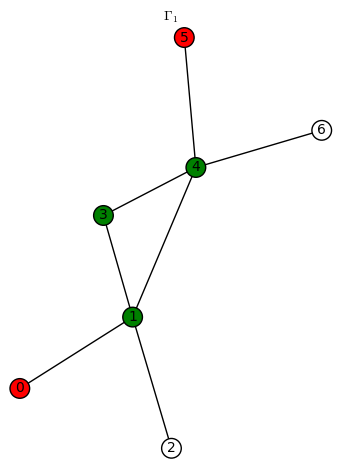
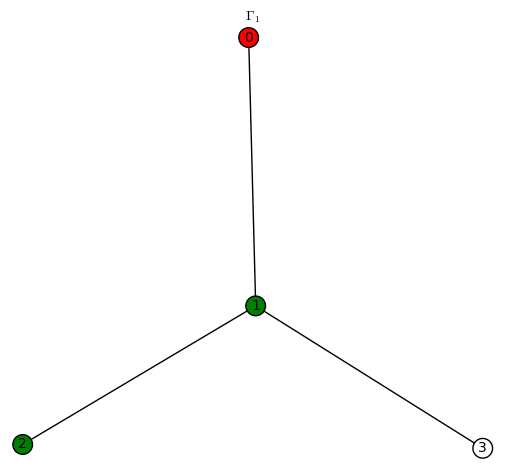
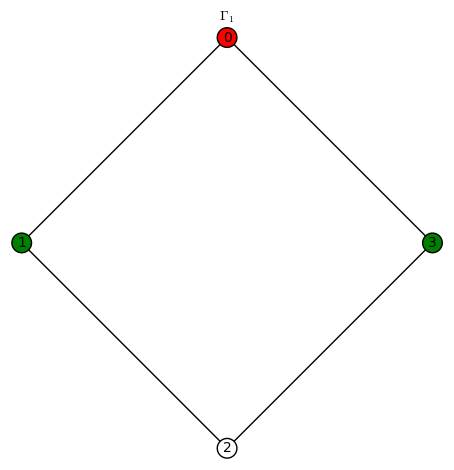
An example of a harmonic morphism can be described in the plot below as follows: \phi:\Gamma_1\to \Gamma_2=P_3 sends the red vertices in \Gamma_1 to the red vertex of \Gamma_2=P_3, the green vertices in \Gamma_1 to the green vertex of \Gamma_2=P_3, and the white vertices in \Gamma_1 to the white vertex of \Gamma_2=P_3.

Example 1:

P3-C3-V

Example 2:
D3-2110

Example 3:
cyclic4-2101

MINIMOGs and Mathematical blackjack

This is an exposition of some ideas of Conway, Curtis, and Ryba on S(5,6,12) and a card game called mathematical blackjack (which has almost no relation with the usual Blackjack).

Many thanks to Alex Ryba and Andrew Buchanan for helpful discussions on this post.

Definitions

An m-(sub)set is a (sub)set with m elements. For integers k<m<n, a Steiner system S(k,m,n) is an n-set X and a set S of m-subsets having the property that any k-subset of X is contained in exactly one m-set in S. For example, if X = \{1,2,\dots,12\}, a Steiner system S(5,6,12) is a set of 6-sets, called hexads, with the property that any set of 5 elements of X is contained in (“can be completed to”) exactly one hexad.

Rob Beezer has a nice Sagemath description of S(5,6,12).

If S is a Steiner system of type (5,6,12) in a 12-set X then any element the symmetric group \sigma\in Symm_X\cong S_{12} of X sends S to another Steiner system \sigma(S) of X. It is known that if S and S’ are any two Steiner systems of type (5,6,12) in X then there is a \sigma\in Symm_X such that S'=\sigma(S). In other words, a Steiner system of this type is unique up to relabelings. (This also implies that if one defines M_{12} to be the stabilizer of a fixed Steiner system of type (5,6,12) in X then any two such stabilizer groups, for different Steiner systems in X, must be conjugate in Symm_X. In particular, such a definition is well-defined up to isomorphism.)

Curtis’ kitten

NICOLESHENTING-Cats-Playing-Poker-Cards-Art-Silk-Fabric-Poster-Canvas-Print-13x20-24x36inch-Funny-Pictures-Home.jpg_640x640

NICOLE SHENTING – Cats Playing Poker Cards

J. Conway and R. Curtis [Cu1] found a relatively simple and elegant way to construct hexads in a particular Steiner system S(5,6,12) using the arithmetical geometry of the projective line over the finite field with 11 elements. This section describes this.

Let \mathbf{P}^1(\mathbf{F}_{11}) =\{\infty,0,1,2,...,9,10\} denote the projective line over the finite field \mathbf{F}_{11} with 11 elements. Let Q=\{0,1,3,4,5,9\} denote the quadratic residues with 0, and let L=\cong PSL(2,\mathbf{F}_{11}), where \alpha(y)=y+1 and \beta(y)=-1/y. Let S=\{\lambda(Q)\ \vert\ \lambda\in L\}.

Lemma 1: S is a Steiner system of type (5,6,12).

The elements of S are known as hexads (in the “modulo 11 labeling”).

 	 	 	 	 	\infty	 	 	 	 	 
 	 	 	 	 	 	 	 	 	 	 
 	 	 	 	 	6	 	 	 	 	 
 	 	 	 	 	 	 	 	 	 	 
 	 	 	 	2	 	10	 	 	 	 
 	 	 	 	 	 	 	 	 	 	 
 	 	 	5	 	7	 	3	 	 	 
 	 	 	 	 	 	 	 	 	 	 
 	 	6	 	9	 	4	 	6	 	 
 	 	 	 	 	 	 	 	 	 	 
 	2	 	10	 	8	 	2	 	10	 
 	 	 	 	 	 	 	 	 	 	 
0	 	 	 	 	 	 	 	 	 	1
 	 	 	 	 	 	 	 	 	 	 

Curtis’ Kitten.

In any case, the “views” from each of the three “points at infinity” is given in the following tables.

6	10	3
2	7	4
5	9	8
picture at \infty

5	7	3
6	9	4
2	10	8
picture at 0	

5	7	3
9	4	6
8	2	10
picture at 1

Each of these 3\times 3 arrays may be regarded as the plane \mathbf{F}_3^2. The lines of this plane are described by one of the following patterns.

\bullet	\bullet	\bullet
\times	\times	\times
\circ	\circ	\circ	
slope 0	

\bullet	\times	\circ
\bullet	\times	\circ	
slope infinity

\bullet	\times	\circ
\circ	\bullet	\times
\times	\circ	\bullet	
slope -1

\times	\circ	\bullet
\circ	\bullet	\times
\bullet	\times	\circ
slope 1

The union of any two perpendicular lines is called a cross. There are 18 crosses. The complement of a cross in \mathbf{F}_3^2 is called a square. Of course there are also 18 squares. The hexads are

  1. \{0,1,\infty\}\cup \{{\rm any\ line}\},
  2. the union of any two (distinct) parallel lines in the same picture,
  3. one “point at infinity” union a cross in the corresponding picture,
  4. two “points at infinity” union a square in the picture corresponding to the omitted point at infinity.

Lemma 2 (Curtis [Cu1]) There are 132 such hexads (12 of type 1, 12 of type 2, 54 of type 3, and 54 of type 4). They form a Steiner system of type $(5,6,12)$.

The MINIMOG description

Following Curtis’ description [Cu2] of a Steiner system S(5,8,24) using a $4\times 6$ array, called the MOG, Conway [Co1] found and analogous description of S(5,6,12) using a 3\times 4 array, called the MINIMOG. This section is devoted to the MINIMOG. The tetracode words are

0	0	0	0		0	+	+	+		0	-	-	-
+	0	+	-		+	+	-	0		+	-	0	+
-	0	-	+		-	+	0	-		-	-	+	0

With ”0″=0, “+”=1, “-“=2, these vectors form a linear code over GF(3). (This notation is Conway’s. One must remember here that “+”+”+”=”-“!) They may also be described as the set of all 4-tuples in of the form

(0,a,a,a),(1,a,b,c),(2,c,b,a),
where abc is any cyclic permutation of 012. The MINIMOG in the shuffle numbering is the array
\begin{array}{cccc} 6 & 3 & 0 & 9\\ 5 & 2 & 7 & 10 \\ 4 & 1 & 8 & 11 \end{array}
We label the rows of the MINIMOG array as follows:

  1. the first row has label 0,
  2. the second row has label +,
  3. the third row has label –

A col (or column) is a placement of three + signs in a column of the MINIMOG array. A tet (or tetrad) is a placement of 4 + signs having entries corresponding (as explained below) to a tetracode.

+	+	+	+
 	 	 	 
 	 	 	 
0	0	0	0
+	 	 	 
 	+	+	+
 	 	 	 
0	+	+	+
+	 	 	 
 	 	 	 
 	+	+	+


0	-	-	-

 	+	 	 
+	 	+	 
 	 	 	+

+	0	+	-
 	 	 	+
+	+	 	 
 	 	+	 

+	+	-	0
 	 	+	 
+	 	 	+
 	+	 	 


+	-	0	+
 	+	 	 
 	 	 	+
+	 	+	 

-	0	-	+

 	 	+	 
 	+	 	 
+	 	 	+

-	+	0	-

 	 	 	+
 	 	+	 
+	+	 	 


-	-	+	0

Each line in \mathbf{F}_3^2 with finite slope occurs once in the 3\times 3 part of some tet. The odd man out for a column is the label of the row corresponding to the non-zero digit in that column; if the column has no non-zero digit then the odd man out is a “?”. Thus the tetracode words associated in this way to these patterns are the odd men out for the tets. The signed hexads are the combinations $6$-sets obtained from the MINIMOG from patterns of the form

col-col, col+tet, tet-tet, col+col-tet.

Lemma 3 (Conway, [CS1], chapter 11, page 321) If we ignore signs, then from these signed hexads we get the 132 hexads of a Steiner system S(5,6,12). These are all possible $6$-sets in the shuffle labeling for which the odd men out form a part (in the sense that an odd man out “?” is ignored, or regarded as a “wild-card”) of a tetracode word and the column distribution is not 0,1,2,3 in any order.

Furthermore, it is known [Co1] that the Steiner system S(5,6,12) in the shuffle labeling has the following properties.

  1. There are 11 hexads with total 21 and none with lower total.
  2. The complement of any of these 11 hexads in \{0,1,...,11\} is another hexad.
  3. There are 11 hexads with total 45 and none with higher total.

Mathematical blackjack

Mathematical blackjack is a 2-person combinatorial game whose rules will be described below. What is remarkable about it is that a winning strategy, discovered by Conway and Ryba [CS2] and [KR], depends on knowing how to determine hexads in the Steiner system S(5,6,12) using the shuffle labeling.

Mathematical blackjack is played with 12 cards, labeled 0,\dots ,11 (for example: king, ace, 2, 3, …, 10, jack, where the king is 0 and the jack is 11). Divide the 12 cards into two piles of 6 (to be fair, this should be done randomly). Each of the 6 cards of one of these piles are to be placed face up on the table. The remaining cards are in a stack which is shared and visible to both players. If the sum of the cards face up on the table is less than 21 then no legal move is possible so you must shuffle the cards and deal a new game. (Conway [Co2] calls such a game *={0|0}, where 0={|}; in this game the first player automatically wins.)

  1. Players alternate moves.
  2. A move consists of exchanging a card on the table with a lower card from the other pile.
  3. The player whose move makes the sum of the cards on the table under 21 loses.

The winning strategy (given below) for this game is due to Conway and Ryba [CS2], [KR]. There is a Steiner system S(5,6,12) of hexads in the set \{0,1,...,11\}. This Steiner system is associated to the MINIMOG of in the “shuffle numbering” rather than the “modulo 11 labeling”.

The following result is due to Ryba.

Proposition 6: For this Steiner system, the winning strategy is to choose a move which is a hexad from this system.

This result is proven in a wonderful paper J. Kahane and A. Ryba, [KR]. If you are unfortunate enough to be the first player starting with a hexad from S(5,6,12) then, according to this strategy and properties of Steiner systems, there is no winning move! In a randomly dealt game there is a probability of 1/7 that the first player will be dealt such a hexad, hence a losing position. In other words, we have the following result.

Corollary 7: The probability that the first player has a win in mathematical blackjack (with a random initial deal) is 6/7.

An example game is given in this expository hexads_sage (pdf).

Bibliography

[Cu1] R. Curtis, “The Steiner system $S(5,6,12)$, the Mathieu group $M_{12}$, and the kitten,” in Computational group theory, ed. M. Atkinson, Academic Press, 1984.
[Cu2] —, “A new combinatorial approach to $M_{24}$,” Math Proc Camb Phil Soc 79(1976)25-42
[Co1] J. Conway, “Hexacode and tetracode – MINIMOG and MOG,” in Computational group theory, ed. M. Atkinson, Academic Press, 1984.
[Co2] —, On numbers and games (ONAG), Academic Press, 1976.
[CS1] J. Conway and N. Sloane, Sphere packings, Lattices and groups, 3rd ed., Springer-Verlag, 1999.
[CS2] —, “Lexicographic codes: error-correcting codes from game theory,” IEEE Trans. Infor. Theory32(1986)337-348.
[KR] J. Kahane and A. Ryba, “The hexad game,” Electronic Journal of Combinatorics, 8 (2001)
Memories of TS Michael, by Thomas Quint

TS Michael passed away on November 22, 2016, from cancer. I will miss him as a colleague and a kind, wise soul. Tom Quint has kindly allowed me to post these reminiscences that he wrote up.


Well, I guess I could start with the reason TS and I met in the first place. I was a postdoc at USNA in about 1991 and pretty impressed with myself. So when USNA offered to continue my postdoc for two more years (rather than give me a tenure track position), I turned it down. Smartest move I ever made, because TS got the position and so we got to know each other.

We started working w each other one day when we both attended a talk on “sphere of influence graphs”. I found the subject moderately interesting, but he came into my office all excited, and I couldn’t get rid of him — wouldn’t leave until we had developed a few research ideas.

Interestingly, his position at USNA turned into a tenure track, while mine didn’t. It wasn’t until 1996 that I got my position at U of Nevada.

Work sessions with him always followed the same pattern. As you may or may not know, T.S. a) refused to fly in airplanes, and b) didn’t drive. Living across the country from each other, the only way we could work together face-to-face was: once each summer I would fly out to the east coast to visit my parents, borrow one of their cars for a week, and drive down to Annapolis. First thing we’d do is go to Whole Foods, where he would load up my car with food and other supplies, enough to last at least a few months. My reward was that he always bought me the biggest package of nigiri sushi we could find — not cheap at Whole Foods!

It was fun, even though I had to suffer through eight million stories about the USNA Water Polo Team.

Oh yes, and he used to encourage me to sneak into one of the USNA gyms to work out. We figured that no one would notice if I wore my Nevada sweats (our color is also dark blue, and the pants also had a big “N” on them). It worked.

Truth be told, TS didn’t really have a family of his own, so I think he considered the mids as his family. He cared deeply about them (with bonus points if you were a math major or a water polo player :-).

One more TS anecdote, complete with photo.  Specifically, TS was especially thrilled to find out that we had named our firstborn son Theodore Saul Quint.  Naturally, TS took to calling him “Little TS”.  At any rate, the photo below is of “Big TS” holding “Little TS”, some time in the Fall of 2000.

tslittlets_photo2000

TS Michael in 2000.

A tribute to TS Michael

I’ve known TS for over 20 years as a principled colleague and a great teacher.

ts-michaels_2015-12-21_small

TS at the USNA in Dec 2015.

However, we really never spoke much except for the past five-to-ten years or so. For a period, I wrote a lot about error-correcting codes and we’d talk occasionally about our common interests (for example, I found his paper “The rigidity theorems of Hamada and Ohmori, revisited” fascinating). However, once I became interested in graph theory, we spoke as often as I could corner him. He taught me a lot and only know I realize how lucky I was to have him as a colleague.

I remember many times, late on a Friday, when we’d talk for an hour or two about chess, mathematics, “office politics” (he always knew more than me), and allergies. Here’s one of his favorite chess problems:

mate-in-549

Mate in 549 moves. This problem was discovered by a team of chess engame experts at Lomonosov University, Moscow, August 2012.

Maybe this says more about me than him, but when it was just the two of us, we rarely talked about families or relationships. None-the-less, he always treated me like a good friend. One of my favorite memories was when my wife and I were shopping at the plaza where his condo building was located (it’s a big plaza). Elva and I were walking store-to-store when we spotted TS. He was walking to distract himself from his discomfort. At the time, doctors didn’t know what his problems were and he suspected allergies. I have a number of food sensitivities and he was a welcomed fountain of medical knowledge about these issues. (In fact, his hints have really helped me a lot, health-wise.) In any case, TS and Elva and I spoke for 30 minutes or so about health and family. I remember how gracious and thoughtful he was, skillfully steering the conversation into non-technical matters for Elva’s benefit. I ran into him another time while waiting for Elva, who was in a nearby doctor’s office (I told you this was a big shopping plaza). TS generously waited with me until Elva was ready to be picked up. What we chatted about is lost in the cobwebs of my memory but I remember vividly where we sat and the kind of day it was. TS had such a kind heart.

As I said, TS taught me a lot about graph theory. Whether in-between classes or when I was lucky enough to spot him late in the day, he’d kindly entertain my naive (usually false) conjectures and speculations about strongly regular graphs. I never heard him speak in anything but the kindest terms. He’d never say “that’s just plain wrong” or “idiotic” (even if it was) but instead teach me the correct way to think about it in a matter in which I could see myself how my speculations were wrong-headed. My upcoming book with Caroline Melles is indebted to his insight and suggestions.

Even after he left Maryland to spend his remaining days with his family in California, TS emailed encouragement and suggestions about an expository paper I was writing to help connect my matrix theory students with the methods of ranking sports teams. While he was very helpful and provided me with his excellent insights as usual, in truth, I used the work on the paper as an excuse to keep up with his health status. I’m relatively ignorant of medical issues and tried to stay optimistic until it’s totally unrealistic. As sad as it was, we was always frank and honest with me about his prognosis.

He’s gone now, but as a teacher, researcher, and as a kind soul, TS is unforgettable.


A list of TS’s publications:

  1. T. S. Michael, Tournaments, book chapter in Handbook of Linear Algebra, 2nd ed, CRC Press, Boca Raton, 2013.
  2. T. S. Michael, Cycles of length 5 in triangle-free graphs: a sporadic counterexample to a characterization of equality, Bulletin of the Institute of Combinatorics and Its Applications, 67 (2013) 6–8.
  3. T. S. Michael and Val Pinciu, Guarding orthogonal prison yards: an upper bound,
    Congressus Numerantium, 211 (2012) 57–64.
  4. Ilhan Hacioglu and T. S. Michael, The p-ranks of residual and derived skew Hadamard designs,
    Discrete Mathematics, 311 (2011) 2216-2219.
  5. T. S. Michael, Guards, galleries, fortresses, and the octoplex, College Math Journal, 42 (2011) 191-200. (This paper won a Polya Award)
  6. Elizabeth Doering, T. S. Michael, and Bryan Shader, Even and odd tournament matrices with minimum rank over finite fields, Electronic Journal of Linear Algebra, 22 (2011) 363-377.
  7. Brenda Johnson, Mark E. Kidwell, and T. S. Michael, Intrinsically knotted graphs have at least 21 edges, Journal of Knot Theory and Its Ramifications, 19 (2010) 1423-1429.
  8. T. S. Michael, How to Guard an Art Gallery and Other Discrete Mathematical Adventures. Johns Hopkins University Press, Baltimore, 2009.
  9. T. S. Michael and Val Pinciu, Art gallery theorems and triangulations, DIMACS Educational Module Series, 2007, 18 pp (electronic 07-1)
  10. T. S. Michael and Thomas Quint, Sphericity, cubicity, and edge clique covers of graphs, Discrete Applied Mathematics, 154 (2006) 1309-1313.
  11. T. S. Michael and Val Pinciu, Guarding the guards in art galleries, Math Horizons, 14 (2006), 22-23, 25.
  12. Richard J. Bower and T. S. Michael, Packing boxes with bricks, Mathematics Magazine, 79 (2006), 14-30.
  13. T. S. Michael and Thomas Quint, Optimal strategies for node selection games: skew matrices and symmetric games, Linear Algebra and Its Applications 412 (2006) 77-92.
  14. T. S. Michael, Ryser’s embedding problem for Hadamard matrices, Journal of Combinatorial Designs 14 (2006) 41-51.
  15. Richard J. Bower and T. S. Michael, When can you tile a box with translates of two given rectangular bricks?, Electronic Journal of Combinatorics 11 (2004) Note 7, 9 pages.
  16. T. S. Michael and Val Pinciu, Art gallery theorems for guarded guards, Computational Geometry 26 (2003) 247-258.
  17. T. S. Michael, Impossible decompositions of complete graphs into three Petersen subgraphs, Bulletin of the Institute of Combinatorics and Its Applications 39 (2003) 64-66.
  18. T. S. Michael and William N. Traves, Independence sequences of well-covered graphs: non-unimodality and the roller-coaster conjecture, Graphs and Combinatorics 19 (2003) 403-411.
  19. T. S. Michael and Thomas Quint, Sphere of influence graphs and the L-Infinity metric, Discrete Applied Mathematics 127 (2003) 447-460.
  20. T. S. Michael, Signed degree sequences and multigraphs, Journal of Graph Theory 41 (2002) 101-105.
  21. T. S. Michael and Val Pinciu, Multiply guarded guards in orthogonal art galleries, Lecture Notes in Computer Science 2073, pp 753-762, in: Proceedings of the International Conference on Computer Science, San Francisco, Springer, 2001.
  22. T. S. Michael, The rigidity theorems of Hamada and Ohmori, revisited, in Coding Theory and Cryptography: From the Geheimschreiber and Enigma to Quantum Theory. (Annapolis, MD, 1998), 175-179, Springer, Berlin, 2000.
  23. T. S. Michael and Thomas Quint, Sphere of influence graphs in general metric spaces, Mathematical and Computer Modelling, 29 (1999) 45-53.
  24. Suk-Geun Hwang, Arnold R. Kraeuter, and T. S. Michael, An upper bound for the permanent of a nonnegative matrix, Linear Algebra and Its Applications 281 (1998), 259-263.
    * First Corrections: Linear Algebra and Its Applications 300 (1999), no. 1-3, 1-2
  25. T. S. Michael and W. D. Wallis, Skew-Hadamard matrices and the Smith normal form, Designs, Codes, and Cryptography, 13 (1998) 173-176.
  26. T. S. Michael, The p-ranks of skew Hadamard designs, Journal of Combinatorial Theory, Series A, 73 (1996) 170-171.
  27. T. S. Michael, The ranks of tournament matrices, American Mathematical Monthly, 102 (1995) 637-639.
  28. T. S. Michael, Lower bounds for graph domination by degrees, pp 789-800 in Graph Theory, Combinatorics, and Algorithms: Proceedings of the Seventh Quadrennial International Conference on the Theory and Applications of Graphs, Y. Alavi and A. Schwenk (eds.), Wiley, New York, 1995.
  29. T. S. Michael and Thomas Quint, Sphere of influence graphs: a survey, Congressus Numerantium, 105 (1994) 153-160.
  30. T. S. Michael and Thomas Quint, Sphere of influence graphs: edge density and clique size, Mathematical and Computer Modelling, 20 (1994) 19-24.
  31. T. S. Michael and Aaron Stucker, Mathematical pitfalls with equivalence classes, PRIMUS, 3 (1993) 331-335.
  32. T. S. Michael, The structure matrix of the class of r-multigraphs with a prescribed degree sequence, Linear Algebra and Its Applications, 183 (1993) 155-177.
  33. T. S. Michael, The decomposition of the complete graph into three isomorphic strongly regular graphs, Congressus Numerantium, 85 (1991) 177-183.
  34. T. S. Michael, The structure matrix and a generalization of Ryser’s maximum term rank formula, Linear Algebra and Its Applications, 145 (1991) 21-31.
  35. Richard A. Brualdi and T. S. Michael, The class of matrices of zeros, ones and twos with prescribed row and column sums, Linear Algebra and Its Applications, 114(115) (1989) 181-198.
  36. Richard A. Brualdi and T. S. Michael, The class of 2-multigraphs with a prescribed degree sequence, Linear and Multilinear Algebra, 24 (1989) 81-102.
  37. Richard A. Brualdi, John L. Goldwasser, and T. S. Michael, Maximum permanents of matrices of zeros and ones, Journal of Combinatorial Theory, Series A, 47 (1988) 207-245.