Signed incidence matrices in Sagemath

Let \Gamma be a graph with an edge orientation. This means that we are given \Gamma = (V,E), where V is the set of vertices and E a set of ordered pairs of distinct vertices representing the edges, and, for each edge an “orientation”. Simply put, an orientation on $\latex \Gamma$ is a list e_0 of length |E| consisting of \pm 1‘s. If an edge e=(v,w) is associated to a -1 then we think of the edge as going from w to v; otherwise, it goes from v to w.

Let F be a field, let n = |V| and let m=|E|. The incidence matrix may be regarded as a mapping B from the vector space of function on V to the vector space of functions on E:

B: C^0(\Gamma, F)\to C^1(\Gamma, F),

in the notation of Biggs [B]. If we identify C^0(\Gamma, F) with the vector space of column vectors F^n and C^1(\Gamma, F) with the vector space of column vectors F^m then B may be regarded as an m\times n matrix.

At one point Sagemath’s incidence matrix did not respect the given ordering of the vertices and edges, nor did it allow for orientations. (I’m not sure if that still is true.) I wrote the following the following to implement a function to return a signed incidence matrix

def incidence_matrix(Gamma, eo):
    """
    This computes the incidence matrix (whose rows are indexed by edges
    and whose columns are indexed by vertices) of a graph Gamma with 
    edge-orientation vector eo. The ordering of the edges and of the vertices is the same 
    as Sage's vertices and edges methods.

    INPUT:
        Gamma - graph
        eo - a vector of 1's and -1's whose length is the number of edges in Gamma
             (ie, the size of Gamma, M)

    EXAMPLES:
        sage: Gamma = graphs.PaleyGraph(9)
        sage: E = Gamma.edges()
        sage: V = Gamma.vertices()
        sage: eo = [1, -1, 1, 1, -1, -1, 1, -1, 1, 1, -1, -1, 1, -1, 1, 1, -1, -1]
        sage: incidence_matrix(Gamma, eo)
        [ 1 -1  1  1  0  0  0  0  0  0  0  0  0  0  0  0  0  0]
        [-1  0  0  0 -1 -1  1  0  0  0  0  0  0  0  0  0  0  0]
        [ 0  1  0  0  1  0  0 -1  1  0  0  0  0  0  0  0  0  0]
        [ 0  0  0  0  0  0  0  1  0  1 -1 -1  0  0  0  0  0  0]
        [ 0  0 -1  0  0  0  0  0  0 -1  0  0  1 -1  0  0  0  0]
        [ 0  0  0  0  0  1  0  0  0  0  1  0 -1  0  1  0  0  0]
        [ 0  0  0  0  0  0 -1  0  0  0  0  0  0  0 -1  1 -1  0]
        [ 0  0  0  0  0  0  0  0 -1  0  0  1  0  0  0 -1  0 -1]
        [ 0  0  0 -1  0  0  0  0  0  0  0  0  0  1  0  0  1  1]
        sage: B = incidence_matrix(Gamma, eo) 
        sage: B*B.transpose() == Gamma.laplacian_matrix()
        True

    """
    E = Gamma.edges()
    V = Gamma.vertices()
    IG = [[incidence_value(Gamma, v, e, eo) for v in V] for e in E]
    #print IG
    return matrix(QQ, IG).transpose()

This uses the function below

def incidence_value(Gamma, v, e, eo):
    """
    This computes the incidence value of a vertex and edge of 
    a graph Gamma with edge-orientation vector eo. 

    INPUT:
        Gamma - graph
        v  - vertex of Gamma
        e  - edge of Gamma  
        eo - a vector of 1's and -1's whose length is the number of edges in Gamma
 
    EXAMPLES:
        sage: Gamma = graphs.PaleyGraph(9)
        sage: E = Gamma.edges()
        sage: V = Gamma.vertices()
        sage: eo = [1]*len(E)
        sage: incidence_value(Gamma, V[2], E[3], eo)
        0
        sage: incidence_value(Gamma, V[8], E[3], eo)
        -1

    """
    E = Gamma.edges()
    if v in e:
        if v == e[0]:
            k = E.index(e)
            return eo[k]
        elif v == e[1]:
            k = E.index(e)
            return -eo[k]
        else:
            return 0
    return 0

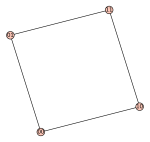
For example, consider the Paley graph on 9 vertices:

graph-sage-paley9

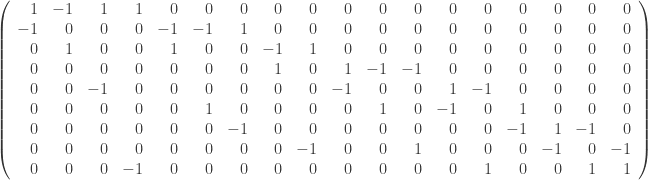
The orientation [1, -1, 1, 1, -1, -1, 1, -1, 1, 1, -1, -1, 1, -1, 1, 1, -1, -1] attached to the edges [(0, 1),
(0, 2), (0, a + 1), (0, 2*a + 2), (1, 2), (1, a + 2), (1, 2*a), (2, a), (2, 2*a + 1), (a, a + 1), (a, a + 2), (a, 2*a + 1), (a + 1, a + 2), (a + 1, 2*a + 2), (a + 2, 2*a), (2*a, 2*a + 1), (2*a, 2*a + 2), (2*a + 1, 2*a + 2)] gives rise to the incidence matrix

\left(\begin{array}{rrrrrrrrrrrrrrrrrr}  1 & -1 & 1 & 1 & 0 & 0 & 0 & 0 & 0 & 0 & 0 & 0 & 0 & 0 & 0 & 0 & 0 & 0 \\  -1 & 0 & 0 & 0 & -1 & -1 & 1 & 0 & 0 & 0 & 0 & 0 & 0 & 0 & 0 & 0 & 0 & 0 \\  0 & 1 & 0 & 0 & 1 & 0 & 0 & -1 & 1 & 0 & 0 & 0 & 0 & 0 & 0 & 0 & 0 & 0 \\  0 & 0 & 0 & 0 & 0 & 0 & 0 & 1 & 0 & 1 & -1 & -1 & 0 & 0 & 0 & 0 & 0 & 0 \\  0 & 0 & -1 & 0 & 0 & 0 & 0 & 0 & 0 & -1 & 0 & 0 & 1 & -1 & 0 & 0 & 0 & 0 \\  0 & 0 & 0 & 0 & 0 & 1 & 0 & 0 & 0 & 0 & 1 & 0 & -1 & 0 & 1 & 0 & 0 & 0 \\  0 & 0 & 0 & 0 & 0 & 0 & -1 & 0 & 0 & 0 & 0 & 0 & 0 & 0 & -1 & 1 & -1 & 0 \\  0 & 0 & 0 & 0 & 0 & 0 & 0 & 0 & -1 & 0 & 0 & 1 & 0 & 0 & 0 & -1 & 0 & -1 \\  0 & 0 & 0 & -1 & 0 & 0 & 0 & 0 & 0 & 0 & 0 & 0 & 0 & 1 & 0 & 0 & 1 & 1  \end{array}\right)

References:
[B] Norman Biggs, “Algebraic potential theory on graphs”, BLMS, 1997.

I think Caroline Melles for help debugging the code above.

Linear systems of graphs in Sage

Let \Gamma be a graph. A divisor on \Gamma is an element of the free group generated by the vertices V, {\mathbb{Z}}[V].

We say that divisors D and D^\prime are linearly equivalent and write D \sim D^\prime if D^\prime-D is a principal divisor, i.e., if D^\prime = D + \text{div}(f) for some function f : V \rightarrow {\mathbb{Z}}. Note that if D and D^\prime are linearly equivalent, they must have the same degree, since the degree of every principal divisor is 0. Divisors of degree 0 are linearly equivalent if and only if they determine the same element of the Jacobian. If D is a divisor of degree 0, we denote by [D] the element of the Jacobian determined by D. A divisor D is said to be effective if D(v) \geq 0 for all vertices v. We write D \geq 0 to mean that D is effective. The linear system associated to a divisor D is the set

|D| = \{ D^\prime \in \text{Div}(\Gamma ) : D^\prime \geq 0 \text{ and } D^\prime \sim D\},

i.e., |D| is the set of all effective divisors linearly equivalent to D. Note that if D_1 \sim D_2, then |D_1| = |D_2|. We note also that if \text{deg}(D)<0, then |D| must be empty.

Sage can be used to compute the linear system of any divisor on a graph.

def linear_system(D, Gamma):
    """
    Returns linear system attached to the divisor D.

    EXAMPLES:
        sage: Gamma2 = graphs.CubeGraph(2)
        sage: Gamma1 = Gamma2.subgraph(vertices = ['00', '01'], edges = [('00', '01')])
        sage: f = [['00', '01', '10', '11'], ['00', '01', '00', '01']]
        sage: is_harmonic_graph_morphism(Gamma1, Gamma2, f)
        True
        sage: PhiV = matrix_of_graph_morphism_vertices(Gamma1, Gamma2, f); PhiV
        [1 0 1 0]
        [0 1 0 1]
        sage: D = vector([1,0,0,1])
        sage: PhiV*D
        (1, 1)
        sage: linear_system(PhiV*D, Gamma1)
        [(2, 0), (1, 1), (0, 2)]
        sage: linear_system(D, Gamma2)
        [(0, 2, 0, 0), (0, 0, 2, 0), (1, 0, 0, 1)]
        sage: [PhiV*x for x in linear_system(D, Gamma2)]
        [(0, 2), (2, 0), (1, 1)]

    """
    Q = Gamma.laplacian_matrix()
    CS = Q.column_space()
    N = len(D.list())
    d = sum(D.list())
    #print d
    lin_sys = []
    if d < 0:
        return lin_sys
    if (d == 0) and (D in CS):
        lin_sys = [CS(0)]
        return lin_sys
    elif (d == 0):
        return lin_sys
    S = IntegerModRing(d+1)^N
    V = QQ^N
    for v in S:
        v = V(v)
        #print D-v,v,D
        if D-v in CS:
            lin_sys.append(v)
    return lin_sys


Differential calculus using Sagemath

Granville’s classic text book Elements of the Differential and Integral Calculus fell into the public domain and then much of it (but not all, at the time of this writing) was scanned into wikisource primarily by R. J. Hall. Granville’s entire book contains material on differential, integral, and even multivariable calculus. The material in the subset here is restricted to differential calculus topics, though contains some material which might properly belong to an elementary differential geometry course. The above-mentioned wikisource document uses mathml and latex and some Greek letter fonts.

In particular, the existence of this document owes itself primarily to three great open source projects: TeX/LaTeX, Wikipedia, and Sagemath (http://www.sagemath.org). Some material from Sean Mauch’s public domain text on Applied Mathematics, was also included.

The current latex document is due to David Joyner, who is responsible for re-formatting, editing for readability, the correction (or introduction) of typos from the scanned version, and any extra material added (for example, the hyperlinked cross references, and the Sagemath material). Please email corrections to wdjoyner@gmail.com.

Though the original text of Granville is public domain, the extra material added in this version is licensed under the GNU Free Documentation License (please see the FDL) as is most of Wikipedia.

Acknowledgements: I thank the following readers for reporting typos: Mario Pernici, Jacob Hicks.

Now available from amazon.com for $20 (not including shipping).

Discrete Fourier transforms using Sagemath

Here are some Sagemath examples for DFTs, DCTs, and DST’s. You can try copying and pasting them into the Sagemath cloud, for example.

The Sagemath dft command applies to a sequence S indexed by a set J computes the un-normalized DFT: (in Python)

[sum([S[i]*chi(zeta**(i*j)) for i in J]) for j in J]Here are some examples which explain the syntax:

sage: J = range(6)
sage: A = [ZZ(1) for i in J]
sage: s = IndexedSequence(A,J)
sage: s.dft(lambda x:x^2)
   Indexed sequence: [6, 0, 0, 6, 0, 0]
   indexed by [0, 1, 2, 3, 4, 5]
sage: s.dft()
   Indexed sequence: [6, 0, 0, 0, 0, 0]
   indexed by [0, 1, 2, 3, 4, 5]
sage: G = SymmetricGroup(3)
sage: J = G.conjugacy_classes_representatives()
sage: s = IndexedSequence([1,2,3],J) # 1,2,3 are the values of a class fcn on G
sage: s.dft()   # the "scalar-valued Fourier transform" of this class fcn
    Indexed sequence: [8, 2, 2]
    indexed by [(), (1,2), (1,2,3)]
sage: J = AbelianGroup(2,[2,3],names='ab')
sage: s = IndexedSequence([1,2,3,4,5,6],J)
sage: s.dft()   # the precision of output is somewhat random and arch. dependent.
    Indexed sequence: [21.0000000000000, -2.99999999999997 - 1.73205080756885*I, -2.99999999999999 + 1.73205080756888*I, -9.00000000000000 + 0.0000000000000485744257349999*I, -0.00000000000000976996261670137 - 0.0000000000000159872115546022*I, -0.00000000000000621724893790087 - 0.0000000000000106581410364015*I]                
     indexed by Multiplicative Abelian Group isomorphic to C2 x C3
sage: J = CyclicPermutationGroup(6)
sage: s = IndexedSequence([1,2,3,4,5,6],J)
sage: s.dft()   # the precision of output is somewhat random and arch. dependent.
    Indexed sequence: [21.0000000000000, -2.99999999999997 - 1.73205080756885*I, -2.99999999999999 + 1.73205080756888*I, -9.00000000000000 + 0.0000000000000485744257349999*I, -0.00000000000000976996261670137 - 0.0000000000000159872115546022*I, -0.00000000000000621724893790087 - 0.0000000000000106581410364015*I]
     indexed by Cyclic group of order 6 as a permutation group
sage: p = 7; J = range(p); A = [kronecker_symbol(j,p) for j in J]
age: s = IndexedSequence(A,J)
sage: Fs = s.dft()
sage: c = Fs.list()[1]; [x/c for x in Fs.list()]; s.list()
     [0, 1, 1, -1, 1, -1, -1]
     [0, 1, 1, -1, 1, -1, -1]


The DFT of the values of the quadratic residue symbol is itself, up to a constant factor (denoted c on the last line above).

Here is a 2nd example:

sage: J = range(5)
sage: A = [ZZ(1) for i in J]
sage: s = IndexedSequence(A,J)
sage: fs = s.dft(); fs
  Indexed sequence: [5, 0, 0, 0, 0]
   indexed by [0, 1, 2, 3, 4]
sage: it = fs.idft(); it
  Indexed sequence: [1, 1, 1, 1, 1]
   indexed by [0, 1, 2, 3, 4]
age: it == s
True
sage: t = IndexedSequence(B,J)
sage: s.convolution(t)
 [1, 2, 3, 4, 5, 4, 3, 2, 1]

Here is a 3rd example:

sage: J = range(5)
sage: A = [exp(-2*pi*i*I/5) for i in J]
sage: s = IndexedSequence(A,J)
sage: s.dct()    # discrete cosine
   Indexed sequence: [2.50000000000011 + 0.00000000000000582867087928207*I, 2.50000000000011 + 0.00000000000000582867087928207*I, 2.50000000000011 + 0.00000000000000582867087928207*I, 2.50000000000011 + 0.00000000000000582867087928207*I, 2.50000000000011 + 0.00000000000000582867087928207*I]
    indexed by [0, 1, 2, 3, 4]
sage: s.dst()        # discrete sine
  Indexed sequence: [0.0000000000000171529457304586 - 2.49999999999915*I, 0.0000000000000171529457304586 - 2.49999999999915*I, 0.0000000000000171529457304586 - 2.49999999999915*I, 0.0000000000000171529457304586 - 2.49999999999915*I, 0.0000000000000171529457304586 - 2.49999999999915*I]
   indexed by [0, 1, 2, 3, 4]

Here is a 4th example:

sage: I = range(3)
sage: A = [ZZ(i^2)+1 for i in I]
sage: s = IndexedSequence(A,I)
sage: P1 = s.plot()
sage: P2 = s.plot_histogram()

P1 and P2 are displayed below:

The plots of P1

The plot of P1

The plot of P2

The plot of P2

Remarks on mathematical research, according to Ira Glass

Ira Glass, of This American Life (http://www.thisamericanlife.org/), did an interview where he talked at length about writing news stories. They are here (links are to short youtube videos):

  1. Ira Glass on Storytelling, part 1 of 4
  2. Ira Glass on Storytelling, part 2 of 4
  3. Ira Glass on Storytelling, part 3 of 4
  4. Ira Glass on Storytelling, part 4 of 4

I thought a lot of what he said was based on general principles which applied to mathematical research as well. Here is perhaps what he would have said if he was talking about mathematics, sometimes with direct quotes from his interview:

There are two building blocks to a idea for a paper

  1.  The problem or question. This is sometimes an issue in the intersection of two fields or a question of why some object of interest behaves the way you think it does, based on an example you know.
  2. The revelation. This might be a key example or technique that will hopefully reveal the answer to your question.

You can have a great question, but if they don’t turn out to have any useful techniques or examples to work with, your idea is uninteresting. Conversely you can have a significant revelation with a fantastically powerful method, but if the problem or examples themselves are uninteresting, again you’ve got a weak idea.

You have to set aside just as much time looking for good ideas as you do producing them. In other words, the work of thinking up a good idea to write about is as much work and time as writing it up.

Not enough gets said about the importance of abandoning crap.

Most of your research ideas are going to be crap. That’s okay because the only way you can surface great ideas is by going through a lot of crappy ones. The only reason you want to be doing this is to make something memorable and special.

“The thing I’d like to say to you with all my heart is that most everybody I know who does interesting creative work went through a phase of years where with their good taste, they could tell what they were doing wasn’t as good as they wanted it to be … it didn’t have that special thing they wanted it to have … Everybody goes through that phase … and the most important thing you can do is do a lot of work.”

Ira Glass.

Examples of graph-theoretic harmonic morphisms using Sage

In the case of simple graphs (without multiple edges or loops), a map f between graphs \Gamma_2 = (V_2,E_2) and \Gamma_1 = (V_1, E_1) can be uniquely defined by specifying where the vertices of \Gamma_2 go. If n_2 = |V_2| and n_1 = |V_1| then this is a list of length n_2 consisting of elements taken from the n_1 vertices in V_1.

Let’s look at an example.

Example: Let \Gamma_2 denote the cube graph in {\mathbb{R}}^3 and let \Gamma_1 denote the “cube graph” (actually the unit square) in {\mathbb{R}}^2.

This is the 3-diml cube graph

This is the 3-diml cube graph \Gamma_2 in Sagemath

The cycle graph on 4 vertices

The cycle graph \Gamma_1 on 4 vertices (also called the cube graph in 2-dims, created using Sagemath.

We define a map f:\Gamma_2\to \Gamma_1 by

f = [[‘000’, ‘001’, ‘010’, ‘011’, ‘100’, ‘101’, ‘110’, ‘111’], [“00”, “00”, “01”, “01”, “10”, “10”, “11”, “11”]].

Definition: For any vertex v of a graph \Gamma, we define the star St_\Gamma(v) to be a subgraph of \Gamma induced by the edges incident to v. A map f : \Gamma_2 \to \Gamma_1 is called harmonic if for all vertices v' \in V(\Gamma_2), the quantity

|\phi^{-1}(e) \cap St_{\Gamma_2}(v')|

is independent of the choice of edge e in St_{\Gamma_1}(\phi(v')).

 
Here is Python code in Sagemath which tests if a function is harmonic:

def is_harmonic_graph_morphism(Gamma1, Gamma2, f, verbose = False):
    """
    Returns True if f defines a graph-theoretic mapping
    from Gamma2 to Gamma1 that is harmonic, and False otherwise. 

    Suppose Gamma2 has n vertices. A morphism 
              f: Gamma2 -> Gamma1
    is represented by a pair of lists [L2, L1],
    where L2 is the list of all n vertices of Gamma2,
    and L1 is the list of length n of the vertices
    in Gamma1 that form the corresponding image under
    the map f.

    EXAMPLES:
        sage: Gamma2 = graphs.CubeGraph(2)
        sage: Gamma1 = Gamma2.subgraph(vertices = ['00', '01'], edges = [('00', '01')])
        sage: f = [['00', '01', '10', '11'], ['00', '01', '00', '01']]
        sage: is_harmonic_graph_morphism(Gamma1, Gamma2, f)
        True
        sage: Gamma2 = graphs.CubeGraph(3)
        sage: Gamma1 = graphs.TetrahedralGraph()
        sage: f = [['000', '001', '010', '011', '100', '101', '110', '111'], [0, 1, 2, 3, 3, 2, 1, 0]]
        sage: is_harmonic_graph_morphism(Gamma1, Gamma2, f)
        True
        sage: Gamma2 = graphs.CubeGraph(3)
        sage: Gamma1 = graphs.CubeGraph(2)
        sage: f = [['000', '001', '010', '011', '100', '101', '110', '111'], ["00", "00", "01", "01", "10", "10", "11", "11"]]
        sage: is_harmonic_graph_morphism(Gamma1, Gamma2, f)
        True
        sage: is_harmonic_graph_morphism(Gamma1, Gamma2, f, verbose=True)
        This [, ]] passes the check: ['000', [1, 1]]
        This [, ]] passes the check: ['001', [1, 1]]
        This [, ]] passes the check: ['010', [1, 1]]
        This [, ]] passes the check: ['011', [1, 1]]
        This [, ]] passes the check: ['100', [1, 1]]
        This [, ]] passes the check: ['101', [1, 1]]
        This [, ]] passes the check: ['110', [1, 1]]
        This [, ]] passes the check: ['111', [1, 1]]
        True
        sage: Gamma2 = graphs.TetrahedralGraph()
        sage: Gamma1 = graphs.CycleGraph(3)
        sage: f = [[0,1,2,3],[0,1,2,0]]
        sage: is_harmonic_graph_morphism(Gamma1, Gamma2, f)
        False
        sage: is_harmonic_graph_morphism(Gamma1, Gamma2, f, verbose=True)
        This [, ]] passes the check: [0, [1, 1]]
        This [, ]] fails the check: [1, [2, 1]]
        This [, ]] fails the check: [2, [2, 1]]
        False

    """
    V1 = Gamma1.vertices()
    n1 = len(V1)
    V2 = Gamma2.vertices()
    n2 = len(V2)
    E1 = Gamma1.edges()
    m1 = len(E1)
    E2 = Gamma2.edges()
    m2 = len(E2)
    edges_in_common = []
    for v2 in V2:
        w = image_of_vertex_under_graph_morphism(Gamma1, Gamma2, f, v2)
        str1 = star_subgraph(Gamma1, w)
        Ew = str1.edges()
        str2 = star_subgraph(Gamma2, v2)
        Ev2 = str2.edges()
        sizes = []
        for e in Ew:
            finv_e = preimage_of_edge_under_graph_morphism(Gamma1, Gamma2, f, e)
            L = [x for x in finv_e if x in Ev2]
            sizes.append(len(L))
            #print v2,e,L
        edges_in_common.append([v2, sizes])
    ans = True
    for x in edges_in_common:
        sizes = x[1]
        S = Set(sizes)
        if S.cardinality()>1:
            ans = False
            if verbose and ans==False:
                print "This [, ]] fails the check:", x
        if verbose and ans==True:
            print "This [, ]] passes the check:", x
    return ans
            

For further details (e.g., code to

star_subgraph

, etc), just ask in the comments.

Lester Hill’s “The checking of the accuracy …” – finally completed

I’ve finally finished LaTeXing Lester Hill’s manuscript. You can download the pdf here: hill-error-checking-notes-unpublished. Just ask if you want a copy of the latex source.

hill, lester s

This post is to simply state Hill’s conclusion. It gives a clue as to why the paper was never published. If I had to guess, I’d say it was because he could not solve the problem he stated in that section.

As far as I know it is still unsolved.

Here is Hill’s Conclusion section:


Further problems connected with checking operations in finite fields will be treated in another paper. Machines may be devised to render almost quite automatic the evaluation of checking elements c_1,c_2,\dots,c_q according to any proposed reference matrix of the general type described in Section 7, whatever the finite field in which the operations are effected. Such machines would enable us to dispense entirely with tables of any sort, and checks could be determined with great speed. But before checking machines could be seriously planned, the following problem — which is one, incidentally, of considerable interest from the standpoint of pure number theory — would require solution:

To construct, for a given finite field F with \Gamma elements, and for the checking therein of n-element sequence f_1,f_2,\dots,f_n, a reference matrix

\left( \begin{array}{cccc} a_1 & a_2 & \dots & a_{n} \\ a_1^2 & a_2^2 & \dots & a_{n}^2 \\ \vdots & & & \vdots \\ a_1^q & a_2^q & \dots & a_{n}^q \\ \end{array} \right)

without a vanishing determinant of any order, in which the integer q is the greatest possible. Corresponding to any F, and any n — provided that n is less than \Gamma — there is a definite maximum q. This maximum should be ascertained, and the reference matrix therefore constructed.

We are not able to communicate a solution of this general problem.

(signed) Lester S. Hill


Lester Hill’s “The checking of the accuracy …”, part 14

Backstory: Lester Saunders Hill wrote unpublished notes, about 40 pages long, probably in the mid- to late 1920s. They were titled “The checking of the accuracy of transmittal of telegraphic communications by means of operations in finite algebraic fields”. In the 1960s this manuscript was given to David Kahn by Hill’s widow. The notes were typewritten, but mathematical symbols, tables, insertions, and some footnotes were often handwritten. I thank Chris Christensen, the National Cryptologic Museum, and NSA’s David Kahn Collection, for their help in obtaining these notes. Many thanks also to Rene Stein of the NSA Cryptologic Museum library and David Kahn for permission to publish this transcription. Comments by transcriber will look like this: [This is a comment. – wdj]. I used Sage (www.sagemath.org) to generate the tables in LaTeX.

Here is just the 15th section of his paper. I hope to post more later. (Part 14 is here.)


Lemma concerning reference matrices

The general reference matrix of Section 3 was:

Q =   \left(  \begin{array}{cccc}  k_{11} & k_{12} &  \dots & k_{1n} \\  k_{21} & k_{22} &  \dots & k_{2n} \\  \vdots & & & \vdots \\  k_{q1} & k_{q2} &  \dots & k_{qn} \\  \end{array}  \right)
the k_{ij} being elements of any given finite algebraic field F, and q being less than or equal to n.

This matrix contains determinants of order r with r=1,2,\dots, q — determinants of first order (r=1) being single elements of the matrix.

We recall that if f_1, f_2, \dots, f_{s} is an s element operand
sequence in F, a t-element check based upon the matrix Q is:

c_j = \sum_{i=1}^{s} k_{ji} f_i,\ \ \ \ \ \ \ (j = 1, 2, \dots, t).
it being understood that s\leq n, t\leq q.

Let Q contain no vanishing determinant of any order: Let c_1, c_2, \dots, c_{t} be a t-element check, t\leq q, on the operand sequence f_1, f_2, \dots, $f_{s}$, $s\leq n$. Let v be a positive integer less than or equal to s+t. If, in the transmittal of the sequence

f_1, f_2, \dots, f_{s}, c_1, c_2, \dots, c_{t},
errors occur in v of its s+t elements, whatever the distribution of the errors, the presence of error will certainly be disclosed, or will enjoy only a 1-in-(\Gamma-1)^t chance of escaping disclosure, according as $v$ is, or is not, less than t+1. In this statement, \Gamma denotes the total number of elements in the field F.

proof:
Case 1:
Let all v errors fall among the c_1, c_2, \dots, c_{t}. The presence of error is evidently certain to be disclosed.

Case 2:
Let all v errors fall among the $f_1, f_2, \dots, f_{s}$.

(2.1): Let v\leq t. There is no loss of generality of we assume [This assumption implies v\leq s. – wdj] the $v$ errors are \epsilon_1, \epsilon_2, \dots, \epsilon_v, affecting f_1, f_2, \dots, f_{v}. The errors cannot escape disclosure. For, to do so, they would have to satisfy the system of homogeneous linear equations:

\sum_{i=1}^{v} k_{ji} \epsilon_i,\ \ \ \ \ \ \ (j = 1, 2, \dots, t).
in which the matrix of coefficients k_{ji} contains no vanishing determinant of any order, and which, therefore admits no solution other than \epsilon_i=0 (i = 1, 2, \dots, v).

For this treatment of the errors, compare Sections 4, 5.

Case 3:
Let z errors fall among the f_i and w=v-z errors fall among the c_j. Without loss in generality, we may assume that the errors are \epsilon_1, \epsilon_2, \dots, \epsilon_z, affecting f_1, f_2, \dots, f_{z}, and \delta_{j_1}, \delta_{j_2}, \dots, \delta_{j_w}, affecting c_{j_1}, c_{j_2}, \dots, c_{j_w}.

(3.1): Let z+w\leq t. Writing t=v+h=z+w+h, where h denotes a non-negative integer which may or may not be zero, we have t-w = z+h. Hence z+h of the c_j are transmitted without error.

If the presence of error is to escape disclosure, we see, therefore, that the z errors $\epsilon_i$ must satisfy the system of at least z homogeneous linear equations:

\sum_{i=1}^{z} k_{r_m,i} \epsilon_i,\ \ \ \ \ \ \ (m = 1, 2, \dots, z+h),
where the indices r_m denote a set of z+h integers selected from 1, 2, \dots, t. But the matrix of coefficients in this system contains no vanishing determinant, so that the only solution would be \epsilon_i=0 (i = 1, 2, \dots, z).

For details in this treatment of errors, see Section \ref{sec:5}.

(3.2): Let z+w> t. Then w = t-(z-h), where $h$ denotes a positive integer. Assuming that the presence of error is to escape detection, we see, therefore, that the v errors must satisfy t linear equations as follows:

(\alpha) a system of z-h equations involving only the errors \epsilon_i, (i = 1, 2, \dots, z), and homogeneous in these $z$ errors;

(\beta) a system of w equations involving all v errors.

Since the matrix of the coefficients in the system (\alpha) contains no vanishing determinant, we can solve this system for $z-h$ of the $\epsilon_i$ as rational functions of the remaining h of the \epsilon_i.

The system (\beta) determines all errors affecting the c_j — that is, all the errors \delta_{j_i} — as polynomial functions of the \epsilon_i, (i = 1, 2, \dots, z).

Hence, all told, (z-h)+w errors are determined as rational functions of the remaining h errors. In other words, v-t errors determine the other $t$ errors.

An accidental error can assume any one of $\Gamma -1$ values, there being \Gamma elements in the finite field F. Hence the chance that the errors will check up, and thus escape disclosure, is only 1-in-(\Gamma-1)^t.
QED

Lester Hill’s “The checking of the accuracy …”, part 13

Backstory: Lester Saunders Hill wrote unpublished notes, about 40 pages long, probably in the mid- to late 1920s. They were titled “The checking of the accuracy of transmittal of telegraphic communications by means of operations in finite algebraic fields”. In the 1960s this manuscript was given to David Kahn by Hill’s widow. The notes were typewritten, but mathematical symbols, tables, insertions, and some footnotes were often handwritten. I thank Chris Christensen, the National Cryptologic Museum, and NSA’s David Kahn Collection, for their help in obtaining these notes. Many thanks also to Rene Stein of the NSA Cryptologic Museum library and David Kahn for permission to publish this transcription. Comments by transcriber will look like this: [This is a comment. – wdj]. I used Sage (www.sagemath.org) to generate the tables in LaTeX.

Here is just the 14th section of his paper. I hope to post more later. (Part 13 is here.)


Illustration of checking in the field F_{101}


We wish to provide checks upon arbitrary sequences f_1, f_2, …, f_n of elements of any given finite algebraic field. Operations in the field F_{101} can be used to illustrate all the essential points arising in this connection.

Example 1: Check of Type A upon a sequence f_1, f_2, …, f_{10}. Suppose that we wish, in a certain message, to transmit the numerical sequence

38460000600800000299.
The origin and significance of this sequence in the following form, in which it appears as a sequence of ten elements of F_{101}:

\begin{array}{cccccccccc}  38  & 46  & 00  & 00 & 60  & 08  & 00 & 00  & 02  & 99\\  f_1 & f_2 & f_3 & f_4 & f_5 & f_6 & f_7 & f_8 & f_9 & f_{10}\\  \end{array}
A five-element check (q=5) is obtained by the simple tabulation which follows. We use Table 4, noting that in each of the nine rows, the one-hundred columns are shown in four sections, there being twenty-five columns in each section.

For the first element, 38, in the operand sequence f_i, place ruler under the proper section of row 1 of the Table. In row 1, read: 13 in column 38, 39 in column 13, 16 in column 39, 48 in column 16, 43 in column 48. Start a tabulation:

13\quad 39\quad 16 \quad 48 \quad 43.
For the second element, 46, in the operand sequence, place ruler under the proper section of row 2 of the Table. In row 2, read: 83 in column 46, 29 in column 83, 15 in column 29, 60 in column 15, 38 in column 60. Continue the tabulation:

13\quad 39\quad 16 \quad 48 \quad 43\\  83\quad 29\quad 15 \quad 60 \quad 38
Since the third and fourth elements of the operand sequence are equal to zero, skip them entirely. For the fifth element, 60, read in row 5 of the Table: 76 in column 60, 2 in column 76, 16 in column 2, 27 in column 16, 14 in column 27. Continue the tabulation:

13\quad 39\quad 16 \quad 48 \quad 43\\  83\quad 29\quad 15 \quad 60 \quad 38\\  76\quad 2\quad 16 \quad 27 \quad 14

Proceed in this manner to the ninth element, 2, inclusive of the operand sequence. There being no tenth row in the Table, simply add the tenth element, 99, of the operand sequence in each vertical column of the tabulation. The full tabulation is:

\begin{array}{rrrrrl}  13 & 39 & 16  & 48  & 43  & \\  83 & 29 & 15  & 60  & 38  & \\  76 & 2 & 16  & 27  & 14  & \\  99 & 51 & 63 & 60 & 86  & \\  84 & 94 & 9 & 75 & 19  & \\ \hline  454 & 314 & 218 & 369 & 299   & sum\ in\ ZZ\\  50 & 11 & 16 & 66 & 97 & sum\ in\ F_{101}\\  \end{array}
The five-element check is therefore:

c_1 = 50, c_2 = 11, c_3 = 16, c_4 = 66, c_5 = 97.
We transmit telegraphically the sequence of fifteen elements of F_{101}:

38 \quad  46\quad   00\quad   00 \quad  60\quad   08  \quad   00 \quad  00\quad   02\quad   99\quad   50  \quad   11\quad   16 \quad  66 \quad  97.
A discussion of possible errors will be given in another section. we simply note here that the $c_j$’s, as determined in the above tabulation, are:

c_1 = \sum_{i=1}^{10} a_i f_i,\quad   c_2 = \sum_{i=1}^{10} a_i^2 f_i,\quad   \dots, c_5 = \sum_{i=1}^{10} a_i^5 f_i.
If only a one-element check had been desired, we should have taken c_1=50, and a one-column tabulation would have sufficed. If a two-element check had been desired, we should have taken c_1=50, c_2=11 and a two-column tabulation would have sufficed. Etc.

If the operand sequence f_i contains less than 10 elements, the procedure, to determine check of Type A, is obvious. A q-element check upon f_1, f_2, \dots, f_{n}, with n<10, is as stated:

c_j = \sum_{i=1}^{10} a_i^j f_i,\ \ \ \ \ \ \ j = 1, 2, \dots, q,
with q=1,2,3,4,5. The manner of its evaluation, by means of Table 4, is clear.

Example 2: Check of Type B upon a sequence f_1, f_2, … , f_{8}.

Suppose that we desire a five-element check upon the numerical sequence 6500000000001794 – that is, upon

\begin{array}{cccccccc}  65  & 00  & 00  & 00 & 00  & 00  & 17  & 94\\  f_1 & f_2 & f_3 & f_4 & f_5 & f_6 & f_7 & f_8 \\  \end{array}
We wish to evaluate c_j = \sum_{i=1}^{8} b_i^j f_i,\ \ \ \ \ \ \ (j = 1, 2, \dots, 5). The tabulation is as follows:

\begin{array}{rrrrrl}  94 & 80 & 38  & 13  & 39  & row\ 1,\ Table\ 4,\ read:\ 94\ in\ column\ 65,\ etc. \\  90 & 19 & 59  & 45  & 60  &row\ 7,\ read:\ 90\ in\ column\ 17,\ etc.  \\  94 & 94 & 94 & 94 & 94  & \\ \hline  278 & 193 & 191 & 152 & 193   & sum\ in\ ZZ\\  76 & 92 & 90 & 51 & 92 & sum\ in\ F_{101}\\  c_1 & c_2 & c_3 & c_4 & c_5 & \\  \end{array}

Example 3: Check of Type A upon the same operand sequence as in Example 2.

We wish to evaluate c_j = \sum_{i=1}^{8} a_i^j f_i,\ \ \ \ \ \ \ (j = 1, 2, \dots, 5). The tabulation is as follows:

\begin{array}{rrrrrl}  94 & 80 & 38  & 13  & 39  & \\  90 & 19 & 59  & 45  & 60  &  \\  97 & 41 & 9 & 34 & 5  &row\ 8,\ Table\ 4,\ read:\ 97\ in\ col.\ 94,\ etc.  \\ \hline  281 & 140 & 106 & 92 & 104   & sum\ in\ ZZ\\  79 & 39 & 5 & 92 & 3 & sum\ in\ F_{101}\\  c_1 & c_2 & c_3 & c_4 & c_5 & \\  \end{array}

Example 4: Check of Type A and B upon the operand sequence

\begin{array}{ccccccc}  00  & 65  & 00  & 00  & 00 & 17  & 94\\  f_1 & f_2 & f_3 & f_4 & f_5 & f_6 & f_7  \\  \end{array}
We wish to evaluate

c_j = \sum_{i=1}^{7} a_i^j f_i= \sum_{i=1}^{7} b_i^j f_i,\ \ \ \ \ \ \ (j = 1, 2, \dots, 5).
The tabulation is as follows:

\begin{array}{rrrrrl}  58 & 30 & 19  & 76  & 1  & row\ 2,\ Table\ 4,\ read:\ 58\ in\ col.\ 65,\ etc. \\  21 & 20 & 96  & 77  & 6  &row\ 6,\ read:\ 21\ in\ col.\ 17,\ etc.  \\  58 & 10 & 47 & 29 & 5  &row\ 7,\ read:\ 58\ in\ col.\ 94,\ etc.  \\ \hline  137 & 60 & 162 & 182 & 12   & sum\ in\ ZZ\\  36 & 60 & 61 & 81 & 12 & sum\ in\ F_{101}\\  c_1 & c_2 & c_3 & c_4 & c_5 & \\  \end{array}

Questions of rigor will be discussed in a subsequent section. It may be noted here, however, that our checks make very
nice discriminations. Thus, although the operand sequence in Examples 3 and 4 are closely similar, the checking sequences are widely different.

It will now be apparent to those who are acquainted with the problems of code communication that we are in a position to furnish powerful and economical checks on message sequences in any conceivable telegraphic system. We have only to partition messages into groups of not more than ten, or not more that eight, elements each — according to any
definite prearrangement — and to check each group with a q-check, q=1,2,3,4,5 (as may be arranged), of Type A or of Type B. If it is desired to work with longer groups, we have only to enlarge Table 4. The limitations introduced in this paper may be largely overcome, or removed, by suitable amplification of the Table employed.

Lester Hill’s “The checking of the accuracy …”, part 12

Backstory: Lester Saunders Hill wrote unpublished notes, about 40 pages long, probably in the mid- to late 1920s. They were titled “The checking of the accuracy of transmittal of telegraphic communications by means of operations in finite algebraic fields”. In the 1960s this manuscript was given to David Kahn by Hill’s widow. The notes were typewritten, but mathematical symbols, tables, insertions, and some footnotes were often handwritten. I thank Chris Christensen, the National Cryptologic Museum, and NSA’s David Kahn Collection, for their help in obtaining these notes. Many thanks also to Rene Stein of the NSA Cryptologic Museum library and David Kahn for permission to publish this transcription. Comments by transcriber will look like this: [This is a comment. – wdj]. I used Sage (www.sagemath.org) to generate the tables in LaTeX.

Here is just the 13th section of his paper. I hope to post more later. (Part 12 is here.)


Reference matrices and table

We now turn our attention to the construction of reference matrices for checking in the field F_{101}. Our object is merely to give an account of problems arising. Hence the purposes of this paper will be served if we choose small illustrative matrices.

With

a_1 = 3, \ a_2 = 4, \ a_3 = 5, \ a_4 = 6, \ a_5 = 8, \ a_6 = 25, \ a_7 = 35, \ a_8 = 15, \ a_9 = 42, \ a_{10} = 1,

consider the reference matrix:

A = \left( \begin{array}{cccc} a_1 & a_2 & \dots & a_{10} \\ a_1^2 & a_2^2 & \dots & a_{10}^2 \\ \vdots & & & \vdots \\ a_1^5 & a_2^5 & \dots & a_{10}^5 \\ \end{array} \right) = \left(\begin{array}{rrrrrrrrrr} 3 & 4 & 5 & 6 & 8 & 25 & 35 & 15 & 42 & 1 \\ 9 & 16 & 25 & 36 & 64 & 19 & 13 & 23 & 47 & 1 \\ 27 & 64 & 24 & 14 & 7 & 71 & 51 & 42 & 55 & 1 \\ 81 & 54 & 19 & 84 & 56 & 58 & 68 & 24 & 88 & 1 \\ 41 & 14 & 95 & 100 & 44 & 36 & 57 & 57 & 60 & 1 \end{array}\right) .

A q-element check, q\leq 5, on the sequence f_1, f_2, \dots, f_n of n elements in F_{101}, n\leq 10, is given by

c_j = \sum_{i=1}^n a_i^j f_i,\ \ \ \ \ (j=1,2,\dots, q).
This check, being based upon the matrix A, will be called a check of “type A”.

With

b_1 = 3, \ b_2 = 4, \ b_3 = 5, \ b_4 = 6, \ b_5 = 8, \  b_6 = 25, \  b_7 = 35, \ b_8 = 1, \
consider the matrix:

B = \left(  \begin{array}{cccc}  b_1 & b_2 & \dots & b_{8} \\  b_1^2 & b_2^2 & \dots & b_{8}^2 \\  \vdots & & & \vdots \\  b_1^5 & b_2^5 & \dots & b_{8}^5 \\  \end{array}  \right)  =  \left(\begin{array}{rrrrrrrrrr}  3 & 4 & 5 & 6 & 8 & 25 & 35 & 1 \\  9 & 16 & 25 & 36 & 64 & 19 & 13 & 1 \\  27 & 64 & 24 & 14 & 7 & 71 & 51 & 1 \\  81 & 54 & 19 & 84 & 56 & 58 & 68 & 1 \\  41 & 14 & 95 & 100 & 44 & 36 & 57 & 1  \end{array}\right)
which is evidently a submatrix of $latex A$. We can obtain a $latex q$-element check, $latex q\leq 5$, on the sequence $latex f_1, f_2, \dots, f_n$, $latex n\leq 8$, taking

c_j = \sum_{i=1}^n b_i^j f_i,\ \ \ \ \ (j=1,2,\dots, q).
This check will be called a check of “type $latex B$”, since it is based upon the matrix $latex B$.

Table 4 below enables us to evaluate easily the checks of types A and B. Table 4 contains nine rows of one hundred columns each. [Note: I have omitted all but the first $14$ columns, for brevity. – wdj.] The ith row shows the products of all non-zero elements of F_{101} by a_i ($i=1,2,\dots, 9$), where the a_i‘s are given above.

\begin{array}{r|rrrrrrrrrrrrrrrrrrrrrrrr}    & 1 & 2 & 3 & 4 & 5 & 6 & 7 & 8 & 9 & 10 & 11 & 12 & 13 & 14 \\ \hline  1 & 3 & 6 & 9 & 12 & 15 & 18 & 21 & 24 & 27 & 30 & 33 & 36 & 39 & 42 \\  2 & 4 & 8 & 12 & 16 & 20 & 24 & 28 & 32 & 36 & 40 & 44 & 48 & 52 & 56 \\  3 & 5 & 10 & 15 & 20 & 25 & 30 & 35 & 40 & 45 & 50 & 55 & 60 & 65 & 70 \\  4 & 6 & 12 & 18 & 24 & 30 & 36 & 42 & 48 & 54 & 60 & 66 & 72 & 78 & 84 \\  5 & 8 & 16 & 24 & 32 & 40 & 48 & 56 & 64 & 72 & 80 & 88 & 96 & 3 & 11 \\  6 & 25 & 50 & 75 & 100 & 24 & 49 & 74 & 99 & 23 & 48 & 73 & 98 & 22 & 47 \\  7 & 35 & 70 & 4 & 39 & 74 & 8 & 43 & 78 & 12 & 47 & 82 & 16 & 51 & 86 \\  8 & 15 & 30 & 45 & 60 & 75 & 90 & 4 & 19 & 34 & 49 & 64 & 79 & 94 & 8 \\  9 & 42 & 84 & 25 & 67 & 8 & 50 & 92 & 33 & 75 & 16 & 58 & 100 & 41 & 83 \\  \end{array}
Caption: A table of products with the a_i‘s.

Table 4 can be replaced by a highly convenient mechanical device, which greatly facilitates the rapid determination of the c_j‘s. But we are here only concerned with the mathematical description of checking operations, and not with devices to affect their practical application.