Sports ranking methods, 1

This is the first of a series of expository posts on matrix-theoretic sports ranking methods. This post, which owes much to discussions with TS Michael, discusses Massey’s method.

Massey’s method, currently in use by the NCAA (for football, where teams typically play each other once), was developed by Kenneth P. Massey
while an undergraduate math major in the late 1990s. We present a possible variation of Massey’s method adapted to baseball, where teams typically play each other multiple times.

There are exactly 15 pairing between these teams. These pairs are sorted lexicographically, as follows:

(1,2),(1,3),(1,4), …, (5,6).

In other words, sorted as

Army vs Bucknell, Army vs Holy Cross, Army vs Lafayette, …, Lehigh vs Navy.

The cumulative results of the 2016 regular season are given in the table below. We count only the games played in the Patriot league, but not including the Patriot league post-season tournament (see eg, the Patriot League site for details). In the table, the total score (since the teams play multiple games against each other) of the team in the vertical column on the left is listed first. In other words, ”a – b” in row $i$ and column $j$ means the total runs scored by team i against team j is a, and the total runs allowed by team i against team j is b. Here, we order the six teams as above (team 1 is Army (USMI at Westpoint), team 2 is Bucknell, and so on). For instance if X played Y and the scores were 10-0, 0-1, 0-1, 0-1, 0-1, 0-1, then the table would read 10-5 in the position of row X and column Y.

X\Y Army Bucknell Holy Cross Lafayette Lehigh Navy
Army x 14-16 14-13 14-24 10-12 8-19
Bucknell 16-14 x 27-30 18-16 23-20 10-22
Holy Cross 13-14 30-27 x 19-15 17-13 9-16
Lafayette 24-14 16-18 15-19 x 12-23 17-39
Lehigh 12-10 20-23 13-17 23-12 x 12-18
Navy 19-8 22-10 16-9 39-17 18-12 x
sm261_baseball-ranking-application_teams-digraph

Win-loss digraph of the Patriot league mens baseball from 2015

In this ordering, we record their (sum total) win-loss record (a 1 for a win, -1 for a loss) in a 15\times 6 matrix:

M = \left(\begin{array}{cccccc} -1 & 1 & 0 & 0 & 0 & 0 \\ 1 & 0 & -1 & 0 & 0 & 0 \\ -1 & 0 & 0 & 1 & 0 & 0 \\ -1 & 0 & 0 & 0 & 1 & 0 \\ -1 & 0 & 0 & 0 & 0 & 1 \\ 0 & -1 & 1 & 0 & 0 & 0 \\ 0 & 1 & 0 & -1 & 0 & 0 \\ 0 & 1 & 0 & 0 & -1 & 0 \\ 0 & -1 & 0 & 0 & 0 & 1 \\ 0 & 0 & 1 & -1 & 0 & 0 \\ 0 & 0 & 1 & 0 & -1 & 0 \\ 0 & 0 & -1 & 0 & 0 & 1 \\ 0 & 0 & 0 & -1 & 1 & 0 \\ 0 & 0 & 0 & -1 & 0 & 1 \\ 0 & 0 & 0 & 0 & -1 & 1 \end{array}\right).

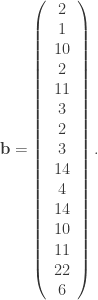
We also record their total losses in a column vector:

{\bf b}= \left(\begin{array}{c} 2 \\ 1 \\ 10 \\ 2 \\ 11 \\ 3 \\ 2 \\ 3 \\ 14 \\ 4 \\ 14 \\ 10 \\ 11 \\ 22 \\ 6 \\ \end{array}\right).

The Massey ranking of these teams is a vector {\bf r} which best fits the equation

M{\bf r}={\bf b}.

While the corresponding linear system is over-determined, we can look for a best (in the least squares sense) approximate solution using the orthogonal projection formula

P_V = B(B^tB)^{-1}B^t,

valid for matrices B with linearly independent columns. Unfortunately, in this case B=M does not have linearly independent columns, so the formula doesn’t apply.

Massey’s clever idea is to solve

M^tM{\bf r}=M^t{\bf b}

by row-reduction and determine the rankings from the parameterized form of the solution. To this end, we compute

M^tM= \left(\begin{array}{rrrrrr} 5 & -1 & -1 & -1 & -1 & -1 \\ -1 & 5 & -1 & -1 & -1 & -1 \\ -1 & -1 & 5 & -1 & -1 & -1 \\ -1 & -1 & -1 & 5 & -1 & -1 \\ -1 & -1 & -1 & -1 & 5 & -1 \\ -1 & -1 & -1 & -1 & -1 & 5 \end{array}\right)

and

M^t{\bf b}= \left(\begin{array}{r} -24 \\ -10 \\ 10 \\ -29 \\ -10 \\ 63 \\ \end{array}\right).

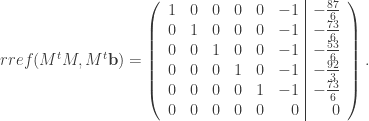
Then we compute the rref of

A= (M^tM,M^t{\bf b}) = \left(\begin{array}{rrrrrr|r} 5 & -1 & -1 & -1 & -1 & -1 & -24 \\ -1 & 5 & -1 & -1 & -1 & -1 & -10 \\ -1 & -1 & 5 & -1 & -1 & -1 & 10 \\ -1 & -1 & -1 & 5 & -1 & -1 & -29 \\ -1 & -1 & -1 & -1 & 5 & -1 & -10 \\ -1 & -1 & -1 & -1 & -1 & 5 & 63 \end{array}\right),

which is

rref(M^tM,M^t{\bf b})= \left(\begin{array}{rrrrrr|r} 1 & 0 & 0 & 0 & 0 & -1 & -\frac{87}{6} \\ 0 & 1 & 0 & 0 & 0 & -1 & -\frac{73}{6} \\ 0 & 0 & 1 & 0 & 0 & -1 & -\frac{53}{6} \\ 0 & 0 & 0 & 1 & 0 & -1 & -\frac{92}{3} \\ 0 & 0 & 0 & 0 & 1 & -1 & -\frac{73}{6} \\ 0 & 0 & 0 & 0 & 0 & 0 & 0 \end{array}\right).

If {\bf r}=(r_1,r_2,r_3,r_4,r_5,r_6) denotes the rankings of Army, Bucknell, Holy Cross, Lafayette, Lehigh, Navy, in that order, then

r_1=r_6-\frac{87}{6},\ \ r_2=r_6-\frac{73}{6},\ \ r_3=r_6-\frac{53}{6},\ \ r_4=r_6-\frac{92}{6},\ \ r_5=r_6-\frac{73}{6}.

Therefore

Lafayette < Army = Bucknell = Lehigh < Holy Cross < Navy.

If we use this ranking to predict win/losses over the season, it would fail to correctly predict Army vs Holy Cross (Army won), Bucknell vs Lehigh, and Lafayette vs Army. This gives a prediction failure rate of 20\%.

A tribute to TS Michael

I’ve known TS for over 20 years as a principled colleague and a great teacher.

ts-michaels_2015-12-21_small

TS at the USNA in Dec 2015.

However, we really never spoke much except for the past five-to-ten years or so. For a period, I wrote a lot about error-correcting codes and we’d talk occasionally about our common interests (for example, I found his paper “The rigidity theorems of Hamada and Ohmori, revisited” fascinating). However, once I became interested in graph theory, we spoke as often as I could corner him. He taught me a lot and only know I realize how lucky I was to have him as a colleague.

I remember many times, late on a Friday, when we’d talk for an hour or two about chess, mathematics, “office politics” (he always knew more than me), and allergies. Here’s one of his favorite chess problems:

mate-in-549

Mate in 549 moves. This problem was discovered by a team of chess engame experts at Lomonosov University, Moscow, August 2012.

Maybe this says more about me than him, but when it was just the two of us, we rarely talked about families or relationships. None-the-less, he always treated me like a good friend. One of my favorite memories was when my wife and I were shopping at the plaza where his condo building was located (it’s a big plaza). Elva and I were walking store-to-store when we spotted TS. He was walking to distract himself from his discomfort. At the time, doctors didn’t know what his problems were and he suspected allergies. I have a number of food sensitivities and he was a welcomed fountain of medical knowledge about these issues. (In fact, his hints have really helped me a lot, health-wise.) In any case, TS and Elva and I spoke for 30 minutes or so about health and family. I remember how gracious and thoughtful he was, skillfully steering the conversation into non-technical matters for Elva’s benefit. I ran into him another time while waiting for Elva, who was in a nearby doctor’s office (I told you this was a big shopping plaza). TS generously waited with me until Elva was ready to be picked up. What we chatted about is lost in the cobwebs of my memory but I remember vividly where we sat and the kind of day it was. TS had such a kind heart.

As I said, TS taught me a lot about graph theory. Whether in-between classes or when I was lucky enough to spot him late in the day, he’d kindly entertain my naive (usually false) conjectures and speculations about strongly regular graphs. I never heard him speak in anything but the kindest terms. He’d never say “that’s just plain wrong” or “idiotic” (even if it was) but instead teach me the correct way to think about it in a matter in which I could see myself how my speculations were wrong-headed. My upcoming book with Caroline Melles is indebted to his insight and suggestions.

Even after he left Maryland to spend his remaining days with his family in California, TS emailed encouragement and suggestions about an expository paper I was writing to help connect my matrix theory students with the methods of ranking sports teams. While he was very helpful and provided me with his excellent insights as usual, in truth, I used the work on the paper as an excuse to keep up with his health status. I’m relatively ignorant of medical issues and tried to stay optimistic until it’s totally unrealistic. As sad as it was, we was always frank and honest with me about his prognosis.

He’s gone now, but as a teacher, researcher, and as a kind soul, TS is unforgettable.


A list of TS’s publications:

  1. T. S. Michael, Tournaments, book chapter in Handbook of Linear Algebra, 2nd ed, CRC Press, Boca Raton, 2013.
  2. T. S. Michael, Cycles of length 5 in triangle-free graphs: a sporadic counterexample to a characterization of equality, Bulletin of the Institute of Combinatorics and Its Applications, 67 (2013) 6–8.
  3. T. S. Michael and Val Pinciu, Guarding orthogonal prison yards: an upper bound,
    Congressus Numerantium, 211 (2012) 57–64.
  4. Ilhan Hacioglu and T. S. Michael, The p-ranks of residual and derived skew Hadamard designs,
    Discrete Mathematics, 311 (2011) 2216-2219.
  5. T. S. Michael, Guards, galleries, fortresses, and the octoplex, College Math Journal, 42 (2011) 191-200. (This paper won a Polya Award)
  6. Elizabeth Doering, T. S. Michael, and Bryan Shader, Even and odd tournament matrices with minimum rank over finite fields, Electronic Journal of Linear Algebra, 22 (2011) 363-377.
  7. Brenda Johnson, Mark E. Kidwell, and T. S. Michael, Intrinsically knotted graphs have at least 21 edges, Journal of Knot Theory and Its Ramifications, 19 (2010) 1423-1429.
  8. T. S. Michael, How to Guard an Art Gallery and Other Discrete Mathematical Adventures. Johns Hopkins University Press, Baltimore, 2009.
  9. T. S. Michael and Val Pinciu, Art gallery theorems and triangulations, DIMACS Educational Module Series, 2007, 18 pp (electronic 07-1)
  10. T. S. Michael and Thomas Quint, Sphericity, cubicity, and edge clique covers of graphs, Discrete Applied Mathematics, 154 (2006) 1309-1313.
  11. T. S. Michael and Val Pinciu, Guarding the guards in art galleries, Math Horizons, 14 (2006), 22-23, 25.
  12. Richard J. Bower and T. S. Michael, Packing boxes with bricks, Mathematics Magazine, 79 (2006), 14-30.
  13. T. S. Michael and Thomas Quint, Optimal strategies for node selection games: skew matrices and symmetric games, Linear Algebra and Its Applications 412 (2006) 77-92.
  14. T. S. Michael, Ryser’s embedding problem for Hadamard matrices, Journal of Combinatorial Designs 14 (2006) 41-51.
  15. Richard J. Bower and T. S. Michael, When can you tile a box with translates of two given rectangular bricks?, Electronic Journal of Combinatorics 11 (2004) Note 7, 9 pages.
  16. T. S. Michael and Val Pinciu, Art gallery theorems for guarded guards, Computational Geometry 26 (2003) 247-258.
  17. T. S. Michael, Impossible decompositions of complete graphs into three Petersen subgraphs, Bulletin of the Institute of Combinatorics and Its Applications 39 (2003) 64-66.
  18. T. S. Michael and William N. Traves, Independence sequences of well-covered graphs: non-unimodality and the roller-coaster conjecture, Graphs and Combinatorics 19 (2003) 403-411.
  19. T. S. Michael and Thomas Quint, Sphere of influence graphs and the L-Infinity metric, Discrete Applied Mathematics 127 (2003) 447-460.
  20. T. S. Michael, Signed degree sequences and multigraphs, Journal of Graph Theory 41 (2002) 101-105.
  21. T. S. Michael and Val Pinciu, Multiply guarded guards in orthogonal art galleries, Lecture Notes in Computer Science 2073, pp 753-762, in: Proceedings of the International Conference on Computer Science, San Francisco, Springer, 2001.
  22. T. S. Michael, The rigidity theorems of Hamada and Ohmori, revisited, in Coding Theory and Cryptography: From the Geheimschreiber and Enigma to Quantum Theory. (Annapolis, MD, 1998), 175-179, Springer, Berlin, 2000.
  23. T. S. Michael and Thomas Quint, Sphere of influence graphs in general metric spaces, Mathematical and Computer Modelling, 29 (1999) 45-53.
  24. Suk-Geun Hwang, Arnold R. Kraeuter, and T. S. Michael, An upper bound for the permanent of a nonnegative matrix, Linear Algebra and Its Applications 281 (1998), 259-263.
    * First Corrections: Linear Algebra and Its Applications 300 (1999), no. 1-3, 1-2
  25. T. S. Michael and W. D. Wallis, Skew-Hadamard matrices and the Smith normal form, Designs, Codes, and Cryptography, 13 (1998) 173-176.
  26. T. S. Michael, The p-ranks of skew Hadamard designs, Journal of Combinatorial Theory, Series A, 73 (1996) 170-171.
  27. T. S. Michael, The ranks of tournament matrices, American Mathematical Monthly, 102 (1995) 637-639.
  28. T. S. Michael, Lower bounds for graph domination by degrees, pp 789-800 in Graph Theory, Combinatorics, and Algorithms: Proceedings of the Seventh Quadrennial International Conference on the Theory and Applications of Graphs, Y. Alavi and A. Schwenk (eds.), Wiley, New York, 1995.
  29. T. S. Michael and Thomas Quint, Sphere of influence graphs: a survey, Congressus Numerantium, 105 (1994) 153-160.
  30. T. S. Michael and Thomas Quint, Sphere of influence graphs: edge density and clique size, Mathematical and Computer Modelling, 20 (1994) 19-24.
  31. T. S. Michael and Aaron Stucker, Mathematical pitfalls with equivalence classes, PRIMUS, 3 (1993) 331-335.
  32. T. S. Michael, The structure matrix of the class of r-multigraphs with a prescribed degree sequence, Linear Algebra and Its Applications, 183 (1993) 155-177.
  33. T. S. Michael, The decomposition of the complete graph into three isomorphic strongly regular graphs, Congressus Numerantium, 85 (1991) 177-183.
  34. T. S. Michael, The structure matrix and a generalization of Ryser’s maximum term rank formula, Linear Algebra and Its Applications, 145 (1991) 21-31.
  35. Richard A. Brualdi and T. S. Michael, The class of matrices of zeros, ones and twos with prescribed row and column sums, Linear Algebra and Its Applications, 114(115) (1989) 181-198.
  36. Richard A. Brualdi and T. S. Michael, The class of 2-multigraphs with a prescribed degree sequence, Linear and Multilinear Algebra, 24 (1989) 81-102.
  37. Richard A. Brualdi, John L. Goldwasser, and T. S. Michael, Maximum permanents of matrices of zeros and ones, Journal of Combinatorial Theory, Series A, 47 (1988) 207-245.

Memories of TS Michael, by Bryan Shader

TS Michael passed away on November 22, 2016, from cancer. I will miss him as a colleague and a kind, wise soul.

ts-michaels_2015-12-21_small

TS Michael in December 2015 at the USNA

Bryan Shader has kindly allowed me to post these reminiscences that he wrote up.

Memories of TS Michael, by Bryan Shader

Indirect influence
TS indirectly influenced my choice of U. Wisconsin-Madison for graduate school. My senior year as an undergraduate, Herb Ryser gave a talk at my school. After the talk I was able to meet Ryser and asked for advice on graduate schools. Herb indicated that one of his very good undergraduate students had chosen UW-Madison and really liked the program. I later found out that the person was TS.

About the name
Back in the dark ages, universities still did registration by hand. This meant that for a couple of days before each semester the masses of students would wind their way through a maze of stations in a large gymnasium. For TS’s first 4 years, he would invariably encounter a road block because someone had permuted the words in his name (Todd Scott Michael) on one of the forms. After concretely verifying the hatcheck probabilities and fearing that this would cause some difficulties in graduating, he legally changed his name to TS Michael.

Polyominoes & Permanents
I recall many stories about how TS’s undergraduate work on polyominoes affected
his life. In particular, he recalled how once he started working on tilings on
polyominoes, he could no longer shower, or swim without visualizing polynomino
tilings on the wall’s or floor’s tiling. We shared an interest and passion for permanents (the permanent is a function of a matrix much like the determinant and plays a critical role in combinatorics). When working together we frequently would find that we both couldn’t calculate the determinant of a 3 by 3 matrix correctly, because we were calculating the permanent rather than the determinant.

Presentations and pipe-dreams
TS and I often talked about how best to give a mathematical lecture, or
presentation at a conference. Perhaps this is not at all surprising, as our common advisor (Richard Brualdi) is an incredible expositor, as was TS’s undergraduate advisor (Herb Ryser, our mathematical grandfather). TS often mentioned how Herb Ryser scripted every moment of a lecture; he knew each word he would write on the board and exactly where it would be written. TS wasn’t quite so prescriptive–but before any presentation he gave he would go to the actual room of the presentation a couple of times and run through the talk. This would include answering questions from the “pretend” audience. After being inspired by TS’s talks, I adopted this preparation method.
TS and I also fantasized about our talks ending with the audience lifting us up on their shoulders and carrying us out of the room in triumph! That is never happened to either of us (that I know of), but to have it, as a dream has always been a good motivation.

Mathematical heritage
TS was very interested in his mathematical heritage, and his mathematics brothers and sisters. TS was the 12th of Brandi’s 37 PhD students; I was the 15th. In 2005, TS and I organized a conference (called the Brualidfest) in honor of Richard Brualdi. Below I attach some photos of the design for the T-shirt.

ts-michaels_memories1

t-shirt design for Brualdi-Fest, 1

The first image shows a biclique partition of K_5; for each color the edges of the given color form a complete bipartite graph; and each each of the completed graph on 5 vertices is in exactly one of these complete bipartite graph. This is related to one of TS’s favorite theorem: the Graham-Pollak Theorem.

ts-michaels_memories2

t-shirt design for Bruldi-Fest, 2

The second image (when the symbols are replaced by 1s) is the incidence matrix of the projective plane of order 2; one of TS’s favorite matrices.

Here’s a photo of the Brualdi and his students at the conference:

ts-michaels_memories3

From L to R they are: John Mason (?), Thomas Forreger, John Goldwasser, Dan Pritikin, Suk-geun Hwang, Han Cho, T.S. Michael, B. Shader, Keith Chavey, Jennifer Quinn, Mark Lawrence, Susan Hollingsworth, Nancy Neudauer, Adam Berliner, and Louis Deaett.

Here’s a picture for a 2012 conference:

ts-michaels_memories4

From bottom to top: T.S. Michael (1988), US Naval Academy, MD; Bryan Shader (1990), University of Wyoming, WY; Jennifer Quinn (1993), University of Washington, Tacoma, WA; Nancy Neudauer (1998), Pacific University, OR; Susan Hollingsworth (2006), Edgewood College, WI; Adam Berliner (2009), St. Olaf College, MN; Louis Deaett (2009), Quinnipiac University, CT; Michael Schroeder (2011), Marshall University, WV; Seth Meyer (2012), Kathleen Kiernan (2012).

Here’s a caricature of TS made by Kathy Wilson (spouse of mathematician
Richard Wilson) at the Brualdifest:

OLYMPUS DIGITAL CAMERA

TS Michael, by Kathy Wilson

Long Mathematical Discussions
During graduate school, TS and I would regularly bump into each other as we
were coming and going from the office. Often this happened as we were crossing University Avenue, one of the busiest streets in Madison. The typical conversation started with a “Hi, how are you doing? Have you considered X?” We would then spend the next 60-90 minutes on the street corner (whether it was a sweltering 90 degrees+, or a cold, windy day) considering X. In more recent years, these conversations have moved to hotel lobbies at conferences that we attend together. These discussions have been some of the best moments of my life, and through them I have become a better mathematician.

Here’s a photo of T.S. Michael with Kevin van der Meulen at the Brualdi-fest.

OLYMPUS DIGITAL CAMERA

I’m guessing they are in the midst of one of those “Have you considered X?” moments that TS is famous for.

Mathematical insight
TS has taught me a lot about mathematics, including:

  •  How trying to generalize a result can lead to better understanding of the original result.
  •  How phrasing a question appropriately is often the key to a mathematical breakthrough
  • Results that are surprising (e.g. go against ones intuition), use an elegant proof (e.g. bring in matrices in an unexpected way), and are aesthetically pleasing are worth pursing (as Piet Hein said “Problems worthy of attack, prove their worth by fighting back.”)
  •  The struggle to present the proof of a result in the simplest, most self-contained way is important because often it produces a better understanding. If you can’t say something in a clean way, then perhaps you really don’t understand it fully.

TS’ mathematics fathers are:
Richard Brualdi ← Herb Ryser ← Cyrus MacDuffee ← Leonard Dickson ← E.H. Moore ← H. A. Newton ← Michel Chasles ← Simeon Poisoon ← Joseph Lagrange ← Leonhard Euler ← Johann Bernoulli.

The minimum upset ranking problem

Suppose n teams play each other, and let Team r_1 < Team r_2 < \dots < Team r_n denote some fixed ranking (where r_1,\dots,r_n is some permutation of 1,\dots,n). An upset occurs when a lower ranked team beats an upper ranked team. For each ranking, {\bf r}, let U({\bf r}) denote the total number of upsets. The minimum upset problem is to find an “efficient” construction of a ranking for which U({\bf r}) is as small as possible.

In general, let A_{ij} denote the number of times Team i beat team $j$ minus the number of times Team j beat Team i. We regard this matrix as the signed adjacency matrix of a digraph \Gamma. Our goal is to find a Hamiltonian (undirected) path through the vertices of \Gamma which goes the “wrong way” on as few edges as possible.

  1. Construct the list of spanning trees of \Gamma (regarded as an undirected graph).
  2. Construct the sublist of Hamiltonian paths (from the spanning trees of maximum degree 2).
  3. For each Hamiltonian path, compute the associated upset number: the total number of edges transversal in \Gamma going the “right way” minus the total number going the “wrong way.”
  4. Locate a Hamiltonian for which this upset number is as large as possible.

Use this sagemath/python code to compute such a Hamiltonian path.

def hamiltonian_paths(Gamma, signed_adjacency_matrix = []):
    """
    Returns a list of hamiltonian paths (spanning trees of 
    max degree <=2).

    EXAMPLES:
        sage: Gamma = graphs.GridGraph([3,3])
        sage: HP = hamiltonian_paths(Gamma)
        sage: len(HP)
        20
        sage: A = matrix(QQ,[
        [0 , -1 , 1  , -1 , -1 , -1 ],
        [1,   0 ,  -1,  1,  1,   -1  ],
        [-1 , 1 ,  0 ,  1 , 1  , -1  ],
        [1 , -1 , -1,  0 ,  -1 , -1  ],
        [1 , - 1 , - 1 , 1 , 0 , - 1  ],
        [1 ,  1  ,  1  , 1  , 1  , 0 ]
        ])
        sage: Gamma = Graph(A, format='weighted_adjacency_matrix')
        sage: HP = hamiltonian_paths(Gamma, signed_adjacency_matrix = A)
        sage: L = [sum(x[2]) for x in HP]; max(L)
        5
        sage: L.index(5)
        21
        sage: HP[21]                                 
        [Graph on 6 vertices,
         [0, 5, 2, 1, 3, 4],
         [-1, 1, -1, -1, -1, 1, 1, 1, 1, 1, 1, 1, 1, 1, -1]]
        sage: L.count(5)
        1

    """
    ST = Gamma.spanning_trees()
    if signed_adjacency_matrix == []:
        HP = []
        for X in ST:
            L = X.degree_sequence()
            if max(L)<=2:
                #print L,ST.index(X), max(L)
                HP.append(X)
        return HP
    if signed_adjacency_matrix != []:
        A = signed_adjacency_matrix
        HP = []
        for X in ST:
            L = X.degree_sequence()
            if max(L)<=2:
                #VX = X.vertices()
                EX = X.edges()
		if EX[0][1] != EX[-1][1]:
                    ranking = X.shortest_path(EX[0][0],EX[-1][1])
		else:
		    ranking = X.shortest_path(EX[0][0],EX[-1][0])
		signature = [A[ranking[i]][ranking[j]] for i in range(len(ranking)-1) for j in range(i+1,len(ranking))]
                HP.append([X,ranking,signature])
        return HP

Wessell describes this method in a different way.

  1. Construct a matrix, M=(M_{ij}), with rows and columns indexed by the teams in some fixed order. The entry in the i-th row and the j-th column is defined bym_{ij}= \left\{ \begin{array}{rr} 0,& {\rm if\ team\ } i {\rm \ lost\ to\ team\ } j,\\ 1,& {\rm if\ team\ } i {\rm\ beat\ team\ } j,\\ 0, & {\rm if}\ i=j. \end{array} \right.
  2. Reorder the rows (and corresponding columns) to in a basic win-loss order: the teams that won the most games go at the
    top of M, and those that lost the most at the bottom.
  3. Randomly swap rows and their associated columns, each time checking if the
    number of upsets has gone down or not from the previous time. If it has gone down, we keep
    the swap that just happened, if not we switch the two rows and columns back and try again.

An implementaiton of this in Sagemath/python code is:

def minimum_upset_random(M,N=10):
    """
    EXAMPLES:
        sage: M = matrix(QQ,[
        [0 , 0 , 1  , 0 , 0 , 0 ],
        [1,   0 ,  0,  1,  1,   0  ],
        [0 , 1 ,  0 ,  1 , 1  , 0  ],
        [1 , 0 , 0,  0 ,  0 , 0  ],
        [1 , 0 , 0 , 1 , 0 , 0  ],
        [1 ,  1  ,  1  , 1  , 1  , 0 ]
        ])
        sage: minimum_upset_random(M)
        (
        [0 0 1 1 0 1]                    
        [1 0 0 1 0 1]                    
        [0 1 0 0 0 0]                    
        [0 0 1 0 0 0]                    
        [1 1 1 1 0 1]                    
        [0 0 1 1 0 0], [1, 2, 0, 3, 5, 4]
        )

    """
    n = len(M.rows())
    Sn = SymmetricGroup(n)
    M1 = M
    wins = sum([sum([M1[j][i] for i in range(j,6)]) for j in range(6)])
    g0 = Sn(1)
    for k in range(N):
        g = Sn.random_element()
        P = g.matrix()
        M0 = P*M1*P^(-1)
        if sum([sum([M0[j][i] for i in range(j,6)]) for j in range(6)])>wins:
            M1 = M0
            g0 = g*g0
    return M1,g0(range(n))

Odd king tours on even chessboards

This blog post discusses a paper “Odd king tours …” written with Michael Fourte (a CS undergrad at the time, now is a lawyer and Naval officer in NYC) in 1997. It was published in the now defunct Journal of Recreational Mathematics, issue 31(3), in 2003.

In the paper, we showed that there is no complete odd king tour on an even chessboard, partially answering a question raised in [BK], [S]. This post surveys that paper.

king-moves

King moves on an 8×8 board.

A complete king tour on an m\times n board may be represented graph theoretically as a Hamiltonian cycle on a particular graph with mn vertices, of which (m-2)\cdot (n-2) of them have degree 8, 2(m+n-4) have degree 5 and the remaining 4 vertices have degree 3. The problem of finding an algorithm to find a hamiltonian circuit in a general graph is known to be NP complete. The problem of finding an efficient algorithm to search for such a tour therefore appears to be very hard problem. In [BK], C. Bailey and M. Kidwell proved that complete even king tours do not exist. They left the question of the existence of complete odd tours open but showed that if they did exist then it would have to end at the edge of the board.

We shall show that
Theorem: No complete odd king tours exist on an m\times n board, except possibly in the following cases:

  • m=n=7
  • m=7 and n=8,
  • m >7, n >7 and m or n (or both) is odd,
  • m>7, n>7 and the tour is “rapidly filling”.

The definition of “rapidly filling” requires some technical notation and will be given later.

Background

Before proving this, we recall briefly some definitions and results from [BK] which we shall use in our proof.

Definition: Two squares are called a neighbor pair if they have a common edge or common vertex. A neighbor pair is called completed if both squares have been visited by the the king at some point in a tour, including the case where the king is still on one of the squares. A foursome is a collection of four squares which form a 2\times 2 array of neighboring squares on the board. A foursome is called completed if all four squares have been visited by the the king at some point in a tour, including the case where the king is still on one of the four squares.

Unless stated otherwise, after a given move of a given odd king tour, let \Delta F denote the change in the number of completed foursomes and let \Delta N denote the change in the number of completed neighbor pairs. Note that \Delta N is equal to the total number of previously visited squares which are neighboring the king.

The following result was proven in [BK] using a counting argument.

Lemma:

  • The number of neighbor pairs of an m\times n board is 2mn+2(m-1)(n-1)-m-n.
  • (b) The number of foursomes of an m\times n board is (m-1)(n-1).

The following result was proven in [BK] using a case-by-case argument:

Lemma: After a particular move in a given even king tour, let \Delta F denote the change in the number of completed foursomes and let \Delta N denote the change in the number of completed neighbor pairs. If \Delta F=0 then \Delta N\geq 2. If \Delta F=1 then \Delta N\geq 4. If \Delta F=2 then \Delta N\geq 6. If \Delta F=3 then \Delta N =8.

We shall need the proof of this lemma (for which we refer the reader to [BK]) rather than the lemma itself. The proof of this lemma implies the following:

Lemma: For an odd king tour: If \Delta F=0 then Delta N\geq 1. If \Delta F=1 then \Delta N \geq 3. If \Delta F=2 then \Delta N\geq 5. If \Delta F=3 then \Delta N =7.

The proof is omitted.

Definition: We call an odd king tour rapidly filling if there is a move in the tour such that 2\Delta F +1<\Delta N and 1\leq \Delta F .

The proof of the theorem

Proposition: If m and n are both even then no complete odd king tour exists.

proof: Let N denote the total number of completed neighbor pairs after a given point of a given odd king tour. We may represent the values of N as a sequence of numbers, 0,1,2,.... Here 0 is the total number of completed neighbor pairs after the first move, 1 for after the second move, and so on. Each time the king moves, $N$ must increase by an odd number of neighbors – either 1, 3, 5, or 7. In particular, the parity of N alternates between odd and even after every move. If m and n are both even and if a complete odd king tour exists then the the final parity of N must be odd. By the lemma above, the value of N after any complete king tour is 2mn+2(m-1)(n-1)-m-n, which is obviously even. This is a contradiction. QED

It therefore suffices to prove the above theorem in the case where at least one of m,n is odd. This follows from a computer computation, an argument from Sands [Sa], and the sequence of lemmas that follow. The proofs are in the original paper, and omitted.

Let N denote the total number of completed neighbor pairs in a given odd king tour. Let F denote the number of completed foursomes in a given odd king tour. Let $M$ denote the number of moves in a given odd king tour. Let T=N-2M-2F+4.

Lemma: Let \Delta T=\Delta N - 2 - 2\Delta F, where \Delta N ,\Delta F are defined as above. Then \Delta T equals -1, 1, 3, or 5. If the tour is not rapidly filling then \Delta T\geq 1 only occurs when \Delta F= 0.

Lemma: Let H(m,n) denote the largest number of non-overlapping 2\times 2 blocks which will fit in the m\times n board. There are no labelings of the m\times n checkerboard by 0‘s and 1‘s with no 2\times 2 blocks of 1‘s and fewer than H(m,n) 0‘s. In particular, if there are no 2\times 2 blocks of 1’s then there must be at least [m/2][n/2] 0’s.

We conclude with a question. An odd king tour of length mn-1 on an m\times n board will be called nearly complete. Which boards have nearly complete odd king tours? We conjecture: If n > then all 7\times n boards have nearly complete odd king tours.

References

[BK] C. Bailey, M. Kidwell, “A king’s tour of the chessboard”, Math. Mag. 58(1985)285-286

[S] S. Sacks, “odd and even”, Games 6(1982)53.

[Sa] B. Sands, “The gunport problem”, Math. Mag. 44(1971)193-194.

Linear systems of graphs in Sage

Let \Gamma be a graph. A divisor on \Gamma is an element of the free group generated by the vertices V, {\mathbb{Z}}[V].

We say that divisors D and D^\prime are linearly equivalent and write D \sim D^\prime if D^\prime-D is a principal divisor, i.e., if D^\prime = D + \text{div}(f) for some function f : V \rightarrow {\mathbb{Z}}. Note that if D and D^\prime are linearly equivalent, they must have the same degree, since the degree of every principal divisor is 0. Divisors of degree 0 are linearly equivalent if and only if they determine the same element of the Jacobian. If D is a divisor of degree 0, we denote by [D] the element of the Jacobian determined by D. A divisor D is said to be effective if D(v) \geq 0 for all vertices v. We write D \geq 0 to mean that D is effective. The linear system associated to a divisor D is the set

|D| = \{ D^\prime \in \text{Div}(\Gamma ) : D^\prime \geq 0 \text{ and } D^\prime \sim D\},

i.e., |D| is the set of all effective divisors linearly equivalent to D. Note that if D_1 \sim D_2, then |D_1| = |D_2|. We note also that if \text{deg}(D)<0, then |D| must be empty.

Sage can be used to compute the linear system of any divisor on a graph.

def linear_system(D, Gamma):
    """
    Returns linear system attached to the divisor D.

    EXAMPLES:
        sage: Gamma2 = graphs.CubeGraph(2)
        sage: Gamma1 = Gamma2.subgraph(vertices = ['00', '01'], edges = [('00', '01')])
        sage: f = [['00', '01', '10', '11'], ['00', '01', '00', '01']]
        sage: is_harmonic_graph_morphism(Gamma1, Gamma2, f)
        True
        sage: PhiV = matrix_of_graph_morphism_vertices(Gamma1, Gamma2, f); PhiV
        [1 0 1 0]
        [0 1 0 1]
        sage: D = vector([1,0,0,1])
        sage: PhiV*D
        (1, 1)
        sage: linear_system(PhiV*D, Gamma1)
        [(2, 0), (1, 1), (0, 2)]
        sage: linear_system(D, Gamma2)
        [(0, 2, 0, 0), (0, 0, 2, 0), (1, 0, 0, 1)]
        sage: [PhiV*x for x in linear_system(D, Gamma2)]
        [(0, 2), (2, 0), (1, 1)]

    """
    Q = Gamma.laplacian_matrix()
    CS = Q.column_space()
    N = len(D.list())
    d = sum(D.list())
    #print d
    lin_sys = []
    if d < 0:
        return lin_sys
    if (d == 0) and (D in CS):
        lin_sys = [CS(0)]
        return lin_sys
    elif (d == 0):
        return lin_sys
    S = IntegerModRing(d+1)^N
    V = QQ^N
    for v in S:
        v = V(v)
        #print D-v,v,D
        if D-v in CS:
            lin_sys.append(v)
    return lin_sys


Examples of graph-theoretic harmonic morphisms using Sage

In the case of simple graphs (without multiple edges or loops), a map f between graphs \Gamma_2 = (V_2,E_2) and \Gamma_1 = (V_1, E_1) can be uniquely defined by specifying where the vertices of \Gamma_2 go. If n_2 = |V_2| and n_1 = |V_1| then this is a list of length n_2 consisting of elements taken from the n_1 vertices in V_1.

Let’s look at an example.

Example: Let \Gamma_2 denote the cube graph in {\mathbb{R}}^3 and let \Gamma_1 denote the “cube graph” (actually the unit square) in {\mathbb{R}}^2.

This is the 3-diml cube graph

This is the 3-diml cube graph \Gamma_2 in Sagemath

The cycle graph on 4 vertices

The cycle graph \Gamma_1 on 4 vertices (also called the cube graph in 2-dims, created using Sagemath.

We define a map f:\Gamma_2\to \Gamma_1 by

f = [[‘000’, ‘001’, ‘010’, ‘011’, ‘100’, ‘101’, ‘110’, ‘111’], [“00”, “00”, “01”, “01”, “10”, “10”, “11”, “11”]].

Definition: For any vertex v of a graph \Gamma, we define the star St_\Gamma(v) to be a subgraph of \Gamma induced by the edges incident to v. A map f : \Gamma_2 \to \Gamma_1 is called harmonic if for all vertices v' \in V(\Gamma_2), the quantity

|\phi^{-1}(e) \cap St_{\Gamma_2}(v')|

is independent of the choice of edge e in St_{\Gamma_1}(\phi(v')).

 
Here is Python code in Sagemath which tests if a function is harmonic:

def is_harmonic_graph_morphism(Gamma1, Gamma2, f, verbose = False):
    """
    Returns True if f defines a graph-theoretic mapping
    from Gamma2 to Gamma1 that is harmonic, and False otherwise. 

    Suppose Gamma2 has n vertices. A morphism 
              f: Gamma2 -> Gamma1
    is represented by a pair of lists [L2, L1],
    where L2 is the list of all n vertices of Gamma2,
    and L1 is the list of length n of the vertices
    in Gamma1 that form the corresponding image under
    the map f.

    EXAMPLES:
        sage: Gamma2 = graphs.CubeGraph(2)
        sage: Gamma1 = Gamma2.subgraph(vertices = ['00', '01'], edges = [('00', '01')])
        sage: f = [['00', '01', '10', '11'], ['00', '01', '00', '01']]
        sage: is_harmonic_graph_morphism(Gamma1, Gamma2, f)
        True
        sage: Gamma2 = graphs.CubeGraph(3)
        sage: Gamma1 = graphs.TetrahedralGraph()
        sage: f = [['000', '001', '010', '011', '100', '101', '110', '111'], [0, 1, 2, 3, 3, 2, 1, 0]]
        sage: is_harmonic_graph_morphism(Gamma1, Gamma2, f)
        True
        sage: Gamma2 = graphs.CubeGraph(3)
        sage: Gamma1 = graphs.CubeGraph(2)
        sage: f = [['000', '001', '010', '011', '100', '101', '110', '111'], ["00", "00", "01", "01", "10", "10", "11", "11"]]
        sage: is_harmonic_graph_morphism(Gamma1, Gamma2, f)
        True
        sage: is_harmonic_graph_morphism(Gamma1, Gamma2, f, verbose=True)
        This [, ]] passes the check: ['000', [1, 1]]
        This [, ]] passes the check: ['001', [1, 1]]
        This [, ]] passes the check: ['010', [1, 1]]
        This [, ]] passes the check: ['011', [1, 1]]
        This [, ]] passes the check: ['100', [1, 1]]
        This [, ]] passes the check: ['101', [1, 1]]
        This [, ]] passes the check: ['110', [1, 1]]
        This [, ]] passes the check: ['111', [1, 1]]
        True
        sage: Gamma2 = graphs.TetrahedralGraph()
        sage: Gamma1 = graphs.CycleGraph(3)
        sage: f = [[0,1,2,3],[0,1,2,0]]
        sage: is_harmonic_graph_morphism(Gamma1, Gamma2, f)
        False
        sage: is_harmonic_graph_morphism(Gamma1, Gamma2, f, verbose=True)
        This [, ]] passes the check: [0, [1, 1]]
        This [, ]] fails the check: [1, [2, 1]]
        This [, ]] fails the check: [2, [2, 1]]
        False

    """
    V1 = Gamma1.vertices()
    n1 = len(V1)
    V2 = Gamma2.vertices()
    n2 = len(V2)
    E1 = Gamma1.edges()
    m1 = len(E1)
    E2 = Gamma2.edges()
    m2 = len(E2)
    edges_in_common = []
    for v2 in V2:
        w = image_of_vertex_under_graph_morphism(Gamma1, Gamma2, f, v2)
        str1 = star_subgraph(Gamma1, w)
        Ew = str1.edges()
        str2 = star_subgraph(Gamma2, v2)
        Ev2 = str2.edges()
        sizes = []
        for e in Ew:
            finv_e = preimage_of_edge_under_graph_morphism(Gamma1, Gamma2, f, e)
            L = [x for x in finv_e if x in Ev2]
            sizes.append(len(L))
            #print v2,e,L
        edges_in_common.append([v2, sizes])
    ans = True
    for x in edges_in_common:
        sizes = x[1]
        S = Set(sizes)
        if S.cardinality()>1:
            ans = False
            if verbose and ans==False:
                print "This [, ]] fails the check:", x
        if verbose and ans==True:
            print "This [, ]] passes the check:", x
    return ans
            

For further details (e.g., code to

star_subgraph

, etc), just ask in the comments.

More odd examples of p-ary bent functions

In an earlier post I discussed bent functions f:GF(3)^2\to GF(3). In this post, I’d like to give some more examples, based on a recent paper with Caroline Melles, Charles Celerier, David Phillips, and Steven Walsh, based on computations using Sage/pythpn programs I wrote with Charles Celerier.

We start with any function f:GF(p)^n\to GF(p). The Cayley graph of f is defined to be the edge-weighted digraph

\Gamma_f = (GF(p)^n, E_f ),
whose vertex set is V=V(\Gamma_f)=GF(p)^n and the set of edges is defined by

E_f =\{(u,v) \in GF(p)^n\ |\ f(u-v)\not= 0\},
where the edge (u,v)\in E_f has weight f(u-v). However, if f is even then we can (and do) regard \Gamma_f as an edge-weighted (undirected) graph.

We assume, unless stated otherwise, that f is even.

For each u\in V, define

  • N(u)=N_{\Gamma_f}(u) to be the set of all neighbors of u in \Gamma_f,
  • N(u,a)=N_{\Gamma_f}(u,a) to be the set of all neighbors v of u in \Gamma_f for which the edge (u,v)\in E_f has weight a (for each a\in GF(p)^\times = GF(p)-\{0\}),
  • N(u,0)=N_{\Gamma_f}(u,0) to be the set of all non-neighbors v of u in \Gamma_f (i.e., we have (u,v)\notin E_f),
  • the support of f is
    {\rm supp}(f)=\{v\in V\ |\ f(v)\not=0\}

Let \Gamma be a connected edge-weighted graph which is regular as a simple (unweighted) graph. The graph \Gamma is called strongly regular with parameters v, k=(k_a)_{a\in W}, \lambda=(\lambda_a)_{a\in W^3}, \mu=(\mu_a)_{a\in W^2}, denoted SRG_{W}(v,k,\lambda,\mu), if it consists of v vertices such that, for each a=(a_1,a_2)\in W^2

|N(u_1,a_1) \cap N(u_2,a_2)| =  \left\{  \begin{array}{ll}  k_{a}, & u_1=u_2,\\  \lambda_{a_1,a_2,a_3}, & u_1\in N(u_2,a_3),\ u_1\not= u_2,\\  \mu_{a}, &u_1\notin N(u_2),\ u_1\not= u_2,\\  \end{array}  \right.
where k, \lambda, \mu are as above. Here, W= GF(p) is the set of weights, including 0 (recall an “edge” has weight 0 if the vertices are not neighbors).

This example is intended to illustrate the bent function b_8 listed in the table below
\begin{array}{c|ccccccccc}  GF(3)^2 & (0, 0) & (1, 0) & (2, 0) & (0, 1) & (1, 1) & (2, 1) & (0,  2) & (1, 2) & (2, 2) \\ \hline  b_8 & 0  & 2  & 2  & 0  & 0  & 1  & 0  & 1  & 0 \\  \end{array}

Consider the finite field
GF(9) = GF(3)[x]/(x^2+1) = \{0,1,2,x,x+1,x+2,2x,2x+1,2x+2\}.
The set of non-zero quadratic residues is given by
D = \{1,2,x,2x\}.
Let \Gamma be the graph whose vertices are GF(9) and whose edges e=(a,b) are those pairs for which a-b\in D.

The graph looks like the Cayley graph for b_8 in the Figure below

Bent function b_8 on GF(3)^2

Bent function b_8 on GF(3)^2

except

8\to 0, 0\to 2x+2, 1\to 2x+1, 2\to 2x,
3\to x+2, 4\to x+1, 5\to x, 6\to 2,  7\to 1, 8\to 0.
This is a strongly regular graph with parameters (9,4,1,2).

\begin{array}{c|ccccccccc}  v       & 0       & 1       & 2       & 3       & 4       & 5       & 6       & 7 & 8 \\ \hline  N(v,0)  & 3,4,6,8 & 4,5,6,7 & 3,5,7,8 & 0,2,6,7 & 0,1,7,8 & 1,2,6,8 & 0,1,3,5 & 1,2,3,4 & 0,2,4,5 \\     N(v,1) & 5,7 & 3,8 & 4,6 & 1,8 & 2,6 & 0,7 & 2,4 & 0,5 & 1,3 \\  N(v,2) & 1,2 & 0,2 & 0,1 & 4,5 & 3,5 & 3,4 & 7,8 & 6,8 & 6,7 \\   \end{array}

The axioms of an edge-weighted strongly regular graph can be directly verified using this table.

Let S be a finite set and let R_0, R_1, \dots, R_s denote binary relations on S (subsets of S\times S). The dual of a relation R is the set

R^* = \{(x,y)\in S\times S\ |\ (y,x)\in R\}.
Assume R_0=\Delta_S= \{ (x,x)\in S\times S\ |\ x\in S\}. We say (S,R_0,R_1,\dots,R_s) is an s-class association scheme on S if the following properties hold.

  • We have a disjoint union

    S\times S = R_0\cup R_1\cup \dots \cup R_s,
    with R_i\cap R_j=\emptyset for all $i\not= j$.

  • For each i there is a j such that R_i^*=R_j (and if R_i^*=R_i for all i then we say the association scheme is symmetric).
  • For all i,j and all (x,y)\in S\times S, define

    p_{ij}(x,y) = |\{z\in S\ |\ (x,z)\in R_i, (z,y)\in R_j\}|.
    For each k, and for all x,y\in R_k, the integer p_{ij}(x,y) is a constant, denoted p_{ij}^k.

These constants p_{ij}^k are called the intersection numbers of the association scheme.

For this example of b_8, we compute the adjacency matrix associated to the members R_1 and R_2 of the association scheme (G,R_0,R_1,R_2,R_3), where G = GF(3)^2,

R_i = \{(g,h)\in  G\times G\ |\ gh^{-1} \in D_i\},\ \ \ \ \ i=1,2,
and D_i = f^{-1}(i).

Consider the following Sage computation:

sage: attach "/home/wdj/sagefiles/hadamard_transform2b.sage"
sage: FF = GF(3)
sage: V = FF^2
sage: Vlist = V.list()
sage: flist = [0,2,2,0,0,1,0,1,0]
sage: f = lambda x: GF(3)(flist[Vlist.index(x)])
sage: F = matrix(ZZ, [[f(x-y) for x in V] for y in V])
sage: F  ## weighted adjacency matrix
[0 2 2 0 0 1 0 1 0]
[2 0 2 1 0 0 0 0 1]
[2 2 0 0 1 0 1 0 0]
[0 1 0 0 2 2 0 0 1]
[0 0 1 2 0 2 1 0 0]
[1 0 0 2 2 0 0 1 0]
[0 0 1 0 1 0 0 2 2]
[1 0 0 0 0 1 2 0 2]
[0 1 0 1 0 0 2 2 0]
sage: eval1 = lambda x: int((x==1))
sage: eval2 = lambda x: int((x==2))
sage: F1 = matrix(ZZ, [[eval1(f(x-y)) for x in V] for y in V])
sage: F1
[0 0 0 0 0 1 0 1 0]
[0 0 0 1 0 0 0 0 1]
[0 0 0 0 1 0 1 0 0]
[0 1 0 0 0 0 0 0 1]
[0 0 1 0 0 0 1 0 0]
[1 0 0 0 0 0 0 1 0]
[0 0 1 0 1 0 0 0 0]
[1 0 0 0 0 1 0 0 0]
[0 1 0 1 0 0 0 0 0]
sage: F2 = matrix(ZZ, [[eval2(f(x-y)) for x in V] for y in V])
sage: F2
[0 1 1 0 0 0 0 0 0]
[1 0 1 0 0 0 0 0 0]
[1 1 0 0 0 0 0 0 0]
[0 0 0 0 1 1 0 0 0]
[0 0 0 1 0 1 0 0 0]
[0 0 0 1 1 0 0 0 0]
[0 0 0 0 0 0 0 1 1]
[0 0 0 0 0 0 1 0 1]
[0 0 0 0 0 0 1 1 0]
sage: F1*F2-F2*F1 == 0
True
sage: delta = lambda x: int((x[0]==x[1]))
sage: F3 = matrix(ZZ, [[(eval0(f(x-y))+delta([x,y]))%2 for x in V] for y in V])
sage: F3
[0 0 0 1 1 0 1 0 1]
[0 0 0 0 1 1 1 1 0]
[0 0 0 1 0 1 0 1 1]
[1 0 1 0 0 0 1 1 0]
[1 1 0 0 0 0 0 1 1]
[0 1 1 0 0 0 1 0 1]
[1 1 0 1 0 1 0 0 0]
[0 1 1 1 1 0 0 0 0]
[1 0 1 0 1 1 0 0 0]
sage: F3*F2-F2*F3==0
True
sage: F3*F1-F1*F3==0
True
sage: F0 = matrix(ZZ, [[delta([x,y]) for x in V] for y in V])
sage: F0
[1 0 0 0 0 0 0 0 0]
[0 1 0 0 0 0 0 0 0]
[0 0 1 0 0 0 0 0 0]
[0 0 0 1 0 0 0 0 0]
[0 0 0 0 1 0 0 0 0]
[0 0 0 0 0 1 0 0 0]
[0 0 0 0 0 0 1 0 0]
[0 0 0 0 0 0 0 1 0]
[0 0 0 0 0 0 0 0 1]
sage: F1*F3 == 2*F2 + F3
True

The Sage computation above tells us that the adjacency matrix of R_1 is

A_1 =   \left(\begin{array}{rrrrrrrrr}  0 & 0 & 0 & 0 & 0 & 1 & 0 & 1 & 0 \\  0 & 0 & 0 & 1 & 0 & 0 & 0 & 0 & 1 \\  0 & 0 & 0 & 0 & 1 & 0 & 1 & 0 & 0 \\  0 & 1 & 0 & 0 & 0 & 0 & 0 & 0 & 1 \\  0 & 0 & 1 & 0 & 0 & 0 & 1 & 0 & 0 \\  1 & 0 & 0 & 0 & 0 & 0 & 0 & 1 & 0 \\  0 & 0 & 1 & 0 & 1 & 0 & 0 & 0 & 0 \\  1 & 0 & 0 & 0 & 0 & 1 & 0 & 0 & 0 \\  0 & 1 & 0 & 1 & 0 & 0 & 0 & 0 & 0  \end{array}\right),
the adjacency matrix of R_2 is

A_2 =   \left(\begin{array}{rrrrrrrrr}  0 & 1 & 1 & 0 & 0 & 0 & 0 & 0 & 0 \\  1 & 0 & 1 & 0 & 0 & 0 & 0 & 0 & 0 \\  1 & 1 & 0 & 0 & 0 & 0 & 0 & 0 & 0 \\  0 & 0 & 0 & 0 & 1 & 1 & 0 & 0 & 0 \\  0 & 0 & 0 & 1 & 0 & 1 & 0 & 0 & 0 \\  0 & 0 & 0 & 1 & 1 & 0 & 0 & 0 & 0 \\  0 & 0 & 0 & 0 & 0 & 0 & 0 & 1 & 1 \\  0 & 0 & 0 & 0 & 0 & 0 & 1 & 0 & 1 \\  0 & 0 & 0 & 0 & 0 & 0 & 1 & 1 & 0  \end{array}\right),
and the adjacency matrix of R_3 is

A_3 =   \left(\begin{array}{rrrrrrrrr}  0 & 0 & 0 & 1 & 1 & 0 & 1 & 0 & 1 \\  0 & 0 & 0 & 0 & 1 & 1 & 1 & 1 & 0 \\  0 & 0 & 0 & 1 & 0 & 1 & 0 & 1 & 1 \\  1 & 0 & 1 & 0 & 0 & 0 & 1 & 1 & 0 \\  1 & 1 & 0 & 0 & 0 & 0 & 0 & 1 & 1 \\  0 & 1 & 1 & 0 & 0 & 0 & 1 & 0 & 1 \\  1 & 1 & 0 & 1 & 0 & 1 & 0 & 0 & 0 \\  0 & 1 & 1 & 1 & 1 & 0 & 0 & 0 & 0 \\  1 & 0 & 1 & 0 & 1 & 1 & 0 & 0 & 0  \end{array}\right)
Of course, the adjacency matrix of R_0 is the identity matrix. In the above computation, Sage has also verified that they commute and satisfy

A_1A_3 = 2A_2+A_3
in the adjacency ring of the association scheme.

Conjecture:
Let f:GF(p)^n\to GF(p) be a bent function, with p>2. If the level curves of f give rise to a weighted partial difference set then f is weakly regular, and the corresponding (unweighted) partial difference set is of (positive or negative) Latin square type.

For more details, see the paper [CJMPW] with Caroline Melles, Charles Celerier, David Phillips, and Steven Walsh.

Paley graphs in Sage

Let q be a prime power such that q\equiv 1 \pmod 4. Note that this implies that the unique finite field of order q, GF(q), has a square root of -1. Now let V=GF(q) and

E = \{(a,b)\in V\times V\ |\ a-b\in GF(q)^2\}.
By hypothesis, (a,b)\in E if and only if (b,a)\in E. By definition G = (V, E) is the Paley graph of order q.

Paley was a brilliant mathematician who died tragically at the age of 26. Paley graphs are one of the many spin-offs of his work. The following facts are known about them.

  1. The eigenvalues of Paley graphs are \frac{q-1}{2} (with multiplicity 1) and
    \frac{-1 \pm \sqrt{q}}{2} (both with multiplicity \frac{q-1}{2}).
  2. It is known that a Paley graph is a Ramanujan graph.
  3. It is known that the family of Paley graphs of prime order is a vertex expander graph family.
  4. If q=p^r, where p is prime, then Aut(G) has order rq(q-1)/2.

Here is Sage code for the Paley graph (thanks to Chris Godsil, see [GB]):

def Paley(q):
    K = GF(q)
    return Graph([K, lambda i,j: i != j and (i-j).is_square()])

(Replace “K” by “K.\langle a\rangle” above; I was having trouble rendering it in html.) Below is an example.

sage: X = Paley(13)
sage: X.vertices()
[0, 1, 2, 3, 4, 5, 6, 7, 8, 9, 10, 11, 12]
sage: X.is_vertex_transitive()
True
sage: X.degree_sequence()
[6, 6, 6, 6, 6, 6, 6, 6, 6, 6, 6, 6, 6]
sage: X.spectrum()
[6, 1.302775637731995?, 1.302775637731995?, 1.302775637731995?,
1.302775637731995?, 1.302775637731995?, 1.302775637731995?,
-2.302775637731995?, -2.302775637731995?, -2.302775637731995?,
-2.302775637731995?, -2.302775637731995?, -2.302775637731995?]
sage: G = X.automorphism_group()
sage: G.cardinality()
78

We see that this Paley graph is regular of degree 6, it has only three distinct eigenvalues, and its automorphism group is order 13\cdot 12/2 = 78.

Here is an animation of this Paley graph:

The frames in this animation were constructed one-at-a-time by deleting an edge and plotting the new graph.

Here is an animation of the Paley graph of order 17:

The frames in this animation were constructed using a Python script:

X = Paley(17)
E = X.edges()
N = len(E)
EC = X.eulerian_circuit()
for i in range(N):
    X.plot(layout="circular", graph_border=True, dpi=150).save(filename="paley-graph_"+str(int("1000")+int("%s"%i))+".png")
    X.delete_edge(EC[i])
X.plot(layout="circular", graph_border=True, dpi=150).save(filename="paley-graph_"+str(int("1000")+int("%s"%N))+".png")

Instead of removing the frames “by hand” they are removed according to their occurrence in a Eulerian circuit of the graph.

Here is an animation of the Paley graph of order 29:

[GB] Chris Godsil and Rob Beezer, Explorations in Algebraic Graph Theory with Sage, 2012, in preparation.

Boolean functions from the graph-theoretic perspective

This is a very short introductory survey of graph-theoretic properties of Boolean functions.

I don’t know who first studied Boolean functions for their own sake. However, the study of Boolean functions from the graph-theoretic perspective originated in Anna Bernasconi‘s thesis. More detailed presentation of the material can be found in various places. For example, Bernasconi’s thesis (e.g., see [BC]), the nice paper by P. Stanica (e.g., see [S], or his book with T. Cusick), or even my paper with Celerier, Melles and Phillips (e.g., see [CJMP], from which much of this material is literally copied).

For a given positive integer n, we may identify a Boolean function

f:GF(2)^n\to GF(2),
with its support

\Omega_f = \{x\in GF(2)^n\ |\ f(x)=1\}.

For each S\subset GF(2)^n, let \overline{S} denote the set of complements \overline{x}=x+(1,\dots,1)\in GF(2)^n, for x\in S, and let \overline{f}=f+1 denote the complementary Boolean function. Note that

\Omega_f^c=\Omega_{\overline{f}},

where S^c denotes the complement of S in GF(2)^n. Let

\omega=\omega_f=|\Omega_f|

denote the cardinality of the support. We call a Boolean function even (resp., odd) if \omega_f is even (resp., odd). We may identify a vector in GF(2)^n with its support, or, if it is more convenient, with the corresponding integer in \{0,1, \dots, 2^n-1\}. Let

b:\{0,1, \dots, 2^n-1\} \to GF(2)^n

be the binary representation ordered with least significant bit last (so that, for example, b(1)=(0,\dots, 0, 1)\in GF(2)^n).

Let H_n denote the $2^n\times 2^n$ Hadamard matrix defined by (H_n)_{i,j} = (-1)^{b(i)\cdot b(j)}, for each i,j such that 0\leq i,j\leq n-1. Inductively, these can be defined by

H_1 = \left( \begin{array}{cc} 1 & 1\\ 1 & -1 \\ \end{array} \right), \ \ \ \ \ \ H_n = \left( \begin{array}{cc} H_{n-1} & H_{n-1}\\ H_{n-1} & -H_{n-1} \\ \end{array} \right), \ \ \ \ \ n>1.
The Walsh-Hadamard transform of f is defined to be the vector in {\mathbb{R}}^{2^n} whose kth component is

({\mathcal{H}} f)(k) = \sum_{i \in \{0,1,\ldots,2^n-1\}}(-1)^{b(i) \cdot b(k) + f(b(i))} = (H_n (-1)^f)_k,

where we define (-1)^f as the column vector where the ith component is

(-1)^f_i = (-1)^{f(b(i))},

for i = 0,\ldots,2^n-1.

Example
A Boolean function of three variables cannot be bent. Let f be defined by:

\begin{array}{c|cccccccc} x_2 & 0 & 0 & 0 & 0 & 1 & 1 & 1 & 1 \\ x_1 & 0 & 0 & 1 & 1 & 0 & 0 & 1 & 1 \\ x_0 & 0 & 1 & 0 & 1 & 0 & 1 & 0 & 1 \\ \hline (-1)^f & 1 & -1 & 1 & -1 & 1 & -1 & 1 & -1 \\ {\mathcal{H}}f & 0 & 8 & 0 & 0 & 0 & 0 & 0 & 0 \\ \end{array}
This is simply the function f(x_0,x_1,x_2)=x_0. It is even because

\Omega_f = \{ (0,0,1), (0,1,1), (1,0,1), (1,1,1) \},\ \mbox{ so } \ \omega = 4.

Here is some Sage code verifying this:

sage: from sage.crypto.boolean_function import *
sage: f = BooleanFunction([0,1,0,1,0,1,0,1])
sage: f.algebraic_normal_form()
x0
sage: f.walsh_hadamard_transform()
(0, -8, 0, 0, 0, 0, 0, 0)

(The Sage method walsh_hadamard_transform is off by a sign from the definition we gave.) We will return to this example later.

Let X=(V,E) be the Cayley graph of f:

V = GF(2)^n,\ \ \ \ E = \{(v,w)\in V\times V\ |\ f(v+w)=1\}.
We shall assume throughout and without further mention that f(0)\not=1, so X has no loops. In this case, X is an \omega-regular graph having r connected components, where

r = |GF(2)^n/{\rm Span}(\Omega_f)|.

For each vertex v\in V, the set of neighbors N(v) of v is given by

N(v)=v+\Omega_f,

where v is regarded as a vector and the addition is induced by the usual vector addition in GF(2)^n. Let A = (A_{ij}) be the 2^n\times 2^n adjacency matrix of X, so

A_{ij} = f(b(i)+b(j)), \ \ \ \ \ 0\leq i,j\leq 2^n-1.

Example:
Returning to the previous example, we construct its Cayley graph.

First, attach afsr.sage from [C] in your Sage session.

     sage: flist = [0,1,0,1,0,1,0,1]
     sage: V = GF(2)ˆ3
     sage: Vlist = V.list()
     sage: f = lambda x: GF(2)(flist[Vlist.index(x)])
     sage: X = boolean_cayley_graph(f, 3)
     sage: X.adjacency_matrix()
     [0 1 0 1 0 1 0 1]
     [1 0 1 0 1 0 1 0]
     [0 1 0 1 0 1 0 1]
     [1 0 1 0 1 0 1 0]
     [0 1 0 1 0 1 0 1]
     [1 0 1 0 1 0 1 0]
     [0 1 0 1 0 1 0 1]
     [1 0 1 0 1 0 1 0]
     sage: X.spectrum()
     [4, 0, 0, 0, 0, 0, 0, -4]
     sage: X.show(layout="circular")

In her thesis, Bernasconi found a relationship between the spectrum of the Cayley graph X,

{\rm Spectrum}(X) = \{\lambda_k\ |\ 0\leq k\leq 2^n-1\},

(the eigenvalues \lambda_k of the adjacency matrix A) to the Walsh-Hadamard transform \mathcal H f = H_n (-1)^f. Note that f and (-1)^f are related by the equation f=\frac 1 2 (e - (-1)^f), where e=(1,1,...,1). She discovered the relationship

\lambda_k = \frac 1 2 (H_n e - \mathcal H f)_k

between the spectrum of the Cayley graph X of a Boolean function and the values of the Walsh-Hadamard transform of the function. Therefore, the spectrum of X, is explicitly computable as an expression in terms of f.

References:

[BC] A. Bernasconi and B. Codenotti, Spectral analysis of Boolean functions as a graph eigenvalue problem, IEEE Trans. Computers 48(1999)345-351.

[CJMP] Charles Celerier, David Joyner, Caroline Melles, David Phillips, On the Hadamard transform of monotone Boolean functions, Tbilisi Mathematical Journal, Volume 5, Issue 2 (2012), 19-35.

[S] P. Stanica, Graph eigenvalues and Walsh spectrum of Boolean functions, Integers 7(2007)\# A32, 12 pages.

Here’s an excellent video of Pante Stanica on interesting applications of Boolean functions to cryptography (30 minutes):