Harmonic morphisms to D_3 – examples

This post expands on a previous post and gives more examples of harmonic morphisms to the tree \Gamma_2=D_3. This graph is also called a star graph Star_3 on 3+1=4 vertices, or the bipartite graph K_{1,3}.
D3-0123

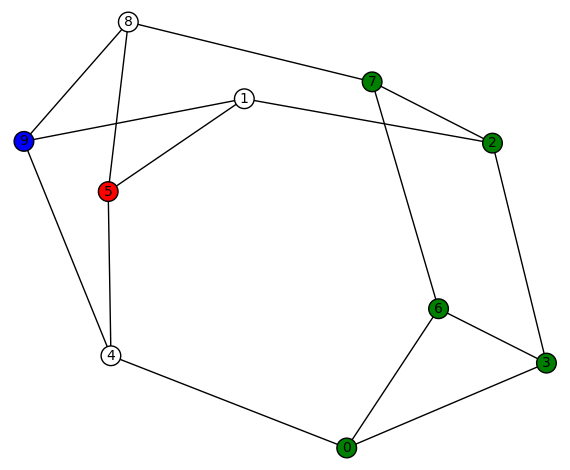
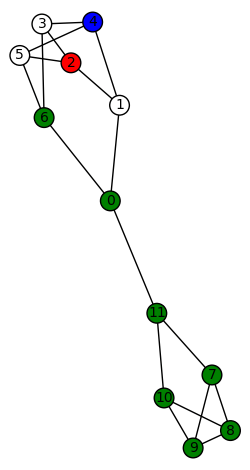
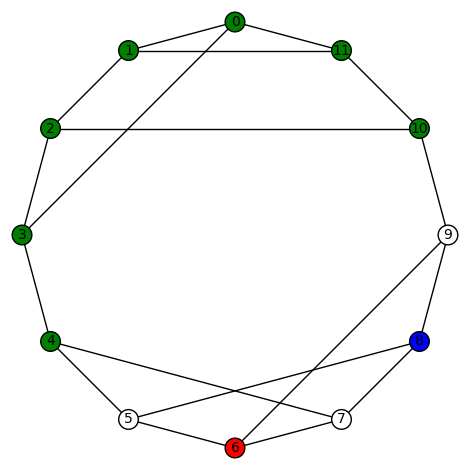
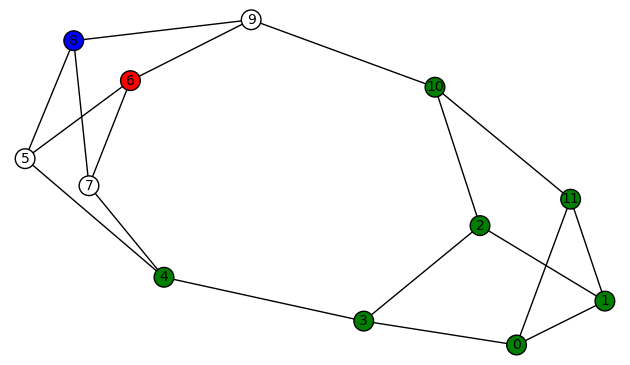
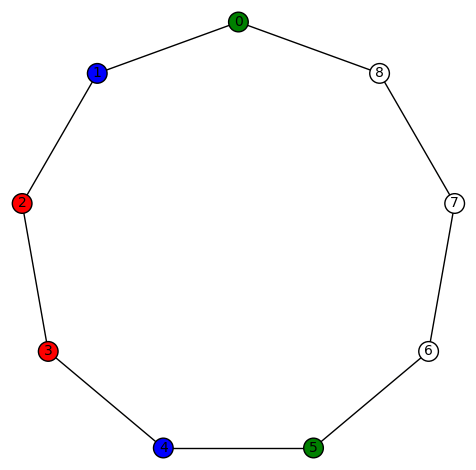
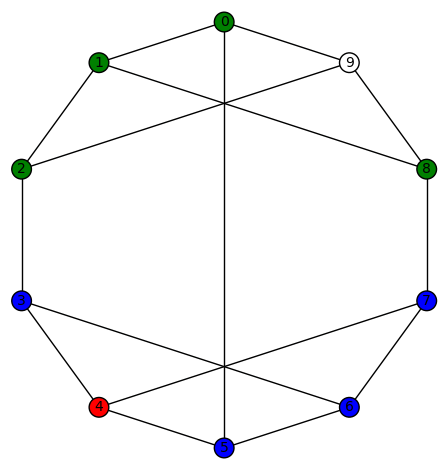
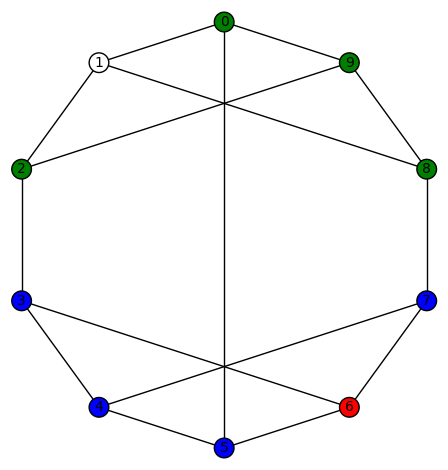
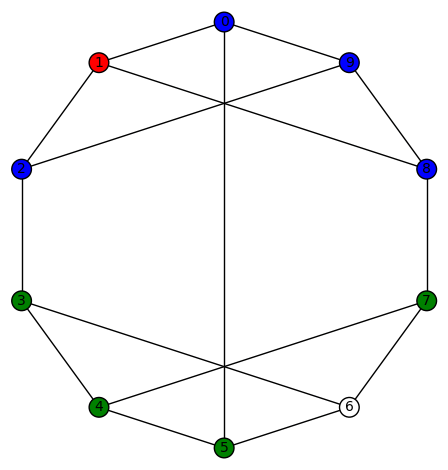
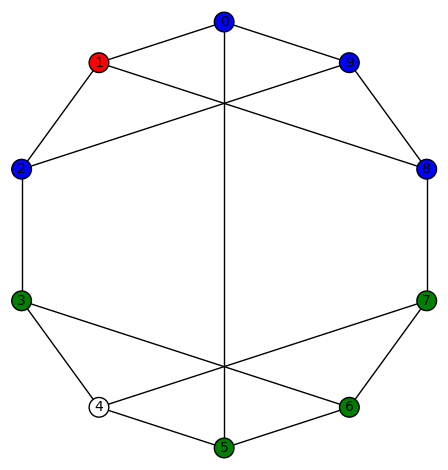
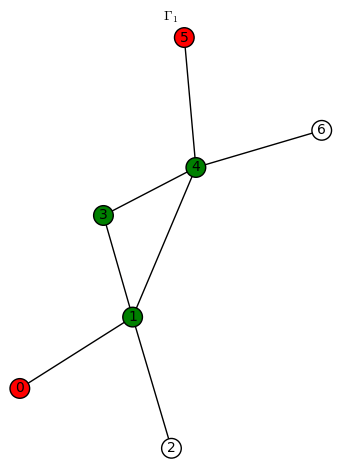
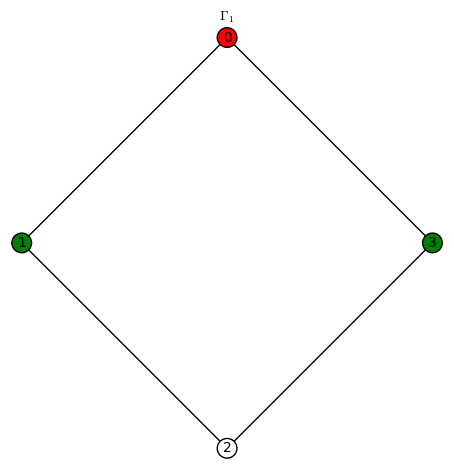
We indicate a harmonic morphism by a vertex coloring. An example of a harmonic morphism can be described in the plot below as follows: \phi:\Gamma_1\to \Gamma_2=D_3 sends the red vertices in \Gamma_1 to the red vertex of \Gamma_2=D_3 (we let 3 be the numerical notation for the color red), the blue vertices in \Gamma_1 to the blue vertex of \Gamma_2=D_3 (we let 2 be the numerical notation for the color blue), the green vertices in \Gamma_1 to the green vertex of \Gamma_2=D_3 (we let 1 be the numerical notation for the color green), and the white vertices in \Gamma_1 to the white vertex of \Gamma_2=D_3 (we let 0 be the numerical notation for the color white).

First, a simple remark about harmonic morphisms in general: roughly speaking, they preserve adjacency. Suppose \phi:\Gamma_1\to \Gamma_2 is a harmonic morphism. Let v,w\in V_1 be adjacent vertices of \Gamma_1. Then either (a) \phi(v)=\phi(w) and \phi “collapses” the edge (vertical) (v,w) or (b) \phi(v)\not= \phi(w) and the vertices \phi(v) and \phi(w) are adjacent in \Gamma_2. In the particular case of this post (ie, the case of \Gamma_2=D_3), this remark has the following consequence: since in D_3 the green vertex is not adjacent to the blue or red vertex, none of the harmonic colored graphs below can have a green vertex adjacent to a blue or red vertex. In fact, any colored vertex can only be connected to a white vertex or a vertex of like color.

To get the following data, I wrote programs in Python using SageMath.

Example 1: There are only the 4 trivial harmonic morphisms Star_4 \to D_3, plus the “obvious” ones obtained from that below and those induced by permutations of the vertices:
Star4-D3-00321.

My guess is that the harmonic morphisms Star_5\to D_3 can be described in a similar manner. Likewise for the higher Star_n graphs. Given a star graph \Gamma with a harmonic morphism to D_3, a leaf (connected to the center vertex 0) can be added to \Gamma and preserve “harmonicity” if its degree 1 vertex is colored 0. You can try to “collapse” such leafs, without ruining the harmonicity property.

Example 2: For graphs like \Gamma_1=
C3LeafLeafLeaf-D3-000321
there are only the 4 trivial harmonic morphisms \Gamma_1 \to D_3, plus the “obvious” ones obtained from that above and those induced by permutations of the vertices with a non-zero color.

Example 2.5: Likewise, for graphs like \Gamma_1=
3C3-D3-0332211
there are only the 4 trivial harmonic morphisms \Gamma_1 \to D_3, plus the “obvious” ones obtained from that above and those induced by permutations of the vertices with a non-zero color.

Example 3: This is really a non-example. There are no harmonic morphisms from the (3-dimensional) cube graph (whose vertices are those of the unit cube) to D_3.
More generally, take two copies of a cyclic graph on n vertices, C_n, one hovering over the other. Now, connect each vertex of the top copy to the corresponding vertex of the bottom copy. This is a cubic graph that can be visualized as a “thick” regular polygon. (The cube graph is the case n=4.) I conjecture that there is no harmonic morphism from such a graph to D_3.

Example 4: There are 30 non-trivial harmonic morphisms \Gamma_1 \to D_3 for the Peterson graph (the last of the 19 simple cubic graphs on 10 vertices listed on this wikipedia page). Here is an example:
petersen-D3-0330120021
Another interesting fact is that this graph has an automorphism group (isomorphic to the symmetric group on 5 letters) which acts transitively on the vertices.

Example 5: There are 12 non-trivial harmonic morphisms \Gamma_1=K_{3,3} \to D_3 for the complete bipartite (“utility”) graph K_{3,3}. They are all obtained from either
K_3_3-D3-321000
or
K_3_3-D3-000231
by permutations of the vertices with a non-zero color (3!+3!=12).

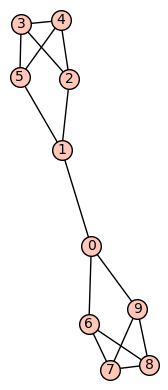
Example 6: There are 6 non-trivial harmonic morphisms \Gamma_1 \to D_3 for the cubic graph \Gamma_1=(V,E), where V=\{0,1,\dots, 9\} and E = \{(0, 3), (0, 4), (0, 6), (1, 2), (1, 5), (1, 9), (2, 3), (2, 7), (3, 6), (4, 5), (4, 9), (5, 8), (6, 7), (7, 8), (8, 9)\}. This graph has diameter 3, girth 3, and edge-connectivity 3. It’s automorphism group is size 4, generated by (5,9) and (1,8)(2,7)(3,6). The harmonic morphisms are all obtained from
random3regular10e-D3-1011031102
by permutations of the vertices with a non-zero color (3!=6). This graph might be hard to visualize but it is isomorphic to the simple cubic graph having LCF notation [−4, 3, 3, 5, −3, −3, 4, 2, 5, −2]:
random3regular10e2
which has a nice picture. This is the ninth of the 19 simple cubic graphs on 10 vertices listed on this wikipedia page.

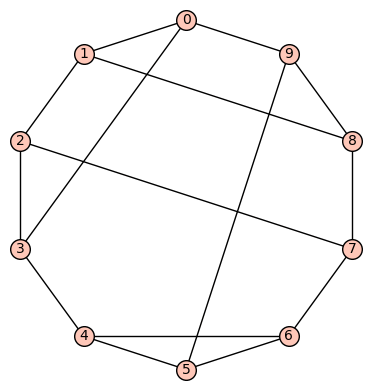
Example 7: (a) The first of the 19 simple cubic graphs on 10 vertices listed on this wikipedia page is the graph \Gamma_1 depicted as:
3regular10f
This graph has diameter 5, automorphism group generated by (7,8), (6,9), (3,4), (2,5), (0,1)(2,6)(3,7)(4,8)(5,9). There are no non-trivial harmonic morphisms \Gamma_1\to D_3.
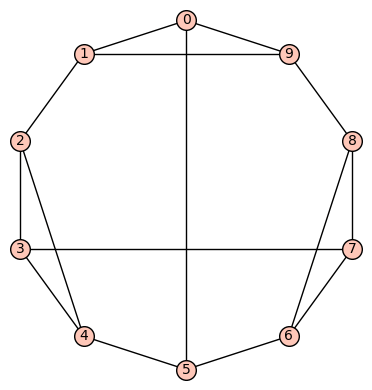
(b) The second of the 19 simple cubic graphs on 10 vertices listed on this wikipedia page is the graph \Gamma_1 depicted as:
3regular10g
This graph has diameter 4, girth 3, automorphism group generated by (7,8), (0,5)(1,2)(6,9). There are no non-trivial harmonic morphisms \Gamma_1\to D_3.
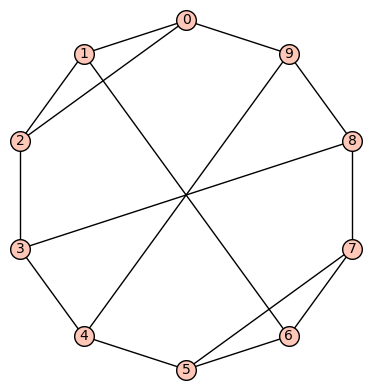
(c) The third of the 19 simple cubic graphs on 10 vertices listed on this wikipedia page is the graph \Gamma_1 depicted as:
3regular10h
This graph has diameter 3, girth 3, automorphism group generated by (4,5), (0,1)(8,9), (0,8)(1,9)(2,7)(3,6). There are no non-trivial harmonic morphisms \Gamma_1\to D_3.

Example 8: The fourth of the 19 simple cubic graphs on 10 vertices listed on this wikipedia page is the graph \Gamma_1 depicted as:
3regular10i
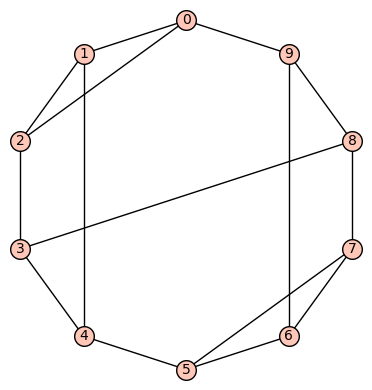
This graph has diameter 3, girth 3, automorphism group generated by (4,6), (3,5), (1,8)(2,7)(3,4)(5,6), (0,9). There are 12 non-trivial harmonic morphisms \Gamma_1\to D_3. For example,
3regular10i-D3-2220301022
and the remaining (3!=6 total) colorings obtained by permutating the non-zero colors. Another example is
3regular10i-D3-1103020111
and the remaining (3!=6 total) colorings obtained by permutating the non-zero colors.

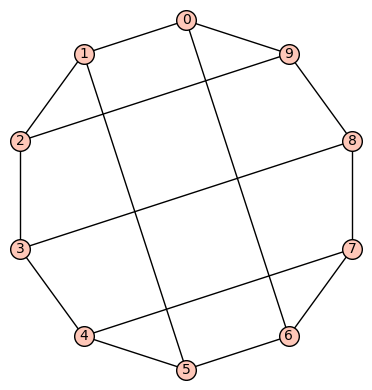
Example 9: (a) The fifth of the 19 simple cubic graphs on 10 vertices listed on this wikipedia page is the graph \Gamma_1 depicted as:
3regular10j
Its SageMath command is Gamma1 = graphs.LCFGraph(10,[2,2,-2,-2,5],2) There are no non-trivial harmonic morphisms \Gamma_1\to D_3.
(b) The sixth of the 19 simple cubic graphs on 10 vertices listed on this wikipedia page is the graph \Gamma_1 depicted as:
3regular10k
Its SageMath command is Gamma1 = graphs.LCFGraph(10,[2,3,-2,5,-3],2) There are no non-trivial harmonic morphisms \Gamma_1\to D_3.

Example 10: The seventh of the 19 simple cubic graphs on 10 vertices listed on this wikipedia page is the graph \Gamma_1 depicted as:
3regular10l-D3-3330222010
Its SageMath command is Gamma1 = graphs.LCFGraph(10,[2,3,-2,5,-3],2). Its automorphism group is order 12, generated by (1,2)(3,7)(4,6), (0,1)(5,6)(7,9), (0,4)(1,6)(2,5)(3,9). There are 6 non-trivial harmonic morphisms \Gamma_1\to D_3, each obtained from the one above by permuting the non-zero colors.

Example 11: The eighth of the 19 simple cubic graphs on 10 vertices listed on this wikipedia page is the graph \Gamma_1 depicted as:
3regular10m
Its SageMath command is Gamma1 = graphs.LCFGraph(10,[5, 3, 5, -4, -3, 5, 2, 5, -2, 4],1). Its automorphism group is order 2, generated by (0,3)(1,4)(2,5)(6,7). There are no non-trivial harmonic morphisms \Gamma_1\to D_3.

Example 12: (a) The tenth (recall the 9th was mentioned above) of the 19 simple cubic graphs on 10 vertices listed on this wikipedia page is the graph \Gamma_1 depicted as:
3regular10o
Its SageMath command is Gamma1 = graphs.LCFGraph(10,[3, -3, 5, -3, 2, 4, -2, 5, 3, -4],1). Its automorphism group is order 6, generated by (2,8)(3,9)(4,5), (0,2)(5,6)(7,9). There are no non-trivial harmonic morphisms \Gamma_1\to D_3.
(b) The 11th of the 19 simple cubic graphs on 10 vertices listed on this wikipedia page is the graph \Gamma_1 depicted as:
3regular10p
Its SageMath command is Gamma1 = graphs.LCFGraph(10,[-4, 4, 2, 5, -2],2). Its automorphism group is order 4, generated by (0,1)(2,9)(3,8)(4,7)(5,6), (0,5)(1,6)(2,7)(3,8)(4,9). There are no non-trivial harmonic morphisms \Gamma_1\to D_3.
(c) The 12th of the 19 simple cubic graphs on 10 vertices listed on this wikipedia page is the graph \Gamma_1 depicted as:
3regular10q
Its SageMath command is Gamma1 = graphs.LCFGraph(10,[5, -2, 2, 4, -2, 5, 2, -4, -2, 2],1). Its automorphism group is order 6, generated by (1,9)(2,8)(3,7)(4,6), (0,4,6)(1,3,8)(2,7,9). There are no non-trivial harmonic morphisms \Gamma_1\to D_3.
(d) The 13th of the 19 simple cubic graphs on 10 vertices listed on this wikipedia page is the graph \Gamma_1 depicted as:
3regular10r
Its SageMath command is Gamma1 = graphs.LCFGraph(10,[2, 5, -2, 5, 5],2). Its automorphism group is order 8, generated by (4,8)(5,7), (0,2)(3,9), (0,5)(1,6)(2,7)(3,8)(4,9). There are no non-trivial harmonic morphisms \Gamma_1\to D_3.

Example 13: The 14th of the 19 simple cubic graphs on 10 vertices listed on this wikipedia page is the graph \Gamma_1 depicted as:
3regular10s-D3-2033020110
By permuting the non-zero colors, we obtain 3!=6 harmonic morphisms from this one. Another harmonic morphism \Gamma_1\to D_3 is depicted as:
3regular10s-D3-0302222201
By permuting the non-zero colors, we obtain 3!=6 harmonic morphisms from this one. And another harmonic morphism \Gamma_1\to D_3 is depicted as:
3regular10s-D3-1110302011
By permuting the non-zero colors, we obtain 3!=6 harmonic morphisms from this one. Its SageMath command is Gamma1 = graphs.LCFGraph(10,[5, -3, -3, 3, 3],2). Its automorphism group is order 48, generated by (4,6), (2,8)(3,7), (1,9), (0,2)(3,5), (0,3)(1,4)(2,5)(6,9)(7,8). There are a total of 18=3!+3!+3! non-trivial harmonic morphisms \Gamma_1\to D_3.

Example 14: The 15th of the 19 simple cubic graphs on 10 vertices listed on this wikipedia page is the graph \Gamma_1 depicted as:
3regular10t-D3-2033020110
By permuting the non-zero colors, we obtain 3!=6 harmonic morphisms from this one. Its SageMath command is Gamma1 = graphs.LCFGraph(10,[5, -4, 4, -4, 4],2). Its automorphism group is order 8, generated by (2,7)(3,8), (1,9)(2,3)(4,6)(7,8), (0,5)(1,4)(2,3)(6,9)(7,8). There are a total of 6=3! non-trivial harmonic morphisms \Gamma_1\to D_3.

Example 15: (a) The 16th of the 19 simple cubic graphs on 10 vertices listed on this wikipedia page is the graph \Gamma_1 depicted as:
3regular10u
Its SageMath command is Gamma1 = graphs.LCFGraph(10,[5, -4, 4, 5, 5],2). Its automorphism group is order 4, generated by (0,3)(1,2)(4,9)(5,8)(6,7), (0,5)(1,6)(2,7)(3,8)(4,9). There are no non-trivial harmonic morphisms \Gamma_1\to D_3.
(b) The 17th of the 19 simple cubic graphs on 10 vertices listed on this wikipedia page is the graph \Gamma_1 depicted as:
3regular10v
Its SageMath command is Gamma1 = graphs.LCFGraph(10,[5, 5, -3, 5, 3],2). Its automorphism group is order 20, generated by (2,6)(3,7)(4,8)(5,9), (0,1)(2,5)(3,4)(6,9)(7,8), (0,2)(1,9)(3,5)(6,8). This group acts transitively on the vertices. There are no non-trivial harmonic morphisms \Gamma_1\to D_3.
(c) The 18th of the 19 simple cubic graphs on 10 vertices listed on this wikipedia page is the graph \Gamma_1 depicted as:
3regular10w
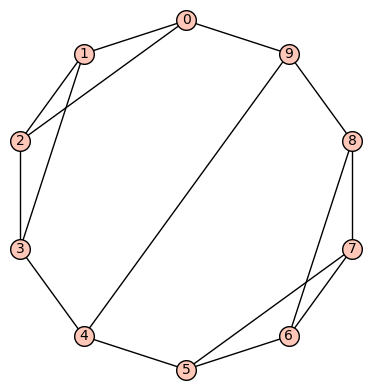
This is an example of a “thick polygon” graph, already mentioned in Example 3 above. Its SageMath command is Gamma1 = graphs.LCFGraph(10,[-4, 4, -3, 5, 3],2). Its automorphism group is order 20, generated by (2,5)(3,4)(6,9)(7,8), (0,1)(2,6)(3,7)(4,8)(5,9), (0,2)(1,9)(3,6)(4,7)(5,8). This group acts transitively on the vertices. There are no non-trivial harmonic morphisms \Gamma_1\to D_3.
(d) The 19th in the list of 19 is the Petersen graph, already in Example 4 above.

We now consider some examples of the cubic graphs having 12 vertices. According to the House of Graphs there are 109 of these, but we use the list on this wikipedia page.

Example 16: I wrote a SageMath program that looked for harmonic morphisms on a case-by-case basis. If there is no harmonic morphism \Gamma_1\to D_3 then, instead of showing a graph, I’ll list the edges (of course, the vertices are 0,1,…,11) and the SageMath command for it.

  1. \Gamma_1=(V_1,E_1), where E_1=\{ (0, 1), (0, 2), (0, 11), (1, 2), (1, 6), (2, 3), (3, 4), (3, 5), (4, 5), (4, 6), (5, 6), (7, 8), (7, 9), (7, 11), (8, 9), (8, 10), (9, 10), (10, 11)\}.
    SageMath command:
    V1 = [0,1,2,3,4,5,6,7,8,9,10,11]
    E1 = [(0, 1), (0, 2), (0, 11), (1, 2), (1, 6), (2, 3), (3, 4), (3, 5), (4, 5), (4, 6), (5, 6), (7, 8), (7, 9), (7, 11), (8, 9), (8, 10), (9, 10), (10, 11)]
    Gamma1 = Graph([V1,E1])

    (Not in LCF notation since it doesn’t have a Hamiltonian cycle.)
  2. \Gamma_1=(V_1,E_1), where E_1=\{(0, 1), (0, 6), (0, 11), (1, 2), (1, 3), (2, 3), (2, 5), (3, 4), (4, 5), (4, 6), (5, 6), (7, 8), (7, 9), (7, 11), (8, 9), (8, 10), (9, 10), (10, 11)\}.
    SageMath command:
    V1 = [0,1,2,3,4,5,6,7,8,9,10,11]
    E1 = [(0, 1), (0, 6), (0, 11), (1, 2), (1, 3), (2, 3), (2, 5), (3, 4), (4, 5), (4, 6), (5, 6), (7, 8), (7, 9), (7, 11), (8, 9), (8, 10), (9, 10), (10, 11)]
    Gamma1 = Graph([V1,E1])

    (Not in LCF notation since it doesn’t have a Hamiltonian cycle.)
  3. \Gamma_1=(V_1,E_1), where E_1=\{(0,1),(0,3),(0,11),(1,2),(1,6),(2,3),(2,5),(3,4),(4,5),(4,6),(5,6),(7,8),(7,9),(7,11),(8,9),(8,10),(9,10),(10,11)\}.
    SageMath command:
    V1 = [0,1,2,3,4,5,6,7,8,9,10,11]
    E1 = [(0,1),(0,3),(0,11),(1,2),(1,6),(2,3),(2,5),(3,4),(4,5),(4,6),(5,6),(7,8),(7,9),(7,11),(8,9),(8,10),(9,10),(10,11)]
    Gamma1 = Graph([V1,E1])

    (Not in LCF notation since it doesn’t have a Hamiltonian cycle.)
  4. This example has 12 non-trivial harmonic morphisms.
    SageMath command:
    V1 = [0,1,2,3,4,5,6,7,8,9,10,11]
    E1 = [(0,1),(0,3),(0,11),(1,2),(1,6),(2,3),(2,5),(3,4),(4,5),(4,6),(5,6),(7,8),(7,9),(7,11),(8,9),(8,10),(9,10),(10,11)]
    Gamma1 = Graph([V1,E1])

    (Not in LCF notation since it doesn’t have a Hamiltonian cycle.) We show two such morphisms:
    3regular12d-D3-110302011111
    3regular12d-D3-103020111111
    The other non-trivial harmonic morphisms are obtained by permuting the non-zero colors. There are 3!=6 for each graph above, so the total number of harmonic morphisms (including the trivial ones) is 6+6+4=16.
  5. \Gamma_1=(V_1,E_1), where E_1=\{(0, 1), (0, 3), (0, 11), (1, 2), (1, 11), (2, 3), (2, 10), (3, 4), (4, 5), (4, 8), (5, 6), (5, 7), (6, 7), (6, 9), (7, 8), (8, 9), (9, 10), (10, 11)\}.
    SageMath command:
    Gamma1 = graphs.LCFGraph(12, [3, -2, -4, -3, 4, 2], 2)
  6. This example has 12 non-trivial harmonic morphisms. \Gamma_1=(V_1,E_1), where E_1=\{(0, 1), (0, 3), (0, 11), (1, 2), (1, 11), (2, 3), (2, 10), (3, 4), (4, 5), (4, 7), (5, 6), (5, 8), (6, 7), (6, 9), (7, 8), (8, 9), (9, 10), (10, 11)\}. (This only differs by one edge from the one above.)
    SageMath command:
    Gamma1 = graphs.LCFGraph(12, [3, -2, -4, -3, 3, 3, 3, -3, -3, -3, 4, 2], 1)
    We show two such morphisms:
    3regular12f-D3-111103020111
    3regular12f-D3-111110302011
    And here is another plot of the last colored graph:
    3regular12f2-D3-111110302011
    The other non-trivial harmonic morphisms are obtained by permuting the non-zero colors. There are 3!=6 for each graph above, so the total number of harmonic morphisms (including the trivial ones) is 6+6+4=16.
  7. \Gamma_1=(V_1,E_1), where E_1=\{(0, 1), (0, 4), (0, 11), (1, 2), (1, 3), (2, 3), (2, 5), (3, 4), (4, 5), (5, 6), (6, 7), (6, 8), (7, 8), (7, 10), (8, 9), (9, 10), (9, 11), (10, 11)\}.
    SageMath command:
    Gamma1 = graphs.LCFGraph(12, [4, 2, 3, -2, -4, -3, 2, 3, -2, 2, -3, -2], 1)
  8. This example has 48 non-trivial harmonic morphisms. \Gamma_1=(V_1,E_1), where E_1=\{(0, 1), (0, 3), (0, 11), (1, 2), (1, 4), (2, 3), (2, 5), (3, 4), (4, 5), (5, 6), (6, 7), (6, 9), (7, 8), (7, 10), (8, 9), (8, 11), (9, 10), (10, 11)\}.
    SageMath command:
    Gamma1 = graphs.LCFGraph(12, [3, 3, 3, -3, -3, -3], 2)
    This example is also interesting as it has a large number of automorphisms – its automorphism group is size 64, generated by (8,10), (7,9), (2,4), (1,3), (0,5)(1,2)(3,4)(6,11)(7,8)(9,10), (0,6)(1,7)(2,8)(3,9)(4,10)(5,11). Here are examples of some of the harmonic morphisms using vertex-colored graphs:
    3regular12h-D3-302010302010
    3regular12h-D3-333333302010
    3regular12h-D3-030201030201
    3regular12h-D3-103020111111
    I think all the other non-trivial harmonic morphisms are obtained by (a) permuting the non-zero colors, or (b) applying a element of the automorphism group of the graph.
  9. (list under construction)

Harmonic morphisms to P_4 – examples

This post expands on a previous post and gives more examples of harmonic morphisms to the path graph \Gamma_2=P_4.
path4-0123

First, a simple remark about harmonic morphisms in general: roughly speaking, they preserve adjacency. Suppose \phi:\Gamma_1\to \Gamma_2 is a harmonic morphism. Let v,w\in V_1 be adjacent vertices of \Gamma_1. Then either (a) \phi(v)=\phi(w) and \phi “collapses” the edge (vertical) (v,w) or (b) \phi(v)\not= \phi(w) and the vertices \phi(v) and \phi(w) are adjacent in \Gamma_2. In the particular case of this post (ie, the case of \Gamma_2=P_4), this remark has the following consequence: since in P_4 the white vertex is not adjacent to the blue or red vertex, none of the harmonic colored graphs below can have a white vertex adjacent to a blue or red vertex.

We first consider the cyclic graph on k vertices, C_k as the domain in this post. However, before we get to examples (obtained by using SageMath), I’d like to state a (probably naive) conjecture.

Let \phi:\Gamma_1 \to \Gamma_2=P_k be a harmonic morphism from a graph \Gamma_1 with n=|V_1| vertices to the path graph having k>2 vertices. Let f:V_2 \to V_1 be the coloring map (identified with an n-tuple whose coordinates are in \{0,1,\dots ,k-1\}). Associated to f is a partition \Pi_f=[n_0,\dots,n_{k-1}] of n (here [...] is a multi-set, so repetition is allowed but the ordering is unimportant): n=n_0+n_1+...+n_{k-1}, where n_j is the number of times j occurs in f. We call this the partition invariant of the harmonic morphism.

Definition: For any two harmonic morphisms \phi:\Gamma_1 \to P_k, \phi:\Gamma'_1 \to P_k, with associated
colorings f, f' whose corresponding partitions agree, \Pi_f=\Pi_{f'} then we say f' and f are partition equivalent.

What can be said about partition equivalent harmonic morphisms? Caroline Melles has given examples where partition equivalent harmonic morphisms are not induced from an automorphism.

Now onto the \Gamma_1 \to P_4 examples!

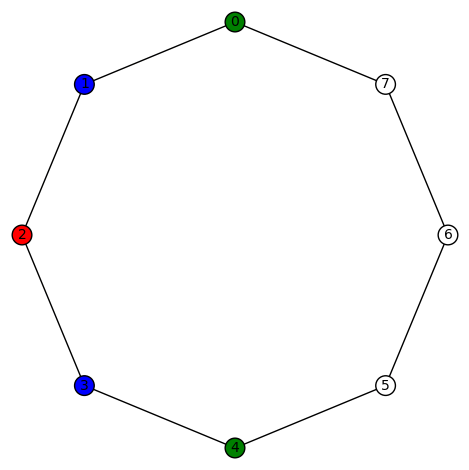
There are no non-trivial harmonic morphisms C_5 \to P_4, so we start with C_6. We indicate a harmonic morphism by a vertex coloring. An example of a harmonic morphism can be described in the plot below as follows: \phi:\Gamma_1\to \Gamma_2=P_4 sends the red vertices in \Gamma_1 to the red vertex of \Gamma_2=P_4 (we let 3 be the numerical notation for the color red), the blue vertices in \Gamma_1 to the blue vertex of \Gamma_2=P_4 (we let 2 be the numerical notation for the color blue), the green vertices in \Gamma_1 to the green vertex of \Gamma_2=P_4 (we let 1 be the numerical notation for the color green), and the white vertices in \Gamma_1 to the white vertex of \Gamma_2=P_4 (we let 0 be the numerical notation for the color white).

To get the following data, I wrote programs in Python using SageMath.

Example 1: There are only the 4 trivial harmonic morphisms C_6 \to P_4, plus that induced by f = (1, 2, 3, 2, 1, 0) and all of its cyclic permutations (4+6=10). This set of 6 permutations is closed under the automorphism of P_4 induced by the transposition (0,3)(1,2) (so total = 10).cyclic6-123210

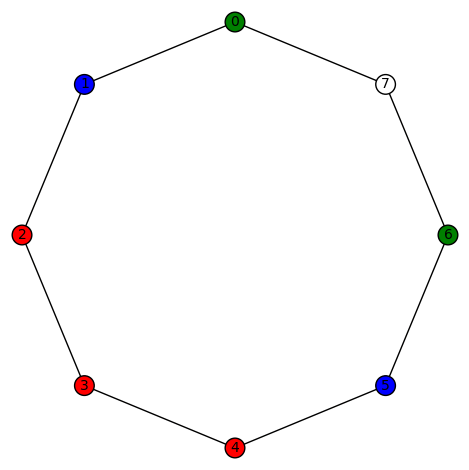
Example 2: There are only the 4 trivial harmonic morphisms, plus f = (1, 2, 3, 2, 1, 0, 0) and all of its cyclic permutations (4+7=11). This set of 7 permutations is not closed under the automorphism of P_4 induced by the transposition (0,3)(1,2), so one also has f = (2, 1, 0, 1, 2, 3, 3) and all 7 of its cyclic permutations (total = 7+11 = 18).
cyclic7-1232100
cyclic7-1233210

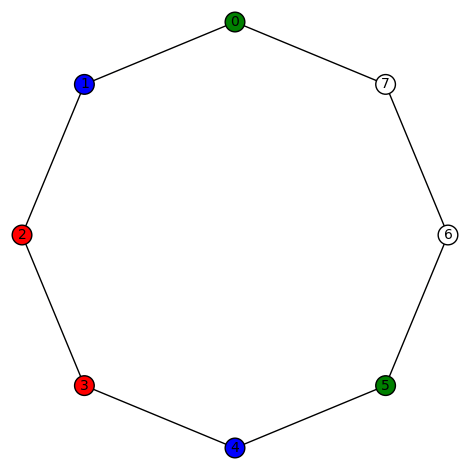
Example 3: There are only the 4 trivial harmonic morphisms, plus f = (1, 2, 3, 2, 1, 0, 0, 0) and all of its cyclic permutations (4+8=12). This set of 8 permutations is not closed under the automorphism of P_4 induced by the transposition (0,3)(1,2), so one also has f = (1, 2, 3, 3, 3, 2, 1, 0) and all of its cyclic permutations (12+8=20). In addition, there is f = (1, 2, 3, 3, 2, 1, 0, 0) and all of its cyclic permutations (20+8 = 28). The latter set of 8 cyclic permutations of (1, 2, 3, 3, 2, 1, 0, 0) is closed under the transposition (0,3)(1,2) (total = 28).
cyclic8-12321000
cyclic8-12333210
cyclic8-12332100

Example 4: There are only the 4 trivial harmonic morphisms, plus f = (1, 2, 3, 2, 1, 0, 0, 0, 0) and all of its cyclic permutations (4+9=13). This set of 9 permutations is not closed under the automorphism of P_4 induced by the transposition (0,3)(1,2), so one also has f = (1, 2, 3, 3, 2, 1, 0, 0, 0) and all 9 of its cyclic permutations (9+13 = 22). This set of 9 permutations is not closed under the automorphism of P_4 induced by the transposition (0,3)(1,2), so one also has f = (1, 2, 3, 3, 3, 2, 1, 0, 0) and all 9 of its cyclic permutations (9+22 = 31). This set of 9 permutations is not closed under the automorphism of P_4 induced by the transposition (0,3)(1,2), so one also has f = (1, 2, 3, 3, 3, 3, 2, 1, 0) and all 9 of its cyclic permutations (total = 9+31 = 40). cyclic9-123210000cyclic9-123321000cyclic9-123332100cyclic9-123333210

Next we consider some cubic graphs.

Example 5: There are 5 cubic graphs on 8 vertices, as listed on this wikipedia page. I wrote a SageMath program that looked for harmonic morphisms on a case-by-case basis. There are no non-trivial harmonic morphisms from any one of these 5 graphs to P_4.

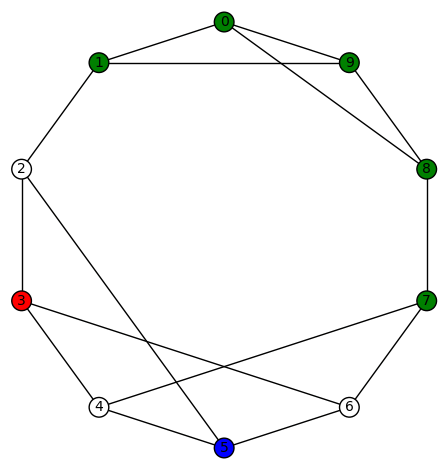
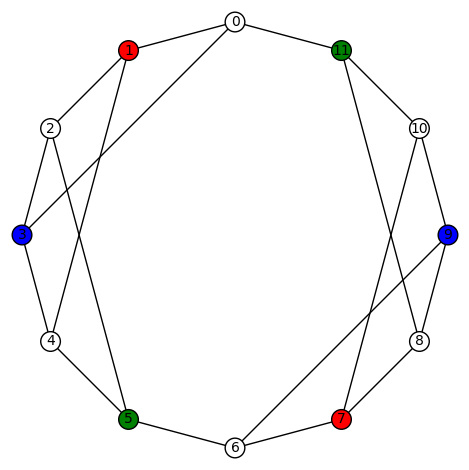
Example 6: There are 19 cubic graphs on 10 vertices, as listed on this wikipedia page. I wrote a SageMath program that looked for harmonic morphisms on a case-by-case basis. The only one of these 19 cubic graphs \Gamma_1 having a harmonic morphism \phi:\Gamma_1\to P_4 is the graph whose SageMath command is graphs.LCFGraph(10,[5, -3, -3, 3, 3],2). It has diameter 3, girth 4, and automorphism group of order 48 generated by (4,6), (2,8)(3,7), (1,9), (0,2)(3,5), (0,3)(1,4)(2,5)(6,9)(7,8). There are eight non-trivial harmonic morphisms \phi:\Gamma_1\to P_4. They are depicted as follows:
3regular10nn-P4-1112322210
3regular10nn-P4-1112223210
3regular10nn-P4-1012322211
3regular10nn-P4-1012223211
3regular10nn-P4-2321110122
3regular10nn-P4-2321011122
3regular10nn-P4-2221110123
3regular10nn-P4-2221011123
Note that the last four are obtained from the first 4 by applying the permutation (0,3)(1,2) to the colors (where 0 is white, etc, as above).

We move to cubic graphs on 12 vertices. There are quite a few of them – according to the House of Graphs page on connected cubic graphs, there are 109 of them (if I counted correctly).

Example 7: The cubic graphs on 12 vertices are listed on this wikipedia page. I wrote a SageMath program that looked for harmonic morphisms on a case-by-case basis. If there is no harmonic morphism \Gamma_1\to P_4 then, instead of showing a graph, I’ll list the edges (of course, the vertices are 0,1,…,11) and the SageMath command for it.

  1. \Gamma_1=(V_1,E_1), where E_1=\{ (0, 1), (0, 2), (0, 11), (1, 2), (1, 6), (2, 3), (3, 4), (3, 5), (4, 5), (4, 6), (5, 6), (7, 8), (7, 9), (7, 11), (8, 9), (8, 10), (9, 10), (10, 11)\}.
    SageMath command:
    V1 = [0,1,2,3,4,5,6,7,8,9,10,11]
    E1 = [(0,1), (0,2), (0,11), (1,2), (1,6),(2,3), (3,4), (3,5), (4,5), (4,6), (5,6), (7,8), (7,9), (7,11), (8,9),(8,10), (9,10), (10,11)]
    Gamma1 = Graph([V1,E1])

    (Not in LCF notation since it doesn’t have a Hamiltonian cycle.)
  2. \Gamma_1=(V_1,E_1), where E_1=\{ (0, 1), (0, 6), (0, 11), (1, 2), (1, 3), (2, 3), (2, 5), (3, 4), (4, 5), (4, 6), (5, 6), (7, 8), (7, 9), (7, 11), (8, 9), (8, 10), (9, 10), (10, 11)\}.
    SageMath command:
    V1 = [0,1,2,3,4,5,6,7,8,9,10,11]
    E1 = [(0, 1), (0, 6), (0, 11), (1, 2), (1, 3), (2, 3), (2, 5), (3, 4), (4, 5), (4, 6), (5, 6), (7, 8), (7, 9), (7, 11), (8, 9), (8, 10), (9, 10), (10, 11)]
    Gamma1 = Graph([V1,E1])

    (Not in LCF notation since it doesn’t have a Hamiltonian cycle.)
  3. \Gamma_1=(V_1,E_1), where E_1=\{(0,1),(0,3),(0,11),(1,2),(1,6),(2,3),(2,5),(3,4),(4,5),(4,6),(5,6),(7,8),(7,9),(7,11),(8,9),(8,10),(9,10),(10,11)\}.
    SageMath command:
    V1 = [0,1,2,3,4,5,6,7,8,9,10,11]
    E1 = [(0,1),(0,3),(0,11),(1,2),(1,6),(2,3),(2,5),(3,4),(4,5),(4,6),(5,6),(7,8),(7,9),(7,11),(8,9),(8,10),(9,10),(10,11)]
    Gamma1 = Graph([V1,E1])

    (Not in LCF notation since it doesn’t have a Hamiltonian cycle.)
  4. \Gamma_1=(V_1,E_1), where E_1=\{(0, 1), (0, 3), (0, 11), (1, 2), (1, 11), (2, 3), (2, 10), (3, 4), (4, 5), (4, 8), (5, 6), (5, 7), (6, 7), (6, 9), (7, 8), (8, 9), (9, 10), (10, 11)\}.
    SageMath command:
    Gamma1 = graphs.LCFGraph(12, [3, -2, -4, -3, 4, 2], 2)
  5. \Gamma_1=(V_1,E_1), where E_1=\{(0, 1), (0, 3), (0, 11), (1, 2), (1, 11), (2, 3), (2, 10), (3, 4), (4, 5), (4, 7), (5, 6), (5, 8), (6, 7), (6, 9), (7, 8), (8, 9), (9, 10), (10, 11)\}.
    SageMath command:
    Gamma1 = graphs.LCFGraph(12, [3, -2, -4, -3, 3, 3, 3, -3, -3, -3, 4, 2], 1)
  6. \Gamma_1=(V_1,E_1), where E_1=\{(0, 1), (0, 4), (0, 11), (1, 2), (1, 3), (2, 3), (2, 5), (3, 4), (4, 5), (5, 6), (6, 7), (6, 8), (7, 8), (7, 10), (8, 9), (9, 10), (9, 11), (10, 11)\}.
    SageMath command:
    Gamma1 = graphs.LCFGraph(12, [4, 2, 3, -2, -4, -3, 2, 3, -2, 2, -3, -2], 1)
  7. \Gamma_1=(V_1,E_1), where E_1=\{(0, 1), (0, 3), (0, 11), (1, 2), (1, 4), (2, 3), (2, 5), (3, 4), (4, 5), (5, 6), (6, 7), (6, 9), (7, 8), (7, 10), (8, 9), (8, 11), (9, 10), (10, 11)\}.
    SageMath command:
    Gamma1 = graphs.LCFGraph(12, [3, 3, 3, -3, -3, -3], 2)
  8. (list under construction)

Harmonic morphisms to P_3 – examples

This post expands on a previous post and gives more examples of harmonic morphisms to the path graph \Gamma_2=P_3.

The path graph P_3

If \Gamma_1 = (V_1, E_1) and \Gamma_2 = (V_2, E_2) are graphs then a map \phi:\Gamma_1\to \Gamma_2 (that is, \phi: V_1\cup E_1\to V_2\cup E_2) is a morphism provided

  1. if \phi sends an edge to an edge then the edges vertices must also map to each other: e=(v,w)\in E_1 and \phi(e)\in E_2 then \phi(e) is an edge in \Gamma_2 having vertices \phi(v)\in V_2 and \phi(w)\in V_2, where \phi(v)\not= \phi(w), and
  2. if \phi sends an edge to a vertex then the edges vertices must also map to that vertex: if e=(v,w)\in E_1 and \phi(e)\in V_2 then \phi(e) = \phi(v) = \phi(w).

As a non-example, if \Gamma_1 is a planar graph, if \Gamma_2 is its dual graph, and if \phi:\Gamma_1\to\Gamma_2 is the dual map V_1\to E_2 and E_1\to V_2, then \phi is not a morphism.

Given a map \phi_E : E_1 \rightarrow E_2 \cup V_2, an edge e_1 is called horizontal if \phi_E(e_1) \in E_2 and is called vertical if \phi_E(e_1) \in V_2. We say that a graph morphism \phi: \Gamma_1 \rightarrow \Gamma_2 is a graph homomorphism if \phi_E (E_1) \subset E_2. Thus, a graph morphism is a homomorphism if it has no vertical edges.

Suppose that \Gamma_2 has at least one edge. Let Star_{\Gamma_1}(v) denote the star subgraph centered at the vertex v. A graph morphism \phi : \Gamma_1 \to \Gamma_2 is called harmonic if for all vertices v \in V(\Gamma_1), the quantity
\mu_\phi(v,f)= |\phi^{-1}(f) \cap Star_{\Gamma_1}(v)|
(the number of edges in \Gamma_1 adjacent to v and mapping to the edge f in \Gamma_2) is independent of the choice of edge f in Star_{\Gamma_2}(\phi(v)).

An example of a harmonic morphism can be described in the plot below as follows: \phi:\Gamma_1\to \Gamma_2=P_3 sends the red vertices in \Gamma_1 to the red vertex of \Gamma_2=P_3, the green vertices in \Gamma_1 to the green vertex of \Gamma_2=P_3, and the white vertices in \Gamma_1 to the white vertex of \Gamma_2=P_3.

Example 1:

P3-C3-V

Example 2:
D3-2110

Example 3:
cyclic4-2101

Differential equations and SageMath

The files below were on my teaching page when I was a college teacher. Since I retired, they disappeared. Samuel Lelièvre found an archived copy on the web, so I’m posting them here.

The files are licensed under the Attribution-ShareAlike Creative Commons license.

  1. Partial fractions handout, pdf
  2. Introduction to matrix determinants handout, pdf
  3. Impulse-response handout, pdf
  4. Introduction to ODEs, pdf
  5. Initial value problems, pdf
  6. Existence and uniqueness, pdf
  7. Euler’s method for numerically approximating solutions to DEs, pdf.
    Includes both 1st order DE case (with Euler and improved Euler) and higher order DE and systems of DEs cases, without improved Euler.
  8. Direction fields and isoclines, pdf
  9. 1st order ODEs, separable and linear cases, pdf
  10. A falling body problem in Newtonian mechanics, pdf
  11. A mixing problem, pdf
  12. Linear ODEs, I, pdf
  13. Linear ODEs, II, pdf
  14. Undetermined coefficients for non-homogeneous 2nd order constant coefficient ODEs, pdf
  15. Variation of parameters for non-homogeneous 2nd order constant coefficient ODEs, pdf.
  16. Annihilator method for non-homogeneous 2nd order constant coefficient ODEs, pdf.
    I found students preferred (the more-or-less equivalent) undetermined coefficient method, so didn’t put much effort into these notes.
  17. Springs, I, pdf
  18. Springs, II, pdf
  19. Springs, III, pdf
  20. LRC circuits, pdf
  21. Power series methods, I, pdf
  22. Power series methods, II, pdf
  23. Introduction to Laplace transform methods, I, pdf
  24. Introduction to Laplace transform methods, II, pdf
  25. Lanchester’s equations modeling the battle between two armies, pdf
  26. Row reduction/Gauss elimination method for systems of linear equations, pdf.
  27. Eigenvalue method for homogeneous constant coefficient 2×2 systems of 1st order ODEs, pdf.
  28. Variation of parameters for first order non-homogeneous linear constant coefficient systems of ODEs, pdf.
  29. Electrical networks using Laplace transforms, pdf
  30. Separation of variables and the Transport PDE, pdf
  31. Fourier series, pdf.
  32. one-dimensional heat equation using Fourier series, pdf.
  33. one-dimensional wave equation using Fourier series, pdf.
  34. one-dimensional Schroedinger’s wave equation for a “free particle in a box” using Fourier series, pdf.
  35. All these lectures collected as one pdf (216 pages).
    While licensed Attribution-ShareAlike CC, in the US this book is in the public domain, as it was written while I was a US federal government employee as part of my official duties. A warning – it has lots of typos. The latest version, written with Marshall Hampton, is a JHUP book, much more polished, available on amazon and the JHUP website. Google “Introduction to Differential Equations Using Sage”.

Course review: pdf

Love, War, and Zombies, pdf
This set of slides is of a lecture I would give if there was enough time towards the end of the semester

Integral Calculus and SageMath

Long ago, using LaTeX I assembled a book on Calculus II (integral calculus), based on notes of mine, Dale Hoffman (which was written in word), and William Stein. I ran out of energy to finish it and the source files mostly disappeared from my HD. Recently, Samuel Lelièvre found a copy of the pdf of this book on the internet (you can download it here). It’s licensed under a Creative Commons Attribution 3.0 United States License. You are free to print, use, mix or modify these materials as long as you credit the original authors.

Table of Contents

0 Preface

1 The Integral
1.1 Area
1.2 Some applications of area
1.2.1 Total accumulation as “area”
1.2.2 Problems
1.3 Sigma notation and Riemann sums
1.3.1 Sums of areas of rectangles
1.3.2 Area under a curve: Riemann sums
1.3.3 Two special Riemann sums: lower and upper sums
1.3.4 Problems
1.3.5 The trapezoidal rule
1.3.6 Simpson’s rule and Sage
1.3.7 Trapezoidal vs. Simpson: Which Method Is Best?
1.4 The definite integral
1.4.1 The Fundamental Theorem of Calculus
1.4.2 Problems
1.4.3 Properties of the definite integral
1.4.4 Problems
1.5 Areas, integrals, and antiderivatives
1.5.1 Integrals, Antiderivatives, and Applications
1.5.2 Indefinite Integrals and net change
1.5.3 Physical Intuition
1.5.4 Problems
1.6 Substitution and Symmetry
1.6.1 The Substitution Rule
1.6.2 Substitution and definite integrals
1.6.3 Symmetry
1.6.4 Problems

2 Applications
2.1 Applications of the integral to area
2.1.1 Using integration to determine areas
2.2 Computing Volumes of Surfaces of Revolution
2.2.1 Disc method
2.2.2 Shell method
2.2.3 Problems
2.3 Average Values
2.3.1 Problems
2.4 Moments and centers of mass
2.4.1 Point Masses
2.4.2 Center of mass of a region in the plane
2.4.3 x-bar For A Region
2.4.4 y-bar For a Region
2.4.5 Theorems of Pappus
2.5 Arc lengths
2.5.1 2-D Arc length
2.5.2 3-D Arc length

3 Polar coordinates and trigonometric integrals
3.1 Polar Coordinates
3.2 Areas in Polar Coordinates
3.3 Complex Numbers
3.3.1 Polar Form
3.4 Complex Exponentials and Trigonometric Identities
3.4.1 Trigonometry and Complex Exponentials
3.5 Integrals of Trigonometric Functions
3.5.1 Some Remarks on Using Complex-Valued Functions

4 Integration techniques
4.1 Trigonometric Substitutions
4.2 Integration by Parts
4.2.1 More General Uses of Integration By Parts
4.3 Factoring Polynomials
4.4 Partial Fractions
4.5 Integration of Rational Functions Using Partial Fractions
4.6 Improper Integrals
4.6.1 Convergence, Divergence, and Comparison

5 Sequences and Series
5.1 Sequences
5.2 Series
5.3 The Integral and Comparison Tests
5.3.1 Estimating the Sum of a Series
5.4 Tests for Convergence
5.4.1 The Comparison Test
5.4.2 Absolute and Conditional Convergence
5.4.3 The Ratio Test
5.4.4 The Root Test
5.5 Power Series
5.5.1 Shift the Origin
5.5.2 Convergence of Power Series
5.6 Taylor Series
5.7 Applications of Taylor Series
5.7.1 Estimation of Taylor Series

6 Some Differential Equations
6.1 Separable Equations
6.2 Logistic Equation

7 Appendix: Integral tables

Ring theory, via coding theory and cryptography

In these notes on ring theory, I tried to cover enough material to get a feeling for basic ring theory, via cyclic codes and ring-based cryptosystems such as NTRU. Here’s a list of the topics.

1 Introduction to rings
1.1 Definition of a ring
1.2 Integral domains and fields
1.3 Ring homomorphisms and ideals
1.4 Quotient rings
1.5 UFDs
1.6 Polynomial rings
1.6.1 Application: Shamir’s Secret Sharing Scheme
1.6.2 Application: NTRU
1.6.3 Application: Modified NTRU
1.6.4 Application to LFSRs

2 Structure of finite fields
2.1 Cyclic multiplicative group
2.2 Extension fields
2.3 Back to the LFSR

3 Error-correcting codes
3.1 The communication model
3.2 Basic definitions
3.3 Binary Hamming codes
3.4 Coset leaders and the covering radius
3.5 Reed-Solomon codes as polynomial codes
3.6 Cyclic codes as polynomial codes
3.6.1 Reed-Solomon codes as cyclic codes
3.6.2 Quadratic residue codes
3.6.3 BCH bound for cyclic codes
3.6.4 Decoding cyclic codes
3.6.5 Cyclic codes and LFSRs

4 Lattices
4.1 Basic definitions
4.2 The shortest vector problem
4.2.1 Application to a congruential PKC
4.3 LLL and a reduced lattice basis
4.4 Hermite normal form
4.5 NTRU as a lattice cryptosystem

Calculus on graphs

In these notes, I tried to cover enough material to get a feeling for “calculus on graphs”, with applications to sports rankings and the Friendship Theorem. Here’s a list of the topics.

1 . Introduction
2. Examples
3. Basic definitions
3.1 Diameter, radius, and all that
3.2 Treks, trails, paths
3.3 Maps between graphs
3.4 Colorings
3.5 Transitivity
4. Adjacency matrix
4.1 Definition
4.2 Basic results
4.3 The spectrum
4.4 Application to the Friendship Theorem
4.5 Eigenvector centrality and the Keener ranking
4.6 Strongly regular graphs
4.7  Orientation on a graph
5. Incidence matrix
5.1 The unsigned incidence matrix
5.2 The oriented case
5.3 Cycle space and cut space
6. Laplacian matrix
6.1 The Laplacian spectrum
7  Hodge decomposition for graphs
7.1 Abstract simplicial complexes
7.2 The Bjorner complex and the Riemann hypothesis
7.3 Homology groups
8. Comparison graphs
8.1 Comparison matrices
8.2 HodgeRank
8.3 HodgeRank example

Gray codes

This is based on work done about 20 years ago with a former student Jim McShea.

Gray codes were introduced by Bell Labs physicist Frank Gray in the 1950s. As introduced, a Gray code is an ordering of the n-tuples in GF(2)^n = \{0,1\}^n such that two successive terms differ in only one position. A Gray code can be regarded as a Hamiltonian path in the cube graph. For example:
[[0, 0, 0], [1, 0, 0], [1, 1, 0], [0, 1, 0], [0, 1, 1], [1, 1, 1], [1, 0, 1], [0, 0, 1]]

These can be generalized to n-tuples of integers (mod m) in the obvious way.

Gray codes have several applications:

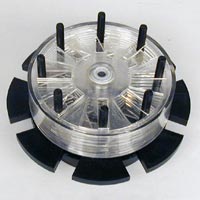
  • solving puzzles such as the Tower of Hanoi and the Brain [G],
  • analog-digital-converters (goniometers) [S],
  • Hamiltonian circuits in hypercubes [Gil] and Cayley graphs of Coxeter groups [CSW],
  • capanology (the study of bell-ringing) [W],
  • continuous space-filling curves [Gi],
  • classification of Venn diagrams [R],
  • design of communication codes,
  • and more (see Wikipedia).
brain-puzzle

The Brain puzzle

Here's a SageMath/Python function for computing Gray codes.
def graycode(length,modulus):
    """
    Returns the n-tuple reverse Gray code mod m.


    EXAMPLES:
        sage: graycode(2,4)
        
        [[0, 0],
         [1, 0],
         [2, 0],
         [3, 0],
         [3, 1],
         [2, 1],
         [1, 1],
         [0, 1],
         [0, 2],
         [1, 2],
         [2, 2],
         [3, 2],
         [3, 3],
         [2, 3],
         [1, 3],
         [0, 3]]

    """
    n,m = length,modulus
    F = range(m)
    if n == 1:
        return [[i] for i in F]
    L = graycode(n-1, m)
    M = []
    for j in F:
        M = M+[ll+[j] for ll in L]
    k = len(M)
    Mr = [0]*m
    for i in range(m-1):
        i1 = i*int(k/m)
        i2 = (i+1)*int(k/m)
        Mr[i] = M[i1:i2]
    Mr[m-1] = M[(m-1)*int(k/m):]
    for i in range(m):
        if is_odd(i):
            Mr[i].reverse()
    M0 = []
    for i in range(m):
        M0 = M0+Mr[i]
    return M0


REFERENCES

[CSW] J. Conway, N. Sloane, and A. Wilks, “Gray codes and reflection groups”, Graphs and combinatorics 5(1989)315-325

[E] M. C. Er, “On generating the N-ary reflected Gray codes”, IEEE transactions on computers, 33(1984)739-741

[G] M. Gardner, “The binary Gray code”, in Knotted donuts and other mathematical entertainments, F. H. Freeman and Co., NY, 1986

[Gi] W. Gilbert, “A cube-filling Hilbert curve”, Math Intell 6 (1984)78

[Gil] E. Gilbert, “Gray codes and paths on the n-cube”, Bell System Technical Journal 37 (1958)815-826

[R] F. Ruskey, “A Survey of Venn Diagrams“, Elec. J. of Comb.(1997), and updated versions.

[S] Web page of T. Sillke

[W] A. White, “Ringing the cosets”, Amer. Math. Monthly 94(1987)721-746

Sports ranking methods, 4

This is the fourth of a series of expository posts on matrix-theoretic sports ranking methods. This post discusses the Elo rating.

This system was originally developed by Arpad Elo (Elo (1903-1992) was a physics professor at Marquette University in Milwaukee and a chess master, eight-time winner of the Wisconsin State Chess Championships.) Originally, it was developed for rating chess players in the 1950s and 1960s. Now it is used for table tennis, basketball, and other sports.

We use the following version of his rating system.

As above, assume all the $n$ teams play each other (ties allowed)
and let r_i denote the rating of Team i, i=1,2,\dots,n.

Let A=(A_{ij}) denote an $n\times n$ matrix of score results:
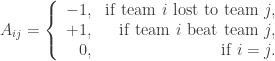

A_{ij}= \left\{ \begin{array}{rr} -1,& {\rm if\ team\ } i {\rm \ lost\ to\ team\ } j,\\ +1,& {\rm if\ team\ } i {\rm\ beat\ team\ } j,\\ 0, & {\rm if}\ i=j. \end{array} \right.

Let S_{ij}=(A_{ij}+1)/2.

As in the previous post, the matrix A associated to the example of the Patriot league is the adjacency matrix of a diagraph.

  1. Initialize all the ratings to be 100: {\bf r}=(r_1,\dots,r_n) = (100,\dots,100).
  2. After Team i plays Team j, update their rating using the formula

    r_i = r_i+K(S_{ij}-mu_{ij}),

    where K=10 and

    \mu_{ij} = (1+e^{-(r_i-r_j)/400})^{-1}.

In the example of the Patriot league, the ratings vector is

{\bf r}=(85.124, 104.79, 104.88, 85.032, 94.876, 124.53).

This gives the ranking

Lafayette < Army < Lehigh < Bucknell < Holy Cross < Navy.

This gives a prediction failure rate of 13.3\%.

Some SageMath code for this:

def elo_rating(A):
    """
    A is a signed adjacency matrix for a directed graph.

    Returns elo ratings of the vertices of Gamma = Graph(A) 
        
    EXAMPLES:
        sage: A = matrix(QQ,[
        [0 , -1 , 1  , -1 , -1 , -1 ],
        [1,   0 ,  -1,  1,  1,   -1  ],
        [-1 , 1 ,  0 ,  1 , 1  , -1  ],
        [1 , -1 , -1,  0 ,  -1 , -1  ],
        [1 , - 1 , - 1 , 1 , 0 , - 1  ],
        [1 ,  1  ,  1  , 1  , 1  , 0 ]
        ])
        sage: elo_rating(A)
        (85.124, 104.79, 104.88, 85.032, 94.876, 124.53)

    """
    n = len(A.rows())
    RR = RealField(prec=20)
    V = RR^n
    K = 10
    r0 = 100 # initial rating
    r = n*[r0]
    for i in range(n):
        for j in range(n):
            if ij and A[i][j]==1:
                S = 1
            elif ij and A[i][j]==-1:
                S = 0
            else:
                S = 1/2
            mu = 1/(1+e^(-(r[i]-r[j])/400))
            r[i] = r[i]+K*(S-mu)
    return V(r)

Sports ranking methods, 1

This is the first of a series of expository posts on matrix-theoretic sports ranking methods. This post, which owes much to discussions with TS Michael, discusses Massey’s method.

Massey’s method, currently in use by the NCAA (for football, where teams typically play each other once), was developed by Kenneth P. Massey
while an undergraduate math major in the late 1990s. We present a possible variation of Massey’s method adapted to baseball, where teams typically play each other multiple times.

There are exactly 15 pairing between these teams. These pairs are sorted lexicographically, as follows:

(1,2),(1,3),(1,4), …, (5,6).

In other words, sorted as

Army vs Bucknell, Army vs Holy Cross, Army vs Lafayette, …, Lehigh vs Navy.

The cumulative results of the 2016 regular season are given in the table below. We count only the games played in the Patriot league, but not including the Patriot league post-season tournament (see eg, the Patriot League site for details). In the table, the total score (since the teams play multiple games against each other) of the team in the vertical column on the left is listed first. In other words, ”a – b” in row $i$ and column $j$ means the total runs scored by team i against team j is a, and the total runs allowed by team i against team j is b. Here, we order the six teams as above (team 1 is Army (USMI at Westpoint), team 2 is Bucknell, and so on). For instance if X played Y and the scores were 10-0, 0-1, 0-1, 0-1, 0-1, 0-1, then the table would read 10-5 in the position of row X and column Y.

X\Y Army Bucknell Holy Cross Lafayette Lehigh Navy
Army x 14-16 14-13 14-24 10-12 8-19
Bucknell 16-14 x 27-30 18-16 23-20 10-22
Holy Cross 13-14 30-27 x 19-15 17-13 9-16
Lafayette 24-14 16-18 15-19 x 12-23 17-39
Lehigh 12-10 20-23 13-17 23-12 x 12-18
Navy 19-8 22-10 16-9 39-17 18-12 x
sm261_baseball-ranking-application_teams-digraph

Win-loss digraph of the Patriot league mens baseball from 2015

In this ordering, we record their (sum total) win-loss record (a 1 for a win, -1 for a loss) in a 15\times 6 matrix:

M = \left(\begin{array}{cccccc} -1 & 1 & 0 & 0 & 0 & 0 \\ 1 & 0 & -1 & 0 & 0 & 0 \\ -1 & 0 & 0 & 1 & 0 & 0 \\ -1 & 0 & 0 & 0 & 1 & 0 \\ -1 & 0 & 0 & 0 & 0 & 1 \\ 0 & -1 & 1 & 0 & 0 & 0 \\ 0 & 1 & 0 & -1 & 0 & 0 \\ 0 & 1 & 0 & 0 & -1 & 0 \\ 0 & -1 & 0 & 0 & 0 & 1 \\ 0 & 0 & 1 & -1 & 0 & 0 \\ 0 & 0 & 1 & 0 & -1 & 0 \\ 0 & 0 & -1 & 0 & 0 & 1 \\ 0 & 0 & 0 & -1 & 1 & 0 \\ 0 & 0 & 0 & -1 & 0 & 1 \\ 0 & 0 & 0 & 0 & -1 & 1 \end{array}\right).

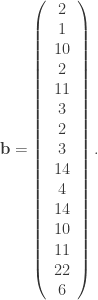
We also record their total losses in a column vector:

{\bf b}= \left(\begin{array}{c} 2 \\ 1 \\ 10 \\ 2 \\ 11 \\ 3 \\ 2 \\ 3 \\ 14 \\ 4 \\ 14 \\ 10 \\ 11 \\ 22 \\ 6 \\ \end{array}\right).

The Massey ranking of these teams is a vector {\bf r} which best fits the equation

M{\bf r}={\bf b}.

While the corresponding linear system is over-determined, we can look for a best (in the least squares sense) approximate solution using the orthogonal projection formula

P_V = B(B^tB)^{-1}B^t,

valid for matrices B with linearly independent columns. Unfortunately, in this case B=M does not have linearly independent columns, so the formula doesn’t apply.

Massey’s clever idea is to solve

M^tM{\bf r}=M^t{\bf b}

by row-reduction and determine the rankings from the parameterized form of the solution. To this end, we compute

M^tM= \left(\begin{array}{rrrrrr} 5 & -1 & -1 & -1 & -1 & -1 \\ -1 & 5 & -1 & -1 & -1 & -1 \\ -1 & -1 & 5 & -1 & -1 & -1 \\ -1 & -1 & -1 & 5 & -1 & -1 \\ -1 & -1 & -1 & -1 & 5 & -1 \\ -1 & -1 & -1 & -1 & -1 & 5 \end{array}\right)

and

M^t{\bf b}= \left(\begin{array}{r} -24 \\ -10 \\ 10 \\ -29 \\ -10 \\ 63 \\ \end{array}\right).

Then we compute the rref of

A= (M^tM,M^t{\bf b}) = \left(\begin{array}{rrrrrr|r} 5 & -1 & -1 & -1 & -1 & -1 & -24 \\ -1 & 5 & -1 & -1 & -1 & -1 & -10 \\ -1 & -1 & 5 & -1 & -1 & -1 & 10 \\ -1 & -1 & -1 & 5 & -1 & -1 & -29 \\ -1 & -1 & -1 & -1 & 5 & -1 & -10 \\ -1 & -1 & -1 & -1 & -1 & 5 & 63 \end{array}\right),

which is

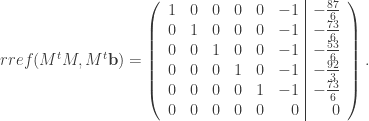
rref(M^tM,M^t{\bf b})= \left(\begin{array}{rrrrrr|r} 1 & 0 & 0 & 0 & 0 & -1 & -\frac{87}{6} \\ 0 & 1 & 0 & 0 & 0 & -1 & -\frac{73}{6} \\ 0 & 0 & 1 & 0 & 0 & -1 & -\frac{53}{6} \\ 0 & 0 & 0 & 1 & 0 & -1 & -\frac{92}{3} \\ 0 & 0 & 0 & 0 & 1 & -1 & -\frac{73}{6} \\ 0 & 0 & 0 & 0 & 0 & 0 & 0 \end{array}\right).

If {\bf r}=(r_1,r_2,r_3,r_4,r_5,r_6) denotes the rankings of Army, Bucknell, Holy Cross, Lafayette, Lehigh, Navy, in that order, then

r_1=r_6-\frac{87}{6},\ \ r_2=r_6-\frac{73}{6},\ \ r_3=r_6-\frac{53}{6},\ \ r_4=r_6-\frac{92}{6},\ \ r_5=r_6-\frac{73}{6}.

Therefore

Lafayette < Army = Bucknell = Lehigh < Holy Cross < Navy.

If we use this ranking to predict win/losses over the season, it would fail to correctly predict Army vs Holy Cross (Army won), Bucknell vs Lehigh, and Lafayette vs Army. This gives a prediction failure rate of 20\%.